
AI Sales Forecast vs. Rep Gut Feeling: Who Wins?
By MetaTechAi ·
Use a validated model as the pipeline baseline, then allow documented manager overrides when a rep supplies relevant evidence the model missed. If the model has not been tested on comparable deals, keep both forecasts visible while you evaluate them. Neither an unexplained gut call nor an untested score should quietly become the reported forecast.
Consider a hypothetical service business: its AI forecast flags a deal as unlikely to close this quarter, while the rep calls it committed. The manager needs to inspect the disagreement before reporting either view. MetaTech installs AI sales and marketing systems for service businesses with sales teams; the process proposed here separates model output, customer evidence and the manager's decision.
The question has public demand evidence. A Salesforce community discussion about trusting CRM forecasts asks whether AI insights and weighted stages improve accuracy or remain dependent on the data reps enter. That is a direct user question, not a search-volume estimate or proof that either forecasting method wins.
What does an AI sales forecast actually measure?
An AI forecast can use historical outcomes, time in stage and logged engagement to estimate future sales. The actual inputs depend on the tool and configuration. Cirrus Insight's forecasting overview contrasts rep-entered expectations with historical patterns and activity signals. Treat that vendor explanation as a description of an approach, not proof of an accuracy improvement for your team.
Before comparing the score with a rep's judgment, confirm what it predicts. A probability of eventually winning a deal is different from a prediction that it will close this quarter. Confirm the reporting period, refresh time and whether the tool predicts individual deals or an aggregate total. A score cannot answer a timing question merely because it looks precise.
Test the model on comparable opportunities using only information available at the forecast cutoff. Keep later outcomes separate from the inputs. A small or inconsistent deal history limits what you can conclude, and a polished dashboard does not resolve that uncertainty.
What does a rep's gut feeling actually capture?
A rep may know something that has not reached the CRM: a budget approval, a change in the buying team or a concern raised during a call. That context matters when it is specific enough to inspect. Some tools analyze conversation records, so the useful distinction is whether this model actually received the information, not whether software can ever read a conversation.
RevPartners' forecasting discussion advocates combining AI projections with engagement signals and human judgment. That supports considering several inputs, but it does not establish a universal weighting formula for service businesses. The framework below is our proposed operating method, not a tested accuracy claim.
Both inputs can fail. A model can miss unlogged evidence or apply patterns from unsuitable deals. A rep can confuse effort invested with the customer's willingness to buy. Averaging the numbers without investigating those differences hides the reason for disagreement. Choose a documented baseline and explain every adjustment.
AI forecast score vs. rep intuition: when does each one earn more weight?
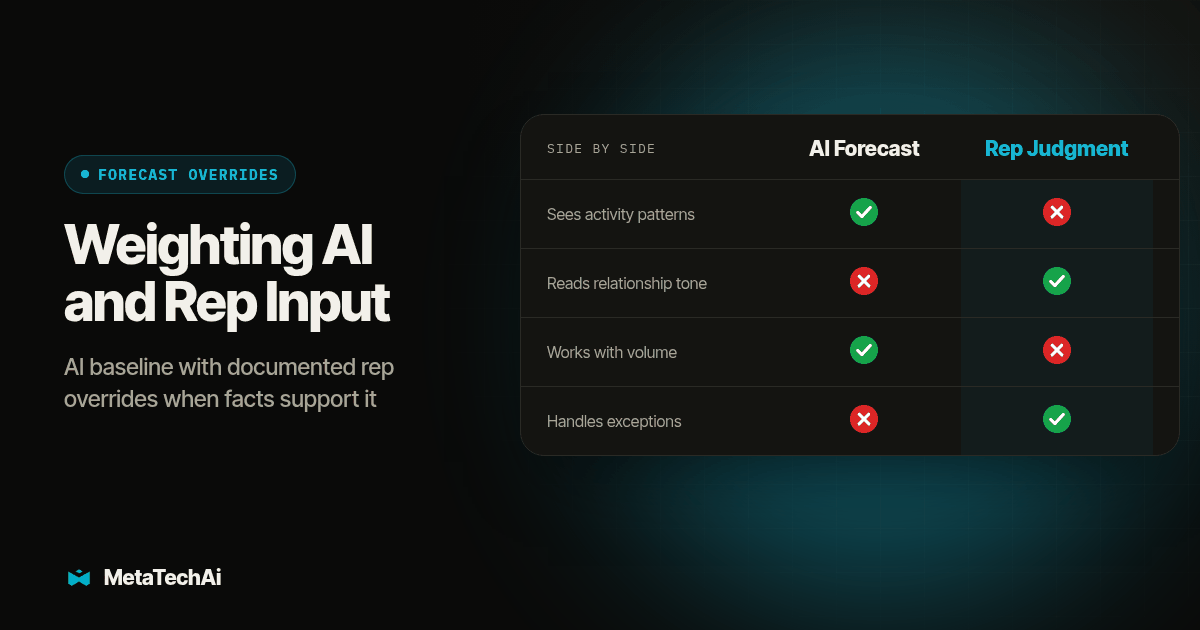
Use the comparison below to decide which input should move your reported number, not which input is smarter in general. Neither one wins across the board.
| Signal | What it reads well | What needs separate review | When it should carry more weight |
|---|---|---|---|
| AI forecast score | Time-in-stage patterns, email and call engagement frequency, how many stakeholders are actually involved | Relevant conversations or buyer context absent from its inputs | Early and mid-stage deals, high deal volume, segments with enough closed-deal history to train on |
| Rep's qualitative read | Tone on calls, stated urgency or budget changes, relationship with the champion, informal competitive intel | Their own attachment to a deal they've worked hard on, inconsistency between how optimistic different reps are by nature | Late-stage single deals the rep worked personally, one-off circumstances the model has never seen in this segment before |
| Manager's weighted call | Catches cases where either signal alone would mislead the number | Only works if the override reason is written down; otherwise it's just a guess with a title attached | Any material disagreement under your written review rules |
The model earns baseline status through evaluation on comparable deals, not simply because the pipeline is large. The rep earns an adjustment by identifying a specific fact and explaining its effect on the forecast period. Neither input should receive automatic authority based on seniority or presentation.
Why do reps and models disagree in the first place?
Use three review categories: data gap, segment mismatch and unsupported judgment. These are proposed triage categories, not a claim that every disagreement has one simple cause. More than one category can apply to the same opportunity.
A data gap could mean the buyer communicates through a channel that is not logged. A segment mismatch could mean the model learned from short service engagements while the current deal requires a long approval process. Unsupported judgment means the rep has expressed confidence without supplying new evidence.
Data gaps and segment mismatch can justify a temporary, documented adjustment while the underlying issue is investigated. Unsupported optimism alone cannot. Preserve the original model output, name the uncertainty and set a review deadline. If the model is unsuitable for the segment, do not enforce it as the default just to keep reporting consistent.
How should a manager run the override process, step by step?
Use this original procedure whenever a disagreement could materially change the reported forecast. Define that trigger before the meeting using your own category definitions and reporting period. Review it weekly and at the reporting cutoff; this is a proposed workflow, not a completed customer test.
- Pull the disagreement list first, before the forecast meeting. Filter for every open deal where the model's category and the rep's self-reported category meet your material-disagreement rule. Do this before the forecast call, not during it, so the conversation starts from a list instead of a debate.
- Sort each disagreement into one of three buckets. Data gap (the CRM is missing a real signal), segment mismatch (the deal doesn't look like the training data), or unsupported judgment (no new fact, just a stronger feeling). Write the bucket next to the deal, not just the disagreement.
- For data-gap and segment-mismatch deals, investigate the input. Log missing evidence and ask the CRM administrator to check coverage. Preserve the raw score. If a correction cannot arrive before reporting, the manager may approve a temporary adjustment with a reason, owner and expiry. Do not silently rewrite the baseline.
-
Require a dated fact before approving an override. Ask for a customer email, meeting note or document reference and explain whether it changes expected timing, likelihood or both. "I just feel good about it" does not qualify. If neither input is supportable, report uncertainty instead of forcing a confident category.
-
Write the override and the reason in the same place every time. A single field or log entry: which number won, who approved the override, and the one-sentence fact behind it. This is the same discipline our guide to reviewing CRM close date changes recommends for date pushes, applied here to the forecast category itself.
- Report the post-override number up the chain, with the override list attached. Ownership should see both the model's raw number and the adjusted one, with the short reason list. Hiding the adjustment is how a forecast stops being trusted the first time it's wrong.
- Score your own overrides at the end of the quarter. Go back and check which overrides turned out right and which didn't. Compare the raw model, rep and manager-adjusted forecasts for the same opportunities and cutoff. Review the size and direction of misses as well as category outcomes. Repeated misses should change evidence requirements, not create a blanket rule that ignores new customer facts.
Retain three separate values in the review record: the original model forecast, the rep submission and the approved manager forecast. Record which version ownership received so a later correction does not overwrite the earlier expectation.
What does a usable override log actually look like?
Keep this as a single row per disagreement, in a shared sheet or a CRM custom object. Fill in the brackets.
Forecast Override Log, [Company Name], week of [date]
- Deal: [Opportunity name / ID]
- Model category: [Commit / Upside / Pipeline]
- Rep category: [Commit / Upside / Pipeline]
- Disagreement bucket: [Data gap / Segment mismatch / Unsupported judgment]
- New fact, if any (must be dated): [Quote, note or document reference]
- Decision: [Model number stands / Override approved]
- Approved by: [Manager name]
- Outcome, reviewed at quarter end: [Closed as model predicted / Closed as rep predicted / Still open]
Why does the money side of this need the same discipline as the forecast?
A forecast that moves by rep feel instead of a written rule is an accountability gap on the pipeline side. Our guide to pipeline stage evidence makes the same argument about moving a deal to the next stage: require the evidence, name the owner, and don't let a single confident claim stand in for a documented fact. A forecast override deserves the identical standard, because the number a manager reports up the chain is only as trustworthy as the weakest link that produced it.
Keep conversion measurement separate from forecast accuracy. MetaTech's positioning is that conversions go up or the business does not pay. That promise concerns actual conversions, not whether a model predicted them correctly. Our guide to proving an AI sales system raised conversions explains agreeing on the comparison method before measurement. An auditable forecast helps preserve expectations, but it cannot establish a conversion lift by itself.
Where does this fit in the bigger question of where to trust AI at all?
This weighing exercise also applies when deciding which business decisions AI may support. Use AI Guy's guide to where you can trust AI in your business as a broader starting point for discussing human review. Here, the manager remains accountable for the reported number and its limitations.
Changing a forecast category may be easy to reverse in a CRM, but decisions based on it can affect hiring and delivery capacity. Keep those downstream approvals separate. A forecast tool should not gain authority to commit resources simply because its score updates automatically.
What should a manager actually do this week?
Start smaller than a full rollout. Pull this week's disagreement list using step one above, even by hand if your CRM doesn't support a saved filter yet. Sort the handful of mismatches into the three buckets. Count the reasons without assuming which will dominate. Fix confirmed input problems, then check whether the next forecast improves against actual outcomes. Keep the original snapshot so cleanup cannot make the earlier forecast appear more accurate after the fact.
If your pipeline is complex enough that this sorting work is eating a manager's whole week, that's a sign the forecasting layer needs to be built into your CRM and sales workflow on purpose, with defined signals, defined override rules and a defined review cadence, rather than patched together from spreadsheets every Friday. That scoping work, deciding which signals your CRM should track and how they should weight into the number you report, is exactly what we map out in an AI infrastructure review before any system goes live.
What do sales managers ask about weighing AI forecasts against rep intuition?
Does an AI forecast score replace the deal stages we already use in our CRM?
No. A forecast score can supplement existing CRM stages using the inputs configured in your tool. Confirm which signals it actually reads. Inconsistent stage definitions can undermine the comparison, so review stage hygiene before relying on the score.
How long before an AI forecast score is reliable enough to act on?
There is no universal waiting period. Evaluate the model on comparable deals using information available at each forecast cutoff, then compare predictions with actual outcomes. Thin history, inconsistent records or an unsuitable model can limit reliability; repeated disagreement alone does not identify the cause.
If we switch CRMs, do we lose the history behind the forecast score?
History can be lost if it is not included in the migration. Confirm export access, available property history and retention limits before switching. Save permitted snapshots and override logs, then verify that opportunity IDs, dates and evidence references survive the move.
Can a rep's gut feeling ever outrank the model when we report the number to ownership?
Yes, but only with a documented reason tied to something the model cannot see: a stated budget change, a new decision-maker, a competitive threat the rep learned about informally. An override without a written reason is just a guess wearing a manager's title.