
Keep an AI Sales System Consistent Across Locations
By MetaTechAi ·
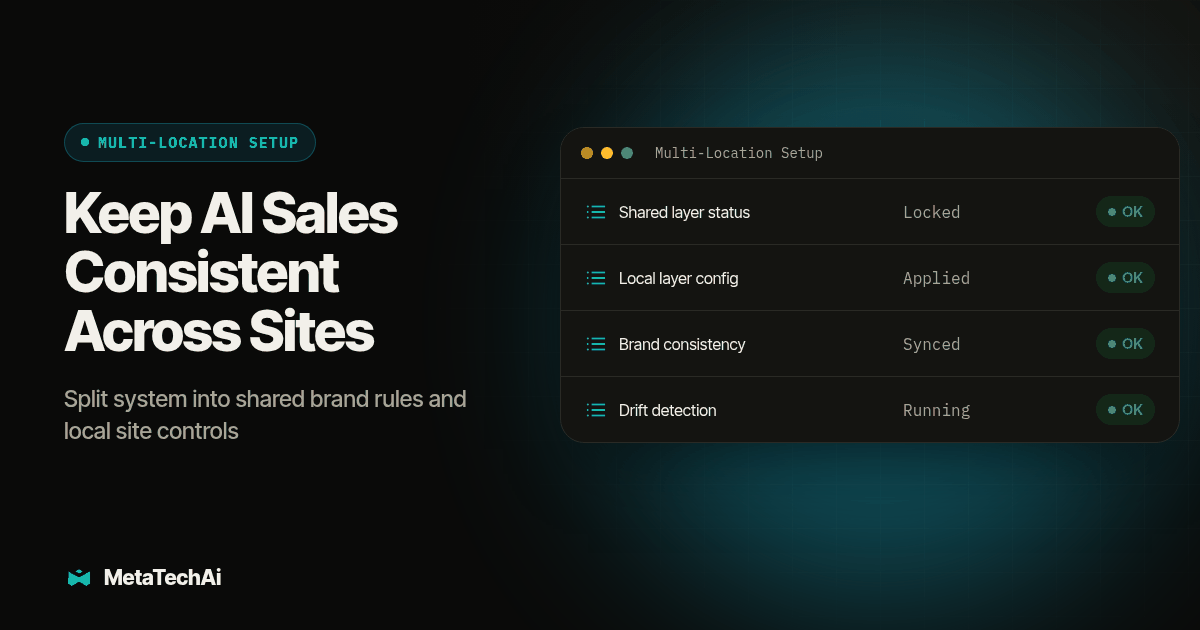
TL;DR: Keep an AI sales system consistent across locations by splitting it into two layers: a locked shared layer (brand voice, pricing logic, compliance language, the offer stack) that no single location can edit, and a local layer (hours, staff names, scheduling windows, local promotions) that each site controls on top of it. Add a flag process that catches any location whose actual customer conversations drift off the shared rules, and review flags on a fixed schedule instead of waiting for a complaint.
A multi-location service business can't run one AI sales system per location and expect them to sound the same, and it can't lock every location into one rigid script and expect local offers to fit. A layered architecture is the fix: brand rules, pricing logic and compliance language live in a shared layer every location inherits and nobody edits alone, while hours, staff and local promotions live in a local layer stacked on top. We build this split into every multi-location engagement, because businesses that skip it learn their locations disagree from an angry customer, not a dashboard.
Why Does an AI Sales System Start Sounding Different at Each Location?
It rarely starts as a deliberate choice. A business opens a second location, copies the first location's AI setup, and within weeks someone "just fixes" a line of script to match a local promotion or a manager's preference. Multiply that across five or ten locations over a year, and you get systems that share a name but no longer share an answer to the same question.
A 2026 guide on AI automation for multi-location businesses describes the same failure on the rollout side: when a promotion goes out location by location instead of through one controlled system, "by the time the last store posts, the promotion is half over, and several versions have drifted off-brand" (Weam.ai, 2026). A 2026 piece on franchise-friendly AI chatbots makes the same point from the customer's side: "a chatbot that quotes the wrong price, shows unavailable items, or operates outside a location's hours is worse than no chatbot at all" (Finitless, 2026).
Almost always, the underlying cause is a missing ownership line: nobody decided, in writing, which parts of the AI sales system belong to the brand and which belong to the location. Without that line, every local edit is a guess, and guesses drift.
What Should Live in the Shared Layer Every Location Inherits?
This shared layer is the part of the system no location touches without a formal change request. Four categories matter most, since they do the most damage when they drift. Brand voice and claims cover the exact language the AI uses to describe the business, its guarantee and what it will and won't promise; a location softening a guarantee to close a deal faster is a liability problem, not a sales win. Pricing logic covers what a quote looks like and which discounts apply when, and it's the most common place drift starts, since it's the easiest thing to tweak under pressure from a hesitant buyer. Compliance and consent language, opt-in wording, cancellation terms, regulated disclosures, has to be identical everywhere the business operates; a regulator won't care that it was "just the Tuesday afternoon shift" that changed it. Last is the offer stack, what's sold, in what order, with what guarantee, which forms the core sales logic, and local promotions sit on top of it rather than replacing it.
Write these four categories down as an actual document, not a shared understanding. A shared layer that exists only in the founder's head is a single point of failure, not a shared layer.
What Should Stay Local, and Who Controls It?
This local layer is deliberately the opposite: anything genuinely different between locations because the locations themselves are different. Hours and availability belong here, one location open until 8pm and another closing at 5, both correct for their market. Staff names and routing belong here too, since which rep a hot lead routes to depends on who actually works there. Local promotions fit as well, a grand-opening discount at the newest location, or a seasonal push tied to that market, layered on top of the shared pricing logic rather than replacing it. So do scheduling windows, local travel time, service radius and crew capacity, which service lead routing already has to account for by territory even inside a single brand.
A simple test applies: would a customer reasonably expect this to differ from one location to another? Hours differ reasonably. A guarantee should not.
Give each location a named owner for its local layer, usually the location manager, with a short list of exactly what they can change without approval. A manager who does not know the boundary will eventually test it, usually by editing the shared layer because filing a request felt slower.
Centralized-Only, Fully Local, or Layered: Which Setup Actually Works?
Most multi-location businesses land on one of three setups, usually by accident rather than by design. Here is how they compare on the things that actually matter day to day:
| Centralized-only | Fully local | Layered (shared + local) | |
|---|---|---|---|
| Brand consistency | High, by force | Low, drifts within months | High, by design |
| Local flexibility | None; every location sounds identical even when conditions differ | Full; every location can do whatever it wants | Full on hours, staff and promotions; locked on pricing, claims and compliance |
| Who can change pricing language | Only whoever controls the one system | Any location, any time | Only through an approval process at the shared layer |
| Risk when a location drifts | Low; there is nothing to drift from | High; drift is the default state, not an exception | Contained; drift is visible through the flag process before it spreads |
| Setup effort | Low at first, high later when local needs get forced into the one-size script | Low per location, but duplicated across every site | Higher up front to split the layers; lower per new location after that |
| Good fit for | A single-location business, or a brand with no meaningful local variation | A loose network of independently run locations with no shared brand promise | A multi-location or franchise-style business that needs one brand promise and real local differences |
A centralized-only setup looks consistent on paper, but it breaks the first time a location has a real local need the script cannot handle, and someone works around it quietly. Fully local setups look flexible, but they have no mechanism to stop five locations from making five different promises about the same guarantee. Layered setups cost more to build upfront, since someone has to decide what belongs where, but they are the only option that stays both consistent and flexible instead of trading one for the other.
How Do You Actually Build the Layered Setup?
Follow this sequence; building the local layer before the shared layer is the single most common reason these projects get redone.
- Document the shared layer first, writing down the exact brand claims, pricing logic, compliance language, and offer stack before any AI configuration begins.
- Test that shared layer against one proving ground location's real conversations so gaps surface before more sites are added.
- Layer that location's own hours, staff list, and promotions on top of the now tested shared layer without altering its pricing logic.
- Name an owner for local edits at each location and write down the change request path for anyone who needs a shared layer exception.
- Extend the setup to each additional location as a configuration task, then put the flag process on a fixed review cadence.
Pick one location as the proving ground and test the shared layer fully against its real conversations before adding a second site, so gaps surface in your own document rather than in production across five locations at once. Put each step in writing: who owns local-layer edits and what they can change without approval, and the change-request path for shared-layer exceptions, a state-specific compliance question, for example, where someone with authority over the brand approves or rejects the request.
Roll out each additional location as a configuration task, not a rebuild; if a new location requires touching the shared layer's core logic again, the shared layer wasn't actually finished at step one. Set a fixed review cadence for the flag process below instead of an open-ended plan to check if something comes up, weekly for the first two months, monthly once the system runs clean, is a reasonable starting point.
How Do You Catch a Location That Drifts Off the Shared Rules?
A layered architecture only works if drift gets caught before a customer does. Build a flag process around three checks. First is transcript sampling against the shared-layer document: pull a rotating sample of AI conversations from each location and check them against the locked brand claims, pricing and compliance language, the same way you would verify a CRM preserves the right fields before trusting its reports. A transcript quoting a different guarantee or discount than the shared document is a flag, not a judgment call. Second is a direct comparison across locations: ask the AI the identical question at two or three locations, the way a comparison shopper would, and compare the answers side by side, since any disagreement on pricing, guarantee or compliance language is the exact failure the layered setup exists to prevent. Third is a named reviewer with a response deadline, because a flag with no owner sits in a queue indefinitely; require a resolution, correct the configuration, update the shared document if the exception is legitimate, or escalate, within a set number of business days.
When a flag turns out to be a real local need, that is useful information: the shared-layer document was incomplete, not that the location did something wrong. Feed that back into the document instead of treating every flag as a correction.
How Does This Connect to Lead Routing and Source Tracking You Already Have?
A layered AI sales system does not replace the territory and attribution work most multi-location businesses have already started; it sits on top of it. If your lead routing already resolves ownership by territory before assigning a rep, the local layer should use that same territory logic rather than inventing a second rule that can disagree with it. Lead source works the same way: if a CRM already preserves the original acquisition source through a merge or a return visit, feed that evidence into the system checking whether a location's conversations matched the shared rules, so you can eventually ask whether the layered setup moved conversions, not just whether it looked consistent.
For businesses already running GoHighLevel across sub-accounts per location, Beam's GoHighLevel iMessage connection is worth a look for the messaging piece: each location keeps its own branded texting number and sub-account, while shared compliance and opt-out language stays locked at the level you control, instead of drifting the way an unmanaged AI script would.
Diagram: a two-layer stack diagram. Its bottom layer, labeled "Shared layer (locked)," lists brand voice, pricing logic, compliance language and the offer stack, with a small padlock icon. Its top layer, labeled "Local layer (location-owned)," lists hours, staff, local promotions and scheduling windows, stacked directly on top with arrows showing it inherits from the shared layer below. A side arrow points from the stack to a small "Flag queue" box labeled with a reviewer icon and a deadline clock.
What Do Multi-Location Owners Ask About Keeping an AI Sales System Consistent?
How much does it cost to run an AI sales system across multiple locations?
Pricing for the system is usually set once around your shared workflows, then scoped per location for the connections each site needs (calendars, CRM pipelines, local numbers). Ask any vendor for a per-location marginal cost, not just the first-location price, since that is where quotes tend to understate the real total.
How long does it take to roll out a layered AI sales system to a five-location business?
Building the shared layer takes longer than any single location does: writing down brand rules, pricing logic and compliance language that currently only live in people's heads is the slow part. Once that layer is built and tested at one location, adding each additional site is mostly a configuration task, which moves faster.
Does a centralized AI sales system integrate with each location's own calendar and CRM?
It should. Its shared layer needs to read and write to whatever scheduling and CRM tools each location actually uses, even across different calendar instances or sub-accounts per site. If a vendor wants you to replace every location's calendar to make their system work, that is a sign the architecture is centralized-only, not layered.
What happens if a franchisee or location manager wants to change the AI's pricing or offer language?
In a layered setup, they cannot change pricing, compliance language or core brand claims on their own; those stay locked at the shared layer, with changes going through an approval process. What they control locally is hours, staff names, local promotions and scheduling. Any request to touch the locked layer becomes a flagged change request, not a silent edit.
Can we start with one location and add more later without rebuilding the system?
Yes. Build and test the shared rules against your first location, then add each new location as a configuration entry rather than a new build. If adding a location requires touching the core logic again, the architecture was not actually layered in the first place.
Where Should You Start?
Start with the shared-layer document, not the software. If you cannot write your exact pricing logic, guarantee wording and compliance language on one page today, no AI system, centralized or layered, will keep your locations consistent, because the inconsistency already exists in how your team talks about the business. We scope this split as the first step of any multi-location AI infrastructure build, before a single workflow gets configured, under the same conversions-up-or-you-don't-pay standard we apply to every engagement.