
AI Agency Not Delivering Results? The Accountability Audit
By MetaTechAi ·
If you are paying an AI or marketing vendor every month and cannot name what each person does or which number it moved, stop guessing and run a four part audit: roles and hours, deliverables per person, a weekly scorecard, and billing tied to outcomes instead of activity. Compare what you find against a conversions up or you do not pay standard before you decide to keep paying, renegotiate, or walk.
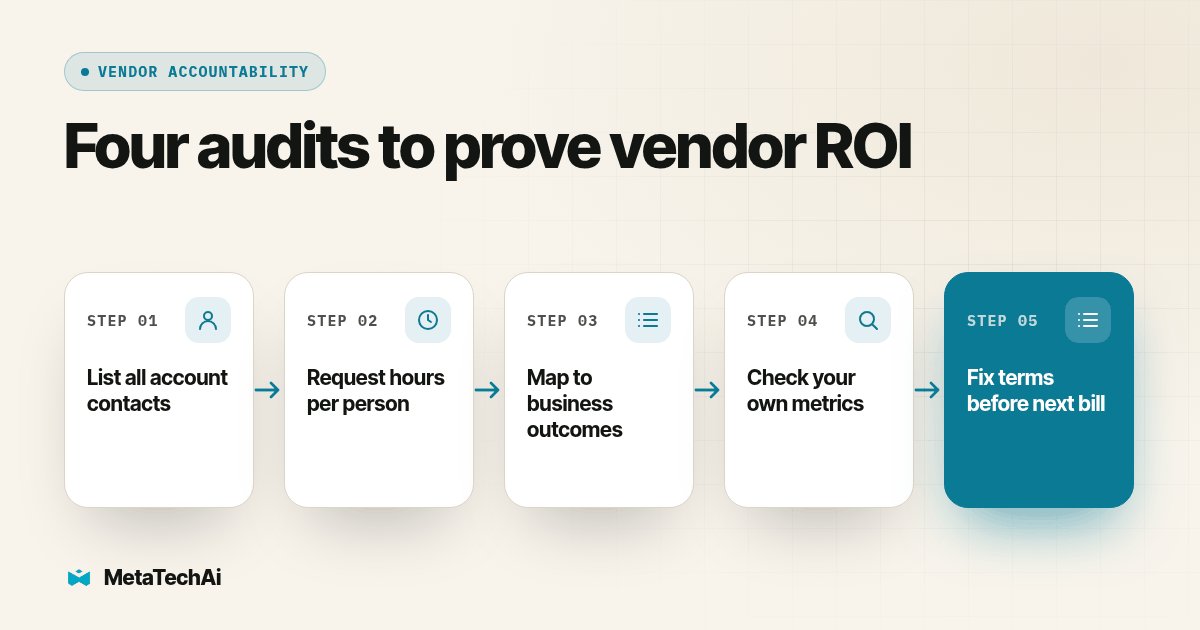
The buyer question behind this audit came from a prospect who described paying an AI and marketing team while members kept dropping, without knowing what each person did. That account identifies a visibility problem to investigate; it does not establish why members left. Ask for records that connect the work to the agreed outcome before deciding what failed.
What Should You Actually Be Able to See From an AI or Marketing Vendor?
You should be able to name, from memory or from a single document, every person touching your account, what each one is responsible for, and what each one produced in the last reporting period. Not a general description like "content" or "AI optimization." A specific list: who wrote which post, who configured which automation, who called which leads, and what happened to each of those efforts after they shipped.
Most buyers who feel like their vendor relationship has gone dark never had that visibility. The invoice arrived, a report full of activity counts arrived with it, and the causal chain between "our team worked on this" and "your number moved" was never drawn. The AI Smart Ventures agency evaluation guide recommends a documented comparison of workflow roles, attribution, case evidence and reporting. Use that as a qualitative checklist, not proof that a particular framework guarantees a return.
Compare customer acquisition effort with the value customers actually generate over a defined period. The Big Red Jelly agency evaluation guide discusses acquisition cost and customer value as performance measures. Set targets from your own margins, sales cycle and records rather than borrowing a universal ratio. If the vendor cannot explain the calculation, record that as a measurement gap before calling it a performance failure.
How Do You Run the Accountability Audit, Step by Step?
Use this proposed procedure before they decide whether to keep paying a vendor, renegotiate the terms, or end the relationship. Start by requesting documents, then schedule the review once both sides can inspect the same records.
- List every person who has touched your account in the last ninety days. Ask the vendor directly for names and roles if you do not already have them. If the answer is vague, "a few people on our team work on it," that vagueness is a data point, not an oversight to forgive.
- Request hours per person per month, next to the deliverable those hours produced. Not a total hours figure. A line per person: this many hours, this specific output. A content writer's hours should map to published pieces you can read. A setter's hours should map to calls made and outcomes logged.
- Map each deliverable to a business outcome, not an activity. "Published four blog posts" is an activity. "Two of those posts generated the qualified leads behind these three closed deals" is an outcome. Ask for evidence of contribution, and separate directly tracked outcomes from shared or delayed effects. Missing attribution is a measurement finding, not proof that an individual contributed nothing.
- Pull your own numbers instead of trusting the vendor's dashboard alone. Check your CRM, your booking calendar, and your billing or membership platform directly for the metric that matters to your business, whether that is booked appointments, qualified leads handed to a rep, or members retained past their first renewal. Compare that independent number against what the vendor reported for the same period.
- Separate the people who are producing verifiable outcomes from the people who are not. This step is uncomfortable because most teams include a mix of both, and it is tempting to average the good and the bad into a single impression of "it's working, mostly." Resist that. Evaluate each role on its own evidence.
- Price what a deliverable-based version of this engagement would cost against what you are paying now for activity. You are not trying to prove the vendor is lying. You are trying to find out whether the rate you pay for hours would still make sense if you paid for outcomes instead.
- Decide on a written remedy before your next payment, not after. Renegotiate the contract to tie future payment to named deliverables and a measurement window, request a defined improvement plan with a deadline, or begin sourcing a replacement. Whichever path you choose, put it in writing so the next review has something concrete to measure against.
What Is Deliverable Based Billing, and Why Does It Change the Conversation?
Activity billing pays for time and output: hours logged, posts published, calls dialed, emails sent. None of those things are worthless, but none of them are the thing you actually want, which is more revenue flowing through your business. In the outcome-based version discussed here, deliverable based billing changes the unit of payment from time spent to an agreed outcome, with the definition of that outcome written into the agreement before anyone starts work.
| Activity billing | Deliverable based billing | |
|---|---|---|
| What you pay for | Hours worked, tasks completed | A named, agreed outcome (booked appointment kept, qualified lead delivered, member retained) |
| Who defines success | The vendor's own activity report | A metric and baseline fixed in writing before work starts |
| What happens if the number does not move | Payment follows the agreed work terms | Payment follows the agreed outcome terms |
| Where the risk sits | Buyer pays for agreed work | Depends on the written acceptance and payment terms |
| What a scorecard looks like | A list of tasks completed | A list of outcomes delivered against named people |
The shift matters because it forces a conversation that activity billing lets everyone avoid. Hourly work can still carry clear acceptance criteria and performance reviews. When a vendor is paid for a defined deliverable, the connection has to exist before the invoice does, because otherwise there is nothing to invoice for.
What Goes on a Weekly Scorecard You Can Actually Use?
A scorecard only works if it is specific enough that a stranger could read it and understand exactly what happened that week, without needing the vendor to explain it verbally. Build it around four columns per person, plus one shared number everyone's work is supposed to move.
| Person / role | Hours this week | Deliverable produced | Outcome it moved |
|---|---|---|---|
| Example: content writer | Logged hours | Long-form articles published, linked | Organic traffic quality, tracked against last month |
| Example: setter / caller | Logged hours | Calls dialed, appointments booked and confirmed | Appointments kept, tracked against last month |
| Example: automation engineer | Logged hours | Follow-up sequence rebuilt and tested | Lead-to-opportunity conversion rate |
| Shared account number | n/a | n/a | The one metric this engagement exists to move |
Copy that structure into a shared document and fill in one row per person, every week, with the vendor responsible for providing the data and you responsible for spot-checking it against your own systems at least monthly. A recurring review gives both sides a place to compare agreed measures and discuss gaps (Big Red Jelly). If a row sits blank for two weeks running because nobody can produce the number, investigate whether the work, reporting or access is missing before judging that person.
What Does a Conversions Up or You Do Not Pay Standard Actually Look Like?
MetaTech installs AI sales and marketing systems for service businesses with sales teams. Our guarantee is that conversions go up or you do not pay. Confirm the conversion being measured and the payment terms in the written agreement; the guarantee alone does not specify an invoice schedule.
That guarantee only means something if the four terms behind it are fixed before installation: the metric being measured, the baseline, the measurement window, and the remedy if the number does not move, plus a data access term that keeps you in control of the system the metric is read from, as we lay out in how performance based AI engagements are written. Skip one of those terms and "conversions go up or you do not pay" becomes a slogan instead of a standard. The same discipline applies to proving the result once the system is live, which is its own measurement problem you solve before installation, not a report you write afterward, covered in how to prove an AI sales system raised conversions.
Run that same four-part test against whatever vendor you are currently paying, whether or not you plan to switch. Ask for the metric, the baseline, the measurement window, and the remedy in writing. A vendor that cannot produce those four things is telling you the relationship was never built to be measured.
What If the Audit Confirms the Agency Isn't Working?
You have three real options once the audit is done, and all three beat doing nothing for another billing cycle. Renegotiate: convert the engagement to deliverable based billing with a defined scorecard and a set review date, and give the vendor one measurement window to prove the new structure works. Redirect: keep the roles that showed verifiable outcomes in step five and cut the ones that could not connect hours to anything measurable, rather than firing the whole relationship over one or two people. Or replace: if the audit showed gaps across every role, start sourcing a new vendor using the audit itself as the requirements document.
Whichever path you take, do not let the decision drag past one more billing cycle. Judge the missed milestones against the agreed sales cycle and dependencies. More time needs a documented reason and a review date, not an indefinite extension. The hiring guide we point prospects to before any AI engagement, how to hire an AI consultant, covers the same accountability questions before the contract is signed instead of nine months into a bad one.
How Can You Test the Scorecard Before Trusting It?
Use a small reconciliation test before the next vendor review. This is a proposed audit procedure, not a reported client result. Select completed records from the same reporting window so a late booking or renewal does not accidentally enter only one side of the comparison.
- Choose a claimed outcome. Take one appointment, qualified handoff or retained member from the vendor report. Record its identifier, the claimed completion date and the rule that makes it count. Avoid copying unnecessary customer details into the audit document.
- Trace it through your systems. Find the corresponding CRM record, calendar attendance or membership status. A booking alone does not prove attendance, and an unanswered retention message does not prove that a member stayed. Record the evidence link and any discrepancy.
- Check an exception. Review a duplicate, cancellation or reassigned lead. Verify that it is excluded or counted consistently with the written definition. Ask who can correct the report and whether the correction reaches future exports.
- Reconcile the denominator. Compare the eligible population in both reports, not just successful outcomes. Check dates, time zones, exclusions and whether the same lead appears more than once. Document unresolved differences before using a percentage to judge performance.
Repeat the test after a reporting fix. If the records now agree but the conversion outcome remains weak, investigate the workflow itself: targeting, response, qualification and rep follow-through. If the records still disagree, the audit has found an evidence problem that prevents a confident outcome claim. Keep those conclusions separate in the written remedy.
What Do Buyers Ask Before Firing an Underperforming AI Vendor?
How long should you give an AI or marketing agency before judging results?
Use the review date agreed for the workflow and sales cycle, rather than a universal ramp period. Implementation milestones can be checked before enough opportunities mature to judge conversions. If there is no baseline, scorecard or explanation of what changed, fix that measurement gap now. Agree on the next evidence checkpoint and who must supply it before extending the engagement.
What is deliverable based billing and how is it different from billing for activity?
Activity billing pays for hours worked, posts scheduled, or calls dialed, regardless of whether any of it moved a number you care about. Deliverable based billing ties payment to a named outcome, such as a booked and kept appointment, a qualified lead handed to a rep, or a membership saved from cancellation, with the rate and the definition of done written into the agreement before work starts.
What belongs on a weekly accountability scorecard for an AI vendor?
One row per person on the account, with their role, hours logged that week, the specific deliverable those hours produced, and the business outcome it is supposed to move, plus one line for the team-wide number everyone is ultimately being paid to change. If a row cannot be filled in because nobody can say what that person did, that is the finding, not a formatting problem.
What does a conversions up or you do not pay guarantee actually guarantee?
MetaTech guarantees that conversions go up or you do not pay. Agree on the conversion definition, baseline, measurement window and remedy in writing before work starts. Check the actual payment terms rather than assuming the guarantee means payment is deferred until verification. A retention target or another business outcome needs explicit agreement; do not assume it is automatically covered.
How do we switch away from an underperforming AI agency without losing momentum?
Run this audit before you cancel anything, because what you learn from it becomes the baseline and requirements document for whoever replaces the current vendor. Export every list, script, prompt, and report the outgoing team produced, confirm who owns the phone numbers and accounts, and start the new engagement with the specific deliverables the audit showed were missing, instead of starting from zero again.
Where Should You Start This Week?
Start with step one of the audit today: get the list of names and roles in writing, even if you have to ask for it directly. Everything after that depends on having it. If the audit confirms your vendor is working, you now have the scorecard to keep it honest. If it confirms the opposite, you have the documentation to renegotiate, redirect, or replace with confidence instead of frustration.
This is the same standard we hold ourselves to with every client. Our managed AI services for service businesses carry a guarantee that conversions go up or you do not pay, with the measurement and payment terms agreed for the engagement. If you want a second set of eyes on an audit you have already started, or you are ready to replace a vendor relationship that never produced a connected number, talk with us about what an accountable version of this work actually looks like for your business.