
A 90-Day AI Implementation Roadmap With Decision Gates
By MetaTechAi ·
A 90-day AI implementation plan works when it starts with one defined workflow, a baseline, and named decision owners. Review operation at day 30, evidence and thresholds at day 60, then decide by day 90 whether to scale, redesign, pause or stop. Adapt the dates to the sales cycle and the evidence available.
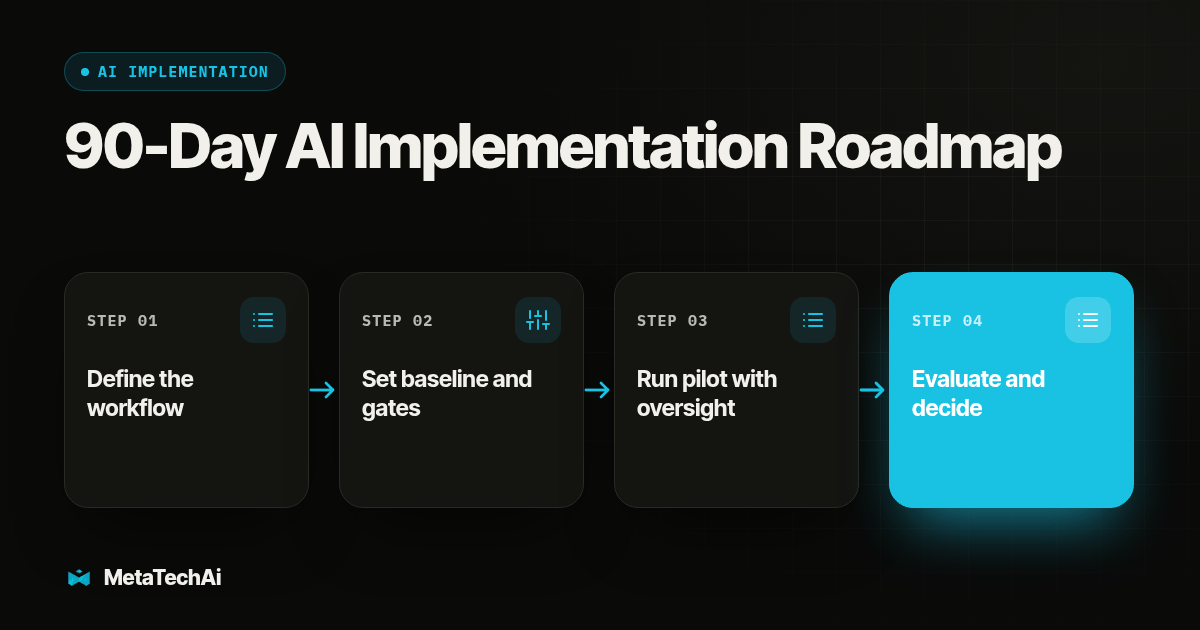
This roadmap is a planning framework for a service business with a sales team. It uses three working phases and two formal decision gates, but the calendar does not prove that a system works. Before launch, agree what the workflow may do, what result you will measure, where the source data lives, who can inspect it, and who can stop the pilot.
What does a 90-day AI implementation roadmap cover?
The roadmap separates preparation from operating evidence and expansion. During days 0 to 30, document the current process, baseline and intended workflow, then test the narrow implementation with controlled inputs. During days 31 to 60, observe real operation within the agreed scope and compare its records with the baseline and acceptance criteria. During days 61 to 90, use the evidence to choose a next step and prepare the right controls for it.
Ninety days is a proposed planning window, not a universal implementation standard. The sales cycle, lead volume, seasonality, staffing changes and quality of historical records all affect how long a comparison takes. If a business has few completed opportunities in the window, it should say that the result is inconclusive rather than present a small set as a reliable conversion finding.
External pilot guidance also recommends separating workflow selection, approval boundaries, evaluation and readiness for production. See Kumo's 30-60-90 day AI agent pilot framework for one example of a staged approach. This article adapts the planning concept to service sales operations; it does not claim that every team should use the same duration or thresholds.
What should a team define before day zero?
Do not start the calendar until the team can describe the workflow and its boundaries in ordinary language. “Improve sales” is too broad to test. “Capture a new inbound inquiry, confirm the service area, and prepare a callback task for a rep” has a start, a defined set of actions, and a human recipient. A narrow scope lets the team inspect what happened when a record is missed or an action looks wrong.
Write the following into a pilot brief and have the business owner approve it:
- Workflow: the triggering event, inputs, allowed actions, exclusions, handoff and completion record.
- Outcome: the conversion event the team cares about and the stage where it is recorded.
- Baseline: the source records, time window, inclusion rules and calculation owner.
- Safety boundary: actions the system may take, actions that need human approval, and conditions that stop further action.
- Evidence access: where the reviewer can inspect source records, not only a summary report.
- Decision rights: who approves changes, who reviews the gates, and who can pause or end the work.
- Team policy: how reps are told about the pilot and how quota or compensation policies will be handled during measurement.
A baseline is a written description, not just a percentage copied into a slide. Define the denominator, the date range, the source system, how duplicates and reopened opportunities are treated, and who verifies the records. Use the same definition during the pilot. If a CRM field changes or a lead source is added, note the change before comparing results.
What should the team do in days 0 to 30?
The first phase establishes a fair test and confirms that the workflow behaves as designed. An original setup procedure for a service sales pilot is:
- Choose one repeatable workflow. Pick a task with a recognizable start and end, such as inbound qualification or appointment confirmation. Record the cases it will not handle.
- Map the current path. Follow a real, appropriately sanitized record from inquiry to the next human action. Note the systems, fields, delays, approvals and exceptions involved.
- Set the measurement definition. State the conversion event, numerator, denominator, observation window and exclusions. If prior data is incomplete, mark the baseline limitation instead of filling gaps with assumptions.
- Record a baseline sample. Pull source records using the agreed rules. Have the CRM owner and business owner review a selection and reconcile mismatches before approving the number.
- Write acceptance and stop criteria. Define what needs to be true for safe operation, what outcome would justify continued testing, and what failure requires pause. Set thresholds using the business's own records and economics.
- Name the people responsible. Assign one business decision owner, one operator for exceptions, a data reviewer, and a technical contact. One person may cover more than one role, but all duties need an owner.
- Test with controlled cases. Use approved test records that cover a normal path, missing information, duplicate data, a handoff and a stop request. Verify the expected action and record after each case.
- Start within the agreed boundary. Limit the pilot to its documented lead source, territory or team. Monitor errors and handoffs before expanding the audience.
The result of this phase may be “ready for a measured pilot,” “fix the data path first,” or “do not start yet.” Delaying a launch for missing ownership or unreliable records protects the later comparison. It is useful progress when the evidence needed for a responsible test does not exist yet.
What should the day 30 decision gate check?
Use the first gate to decide whether the pilot is operating well enough to evaluate. It is generally too early to declare a conversion outcome solely because a calendar interval has elapsed, especially when the sales cycle extends beyond the observation window.
Review a small set of questions against source records. Did eligible leads enter the workflow? Did excluded leads stay out? Were generated tasks assigned to the right person? Can the operator see and resolve exceptions? Did actions stay inside the approval boundary? Can the data reviewer reconcile activity with the CRM history? Record each answer as pass, fail or unknown, and attach an example or system record.
If a required check fails, assign the repair, owner and recheck date. The gate can approve a limited continuation for diagnosis, but that decision should not be represented as a performance pass. If event tracking is broken, repair it and establish what data can still be compared. Do not reset the baseline quietly or remove failed records just to improve a dashboard.
What should the day 60 evaluation measure?
At the second gate, examine outcome evidence and operational quality together. A conversion metric alone cannot tell a manager whether the workflow is safe to expand or whether a rep is receiving useful work. Review at least these dimensions:
- Outcome: compare the agreed conversion measure with the baseline using the same definitions. Explain any difference in lead mix or seasonality.
- Coverage: reconcile eligible inquiries with records processed, missed and excluded.
- Correction: identify the cases a person had to fix, override or repeat, with reasons.
- Handoff: verify that the assigned rep receives context and can take the next action.
- Control: inspect approval and stop events, including whether prohibited actions were prevented.
- Evidence: confirm that a reviewer can explain the history of a selected case from its source records.
- Adoption: ask operators and reps which steps fit the actual process and which create extra work.
Do not set a universal correction-rate or conversion threshold from an article. Agree thresholds before the pilot using your own business context. If the sample is too small or the source data changed, label the result inconclusive and decide whether to collect more evidence, repair measurement or stop. The written gate record should show the data reviewed, limitations, decision, owner and date.
Which option should a team choose at day 90?
The day 90 review has four practical paths. Use the table to connect evidence to a decision, and document the reason even when the decision is to continue testing.
| Decision | When it fits | Next control |
|---|---|---|
| Scale | The agreed outcome and operating checks pass, and the evidence is adequate for the next scope. | Define a new scope, confirm capacity and approvals, and set a fresh baseline for the added workflow or group. |
| Redesign | The use case remains relevant, but a specific part such as routing, data quality or handoff fails. | Change only the documented part, rerun affected acceptance cases and set a new review point. |
| Pause | A temporary business change or missing dependency makes the comparison unreliable. | Record the reason, responsible person, conditions for restart and a review date. |
| Stop | The workflow misses agreed criteria, cannot be operated safely, or lacks a viable way to correct the issue. | Disable the affected process, preserve required records, notify owners and record the reason for closure. |
Scaling should mean a deliberate new decision, not quietly adding more lead sources because the pilot looks promising. Recheck permissions, coverage, staffing, exception handling and data access for the larger scope. A system that works for one team or intake path may not be ready for a different service line.
For a managed engagement, put the conversion definition, baseline, review window and covered work in the agreement before implementation. MetaTechAi installs AI sales and marketing systems for service businesses with sales teams, with a guarantee that conversions go up or the client does not pay. The specific scope and terms belong in the engagement agreement; this roadmap does not alter them. See MetaTechAi managed services for the assigned service page.
How does the roadmap connect to readiness and governance?
Before day zero, use the AI readiness assessment for service sales teams to check process documentation, usable data, ownership, a baseline and tool connections. If an essential input is missing, assign the repair before starting the measurement window. This keeps setup work from being confused with pilot performance.
After the day 90 decision, the AI governance framework for sales teams helps keep permission boundaries, change approvals, logging and accountability in place as the system operates. A scale decision should identify who monitors those rules, who reviews exceptions and when the team revisits the scope.
For pilots involving inbound voice workflows, RizzDial's guide to evaluating and launching an AI receptionist offers relevant questions for defining caller tasks and testing a vendor workflow. Use it as supplementary planning material; the roadmap's measurement and decision rules still need to reflect your own business and systems.
What should the team ask before approving an AI pilot?
How long should a service sales team run an AI pilot before deciding whether it worked?
A 90-day plan can provide a useful decision window when it matches the sales cycle and gives the team enough completed opportunities to review. Use the first phase to establish the baseline and scope, the middle phase to check operation and evidence, and the final phase to scale, redesign, pause or stop. If the sales cycle is longer or the evidence is thin, extend the measurement window explicitly instead of treating a calendar date as proof.
Does MetaTechAi's conversions-up-or-you-don't-pay guarantee cover the pilot phase, or only after scale?
MetaTechAi installs AI sales and marketing systems for service businesses with sales teams, with a guarantee that conversions go up or the client does not pay. The scope, conversion measure, baseline, review window and applicable terms need to be agreed in the engagement before work begins. A roadmap article does not set or change the terms of an individual agreement.
Who needs to attend the day 30 and day 60 decision gates?
Include the business owner who can make the decision, the person who can inspect source records such as call or message outcomes, and the person responsible for CRM fields and routing. Add the operator who handles exceptions if that is someone else. Each attendee should be able to verify the part of the workflow they own.
What should happen to reps' quotas or pay during an AI pilot?
Set the compensation and quota policy with sales leadership before the pilot, explain it to the team, and record any planned changes. Keeping the policy stable during the agreed measurement window can make comparisons easier to interpret. If business conditions require a change, record when it happened and review whether the comparison still answers the original question.
How can a team stop a weak AI pilot from continuing by default?
Write the stop criteria before launch, name the person authorized to pause or end the pilot, and put the decision date on the calendar. At each gate, compare evidence with the criteria and record the decision, owner and next action. If required evidence is missing, pause expansion and assign a specific task to recover or replace it.
A sound roadmap makes the next decision visible before the pilot starts. Set scope, evidence, ownership and stop criteria in writing, then make each gate produce a decision someone is accountable for. That gives a service sales team a usable path from initial test to scale, redesign, pause or closure.