
AI Lead Scoring: What to Verify First
By MetaTechAi ·
Trust an AI lead score only after checking the quality of its historical data, the visible reasons behind its ranking and the rules that reduce stale activity points. Compare its recommendations with real outcomes before changing your sales team's queue. Use a rules-based score when predictive scoring is not supported by your data or cannot pass that test.
Consider a hypothetical service business whose CRM ranks old inquiries above fresh requests. Reps stop using the number because they cannot explain it or see when it last changed. Before replacing the model, check the inputs, the explanation and the update schedule. This example illustrates a failure to test for, not a reported client result.
How Much Historical Converted-Lead Data Does a Scoring Model Actually Need?
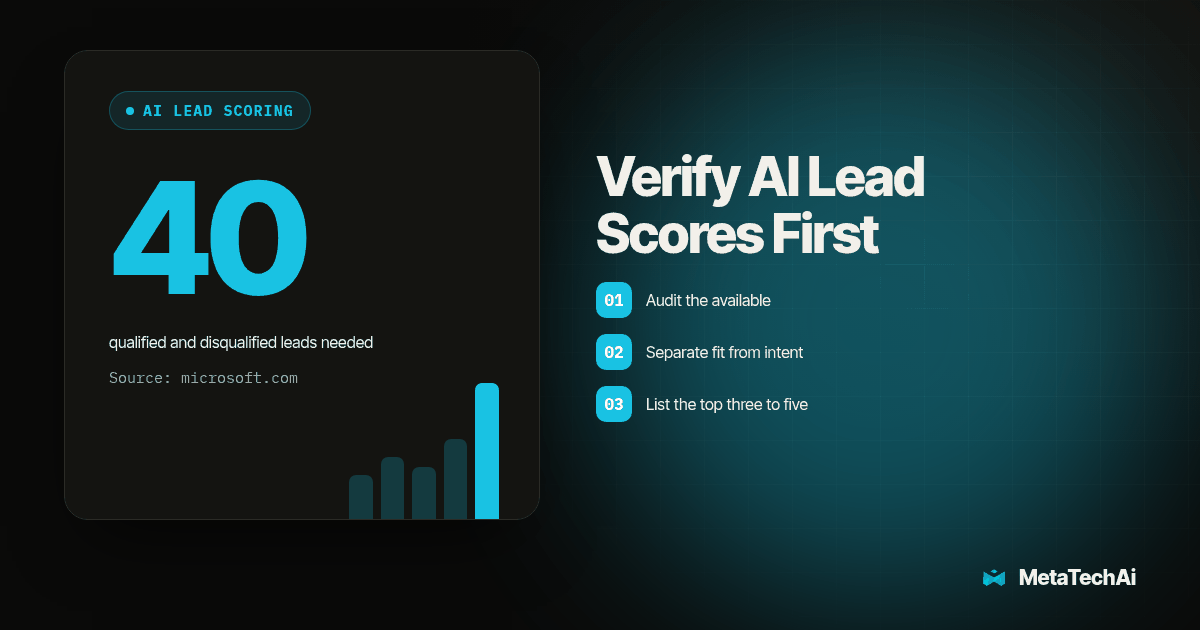
There is no universal closed-deal count that makes every predictive score reliable. Microsoft documents a minimum of 40 qualified and 40 disqualified leads created and closed during the selected training period for its predictive lead scoring. That is a product eligibility requirement, not proof that the resulting ranking will improve your conversions.
Ask the vendor what outcome the model predicts, which records it uses and what happens if your data does not meet its requirements. Lead qualification and a closed sale are different targets. Keep records that did not convert as well as those that did, and check whether missing outcomes or duplicate contacts distort the training set.
Rules-Based or Predictive: Which Model Fits Your Data?
| Decision | Rules-based score | Predictive score |
|---|---|---|
| Data needed to start | Defined fields and events; no trained model required | Historical outcomes meeting the selected product's requirements |
| How the number is explained | Points trace to explicit rules | Inspect the supplied factors and their source records |
| Who sets the weights | Your team sets and reviews the point rules | Model design and training determine the ranking |
| Good fit for | A new process or limited usable outcome history | A process with usable history and a ranking that passes evaluation |
| Maintenance | Review rules, source fields and stale activity | Monitor outcomes, data changes and model updates |
Our recommendation is to start with explicit rules when the history is incomplete, then compare a predictive model when your chosen tool supports it. Neither approach earns trust automatically. This mirrors the evidence-first standard for moving a deal between CRM pipeline stages: a number without backing evidence should not decide the next action.
Why Won't a Rep Act on a Score Without a Reason Attached?
A score without an explanation gives a rep little basis for checking an unexpected ranking. Microsoft shows positive and negative factors alongside predictive lead scores. Use that kind of visibility as an acceptance criterion: the rep should be able to open the underlying record, check the fact and explain what action follows. A plausible explanation still needs verification against the actual input.
Put the explanation where reps work. In a hypothetical record, "requested an assessment yesterday" and "service address is inside our territory" are useful reasons to investigate priority. An unexplained number is not. Separate fit from recent activity so a suitable account with no current request does not look identical to a buyer actively asking for help.
The same question arises when comparing an AI-generated forecast with a rep's judgment about whether a deal closes. Forecasts estimate future outcomes; lead scores help order current work. Test those decisions separately. A useful queue ranking does not establish that a revenue forecast is accurate, and a rep override should record its reason rather than silently changing the evidence.
Why Does a Lead Score Need to Decay?
Old activity should not receive the same treatment as a fresh request indefinitely. HubSpot documents score decay for engagement events, reducing their contribution as they age. Confirm the available controls in your chosen tool. A scoring system may use event expiry, gradual decay or a different recalculation method, and those can produce different queue orders.
Choose decay windows as testable business rules, not universal benchmarks. For example, your team could review an unanswered assessment request after a week while giving a longer research cycle a different window. These are proposed settings to validate against your buying cycle. Do not let a timer erase an agreed callback date or an unresolved customer request. Fit facts need their own refresh process because service area, company size and needs can also change.
How Do You Audit an AI Lead Scoring Model Before Your Team Starts Trusting It?
Run this original checklist before changing how reps prioritize leads. The sample counts and review intervals below are proposed operating tests, not statistical guarantees.
- Audit the available outcomes and fields. Count usable converted and non-converted records, check the chosen product's requirements and inspect missing values. Start rules-based if predictive scoring cannot be supported or evaluated.
- Separate fit from intent in the display, not just the math. Fit is who the account is; intent is what they just did. Reps need to see both, not a single blended total.
- List the top three to five factors behind every score, visibly, in the CRM record. If your CRM cannot show the breakdown next to the number, treat that as a blocking gap, not a detail to fix later.
- Assign a decay window to every behavioral signal you score. Demo requests, pricing page visits, email opens and form fills should each have their own fade-out schedule, not one shared timer.
- Separate activity decay from fit refresh. Do not reduce company-fit points merely because a click aged. Recheck fit when the underlying facts change, and record when those facts were last verified.
- Pull ten closed-won and ten closed-lost leads for a diagnostic review. Reconstruct only information available when the lead was worked. Investigate surprising rankings, but do not expect every winner to outrank every loss. This small inspection finds defects; it does not validate predictive accuracy.
- Name one person who owns the scoring rules. Someone has to review and adjust the point values and decay windows on a set cadence, or the model drifts the same way an unmaintained spreadsheet drifts.
- Set a review trigger, not just a review date. A new lead source, changed offer or rise in missing fields should prompt inspection. Agree who can adjust the model and preserve its previous version for comparison.
- Get rep sign-off on the display, not just the math. Show two or three reps a real scored lead list before full rollout and ask if the ranking matches their own sense of the leads they know. Disagreement at this stage is cheaper to fix than disagreement three weeks into reps ignoring the queue.
- Decide the escalation rule for a tie or a near-tie score. When two leads land within a few points of each other, define whether the rep defaults to most recent activity, highest fit score, or their own judgment, so the queue does not stall on indecision.
How Do You Test a New Lead Score Against Real Outcomes for 30 Days?
Use this proposed 30-day operating test to inspect the rollout. It may be too short to judge completed sales in a longer buying cycle. Preserve your existing response commitments throughout the test so lower-ranked leads are not simply abandoned.
- Run the new score silently alongside the old sort order for the first week. Do not tell reps to change their work order yet; just log what the new score would have ranked first each day.
- Compare the silent ranking against which leads reps actually called and which ones converted. Look for leads the score ranked low that converted anyway, and leads it ranked high that went nowhere.
- Allow a controlled score-ordered queue in week two only if the audit passes. Keep the breakdown visible, preserve urgent requests and agreed callbacks, and log rep overrides. Hold the rollout if the inputs or explanations are still wrong.
- Check the decay curve against three real leads daily for the first two weeks. Confirm a lead that went quiet is actually dropping in rank the way the decay schedule predicted, not staying frozen at its peak score.
- Survey the reps directly at day 14. Ask whether the ranking generally matches their own read of the leads, and whether they can see why any lead that surprised them scored the way it did.
- Hold a scheduled review at day 30 with actual counts. Compare conversions, response coverage and outcomes across rank bands. Record lead source, rep attention and time available to convert. A high-ranked group receiving more calls is not proof the score caused the difference.
The same discipline about visible reasons over blind trust applies anywhere else AI touches your pipeline. We described the spreadsheet version of this habit in how to check whether an AI spreadsheet summary used the right rows and formulas before you trust it: do not act on an AI output until you can see what it based the answer on.
What Happens If You Skip These Checks and Reps Already Stopped Trusting the Score?
If reps have already stopped using the score, collect examples before changing weights. Determine whether the problem is stale activity, incorrect fields, missing explanations or a target that does not match the sales task. A model predicting qualification may be unsuitable for deciding which existing opportunity needs a callback today. Fix the specific gap and repeat the controlled test.
MetaTechAi installs AI sales and marketing systems for service businesses with sales teams, with the guarantee that conversions go up or you do not pay. For an AI infrastructure build, scope the scoring inputs, visible reasons, ownership and testing before asking reps to trust the queue. Agree on the conversion measure, baseline and covered work in writing.
What Should the Review Record Before You Change the Queue?
Keep a simple test log with lead identity, score timestamp, model or rule version, visible reasons, expected action, actual action and eventual outcome. Freeze those values when the ranking is produced. Looking back at today's CRM fields can accidentally use information that was unavailable when the rep made the decision, such as the final won stage or a later appointment.
Separate the records used to set weights from records used to evaluate them. If you repeatedly adjust the score until it explains the same sample, you have learned that sample rather than demonstrated useful future ranking. Ask whoever implements the model to show the evaluation split and explain what changes when the offer, territory or lead source changes.
For a service team, include practical exceptions in the test set: a new inquiry with no activity history, a duplicate contact, an out-of-area request, a buyer waiting for a scheduled callback and an old lead that returns with a new requirement. Write the expected queue action first, then inspect the result. Missing data should be visible, not silently interpreted as low interest.
Use the review to choose expand, hold or revise. Expand only when the controls work and the outcome evidence supports broader use. Hold when there are too few completed outcomes to decide. Revise when explanations, routing or decay fail the agreed tests. Keep a named owner and a way to restore the prior queue order if the rollout makes response coverage worse.
What Else Do Buyers Ask Before Trusting an AI Lead Score?
Does AI lead scoring replace a rep's judgment on which lead to call first?
No, and we would not set it up that way even if a client asked. The score orders the queue and surfaces the reason behind the number, but a rep who knows a specific buyer is traveling, between jobs, or waiting on a spouse's decision should still move that call up or down. The model is a second opinion with receipts, not a replacement for the person who talked to the lead.
What if our business has fewer than 500 closed deals in the CRM?
There is no universal 500-deal cutoff. Check the requirements of the selected tool, the outcome it predicts and the quality of your converted and non-converted records. Start with explicit rules if the history is incomplete, then compare a predictive score with real outcomes before switching the queue.
How long does it take to set up AI lead scoring on an existing CRM?
The timeline depends on field quality, access, scoring rules and testing needs. Agree on a schedule after inspecting the CRM. Treat the 30-day procedure in this article as a proposed operating review, not a guaranteed installation timeline or sufficient proof of sales impact.
Does this integrate with GoHighLevel or does it require a separate platform?
Check the capabilities available in your GoHighLevel account before choosing the design. Require a demonstration of score updates, visible contributing factors, stale-event handling and rep overrides. Use a connected component if the required calculation or explanation cannot be implemented and verified in the CRM.
Does MetaTech's lead scoring work come with the conversions-up-or-you-don't-pay guarantee?
MetaTechAi guarantees to increase your conversions, or you do not pay. Agree on the conversion measure and covered system before installation. Put the baseline, measurement window and remedy in writing rather than assuming every scoring tool or standalone experiment is covered.
Run the ten-item audit before you roll a new lead score out to reps, then run the 30-day test once it is live, and you will know whether the ranking earns trust or just adds a number nobody acts on. If you want help running that audit against your own CRM, or want the whole scoring system built and managed under the conversions-up-or-you-don't-pay guarantee, talk to our team.