
What Is an AI Sales Agent? Tasks It Owns and Handoffs
By James Hill, MetaTechAi ·
An AI sales agent is software that can complete a defined sales task using business context and rules, rather than only answer a question or follow a fixed trigger. It can own qualification, scheduling, and routine follow-up when boundaries are clear, while pricing exceptions and sensitive conversations go to a rep. Before launch, test its decisions against real scenarios from your own sales process.
Every vendor calls its product an AI sales agent, which makes the label less useful than it sounds. For a service business with a sales team, the practical questions are specific: which tasks can the system finish on its own, which ones need a named person, and what evidence shows that it is ready for real leads? We install these systems for service businesses, and task ownership is one of the decisions we work through before a workflow goes live.
What Is an AI Sales Agent, and How Is It Different From a Chatbot or a Dialer?
A chatbot answers questions inside a defined script. A basic dialer places calls or sends messages when someone else sets a trigger. An AI sales agent sits above those tools: it reads context from a CRM record or conversation, chooses a next action within rules the business sets, and carries a task through without a person approving every step.
Salesforce's guide to AI sales agents describes applications that use sales and customer data to perform tasks with little or no human input. The practical dividing line is decision making within guardrails. A tool that only executes a fixed script is automation; an agent interprets a situation and selects an allowed next step. That distinction changes what you test: check the agent's decisions across different situations, not only whether a prepared answer sounds right.
The rest of this guide sets a task boundary, maps it across a service sales process, and gives you a go-live procedure. The goal is to know what the agent may complete, what should trigger a handoff, and how the CRM records both.
Which Sales Tasks Can an AI Sales Agent Own End to End?
Some tasks are narrow enough and repeatable enough for an agent to run from start to finish, if the inputs and exit rules are clear. Four useful candidates are:
- Lead qualification. Ask a defined set of questions, compare the answers with pass and fail rules, and route the result. A rep does not have to sit through every first conversation simply to learn whether the lead meets the business's stated criteria.
- Scheduling. Find an available slot, confirm it against the correct calendar, and send reminders after a lead agrees to talk. The agent follows the calendar and rescheduling rules the team has approved.
- Routine follow-up. Contact a lead who went quiet after a quote, missed call, or unanswered message, using an agreed cadence and stop rule. The agent records replies and stops when the lead responds, opts out, or reaches another defined exit condition.
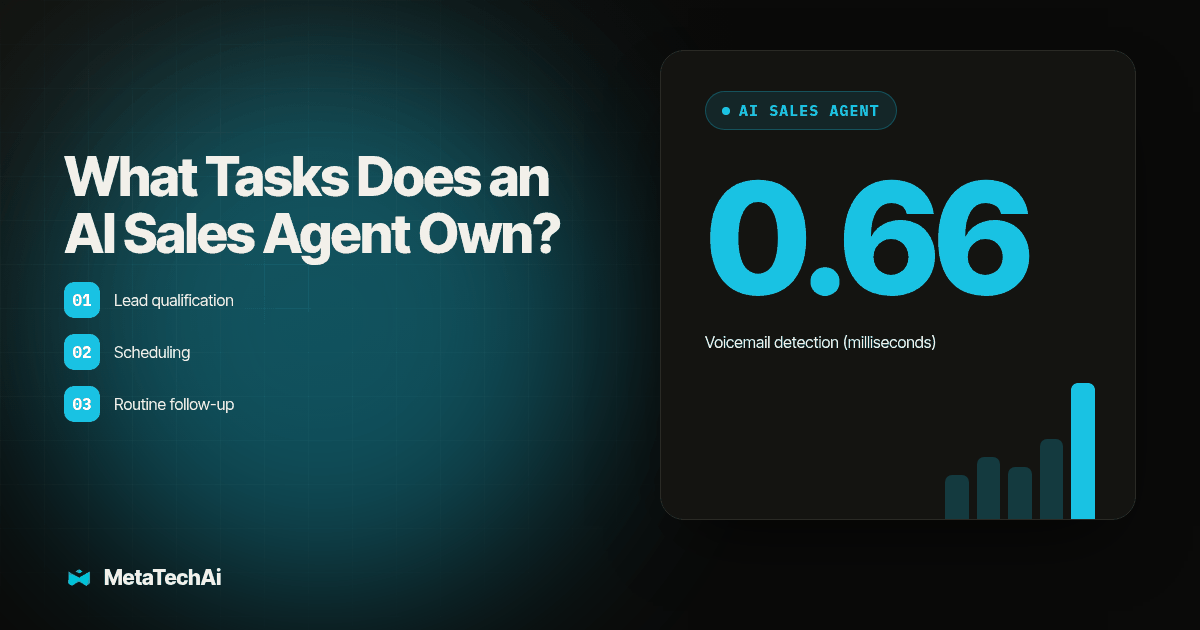
- Call support tasks with a clear signal. Answer an inbound call, detect whether a person or voicemail answered, and record the outcome. For example, RizzDial's proprietary voicemail detection runs in 0.66 milliseconds. Detection is a signal based task; routing a complex complaint or making a commercial judgment should still go to a person.
These tasks still need careful setup. Each has a definable expected result for a given input, which makes it possible to write test cases and review whether the agent followed its boundary. Define the allowed action, the exception conditions, and the record the system must update before granting it ownership.
Which Tasks Should Stay With, or Move To, a Human Rep?
Keep a named person responsible when the right response depends on judgment, creates a commitment, or affects the relationship in a way a rule cannot safely resolve. That typically includes:
- Price negotiation and discounting. A request for a lower price asks the business to make a commercial decision. An agent may collect context or prepare an approved quote, but a person should approve exceptions.
- Contract terms and binding commitments. A scope change, signature, or renewal term needs an accountable person. An agent can prepare paperwork for review, but it should not make an unapproved commitment.
- Upset, confused, or escalating customers. The agent can capture what happened and pass it to the right rep. It should not improvise a resolution when the person needs empathy, investigation, or authority.
- Scenarios missing from the test set. An untested situation has not earned unsupervised handling. The right route is a pause and handoff until the team adds the case to the test plan and verifies a response.
This boundary protects the work that calls for human judgment while moving predictable administration out of a rep's way. It also makes accountability concrete: every exception has an owner, and the team can see whether the system handled the task or handed it off.
What Does Task Ownership Look Like Stage by Stage?
Task ownership should follow risk and judgment, not how sophisticated a tool sounds. Use this table as a starting point for a service business sales process, then change it to match your own policies and customers.
| Sales stage | AI agent owns | Rep owns | Handoff trigger |
|---|---|---|---|
| First contact and qualification | Ask approved questions, score against written criteria, route pass or fail | Review a borderline result | An answer does not match a defined scoring pattern |
| Scheduling | Find a slot, confirm it, and send reminders | Handle a repeated reschedule that needs judgment | The lead asks to reschedule outside the allowed rules |
| Pre-meeting nurture | Run the approved follow-up cadence and log replies | Decide whether to extend outreach for a specific opportunity | A reply asks a question outside approved content |
| Discovery | Prepare a summary and capture requested next steps | Lead the discovery conversation | The conversation needs a decision or interpretation |
| Pricing and proposal | Prepare a draft using approved scope and rules | Approve and present the final offer | The lead requests an exception or discount |
| Objections | Record the issue and route it to the right person | Respond to the objection | The lead disputes, escalates, or asks for an exception |
| Closing and contract | Prepare approved paperwork and update status | Answer final questions and obtain the signature | A term or commitment needs approval |
| Post-sale handoff | Update the CRM and notify the account team when the deal closes | Run the first customer check-in | A required field or owner is missing |
The table is a working agreement, not a universal rule. A business with a tightly standardized offer may permit an agent to prepare more of a proposal. A high-stakes or long-cycle service may keep discovery and pricing with a rep from the start. Write the local version down before testing so reviewers know what a pass looks like.
What Should You Test Before an AI Sales Agent Talks to a Real Lead?
A polished demo shows that the agent handled a rehearsed situation. It does not prove the agent will respect the boundary when an actual lead gives an incomplete answer, changes direction, or asks for an exception. Use this procedure with your own workflows and CRM before enabling live contact.
- Write the ownership boundary. For every row in your table, state what the agent may decide, what it must flag, and what it must never attempt. If the rule is vague, rewrite it before testing.
- Build scenarios from real work. Cover each task the agent will own and include incomplete, contradictory, and unusual cases from your lead history. Remove personal details where appropriate, but preserve the decision the agent needs to make.
- Score each run against observable results. Check whether the agent understood the input, stayed within its rule, updated the CRM field a rep relies on, and sent a handoff to a person who is responsible for acting on it.
- Test failure paths deliberately. Include a discount request outside the approved range, an upset lead, and a request for a commitment the agent cannot make. Confirm that it stops, records enough context, and routes the case correctly.
- Run shadow mode. Let the agent propose actions for incoming leads without taking those actions. Compare its decisions with what the rep actually did, and record each mismatch for review.
- Set the go or no-go rule in advance. Decide what failures block launch and who can approve a change. Choose the threshold before reviewing scores so the team does not redefine success to excuse a bad result.
- Repeat the test after changes. A prompt edit, new CRM field, or additional task can change behavior. Re-run the relevant scenarios and document the result before expanding the agent's authority.
Use this compact checklist to capture the decision:
- Written boundary for every task row
- Scenarios covering normal work and exceptions
- Failure paths tested, including an upset lead and out-of-range request
- Shadow-mode results compared with rep decisions
- Go or no-go threshold agreed before scoring
- Retest owner assigned for future workflow changes
Save the scenario, expected result, actual result, CRM evidence, and reviewer for each run. That record lets a manager distinguish an agent mistake from a missing business rule. It also gives the implementation team a concrete issue to fix instead of a general report that the system “felt off.”
What Can a Go-Live Test Catch That a Demo Misses?
Consider a hypothetical home services company that wants an agent to qualify leads. During a demo, each test lead answers the same three questions and the agent books the ones that qualify. A shadow test against past inquiries reveals a case the demo skipped: some callers already have an estimate from another company. They give the same answers as a new prospect because the script never asks whether they are comparing an existing quote.
If the team has not written that question into its process, the agent may book a meeting that does not fit the rep's intended workflow. The business can add a question, define how the answer changes routing, and re-run the case before the agent contacts a live lead. The example is hypothetical, but the test principle is practical: use messy, representative cases, not only the clean path that makes a product demonstration look simple.
How Is Task Ownership Different From Deciding Whether an Agent May Contact Customers?
Before assigning tasks, decide whether the agent may contact a customer directly, on which channel, and under what consent and disclosure rules. That is a separate operating decision. This article starts after the contact boundary is set and focuses on what the system may do within it.
Once a channel is approved, use the task table and test procedure to decide which actions the agent can complete on its own. If the business has not approved direct contact, the same ownership model can apply to internal preparation, such as drafting a response or proposing a route for a rep to review.
How Does MetaTechAi Scope an AI Sales Agent?
MetaTechAi installs AI sales and marketing systems for service businesses with sales teams. The task-ownership table is part of the scoping conversation: map the current process, assign an owner to each stage, identify exceptions, and decide how a test will show that the system followed its rules.
Our managed AI services team can map a sales process, configure lead response and CRM workflows, and prepare the go-live test around the business's own scenarios. The work carries our guarantee: conversions go up, or you do not pay. Start with one well-defined task and a clear human handoff before expanding the agent's role.
CRM quality is part of that decision. The agent needs reliable records and clear field ownership so it can read and update the right information safely. A useful companion is our guide to what a CRM needs before an AI sales system helps, which covers the data and ownership checks to settle before work is handed over.
What Do Service Businesses Ask About AI Sales Agents?
What does an AI sales agent cost for a service business?
We do not publish a flat price because the scope depends on the tasks, CRM work, and call routing involved. MetaTechAi's managed AI sales and marketing systems carry a guarantee: conversions go up, or you do not pay. Ask for a scoped quote after you decide which task to hand over first.
How long does it take to test an AI sales agent before launch?
There is no fixed number of days. The agent is ready only when it passes the go-live test procedure below on scenarios from your own business. A narrow scheduling task has fewer cases to validate than a system that also qualifies leads, handles pricing questions, and follows up.
Does an AI sales agent replace the CRM we already use?
No. It should work with the CRM you already run; replacing it is a separate decision. The CRM needs clean records and clear field ownership so the agent knows what it may read and update.
Can an AI sales agent contact a real lead directly?
That depends on the channel, contact type, consent, and disclosure rules. Decide whether the agent may contact customers before deciding which tasks it owns. This article covers task ownership after that contact boundary is set.
What is the main switching cost when reps currently do these tasks by hand?
The main switching cost is rep habit and training. Reps need to know which tasks the agent owns, which tasks they still own, and where each handoff happens, or they may keep repeating the agent's work by hand.
Where Should You Start This Week?
Build an ownership table before you talk to a vendor. List each task, who owns it today, who should own it after automation, and the exact event that sends work to a rep. Then test that first task against your own lead history, including situations where the answer is incomplete or the customer changes direction.
If you want help building the table and test plan, contact our managed services team with your current sales process and the first task you are considering. A concrete workflow gives the conversation a useful starting point.