
Data and Security Layers a Sales AI Architecture Needs
By MetaTechAi ·
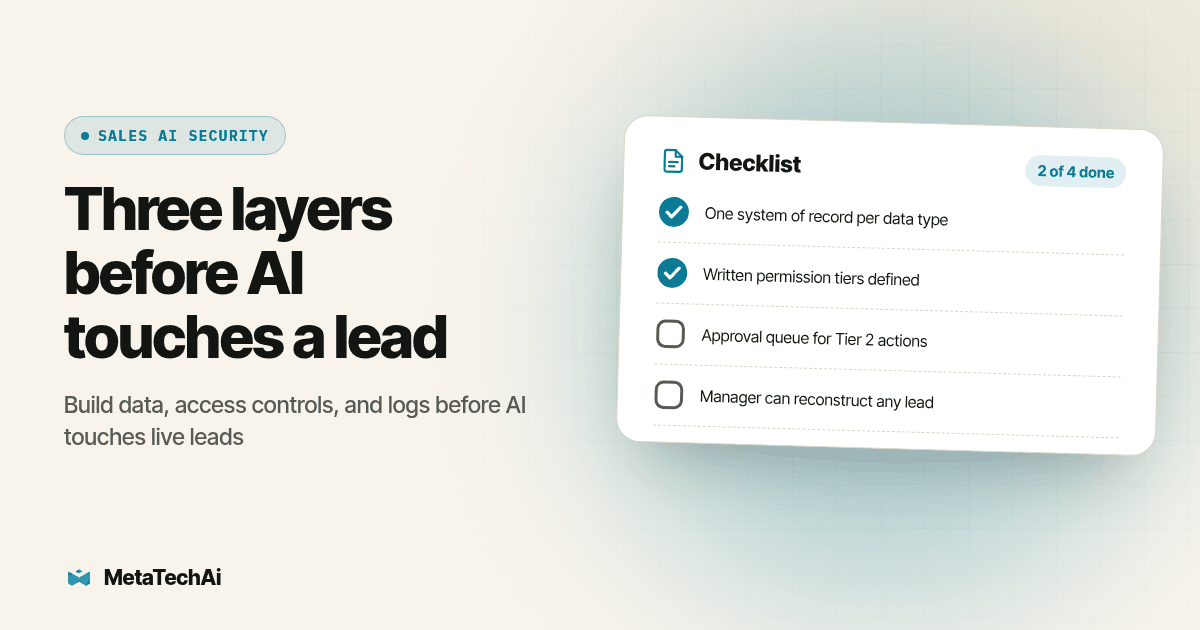
Before an AI sales system touches a live lead, it needs three things in place: a data layer where every AI-touched interaction traces back to one record, access controls that force a human sign-off before the AI acts on payment or contract terms, and logging detailed enough that a manager can reconstruct exactly what happened on any lead. These layers make the system's permissions and actions inspectable before customer-facing automation begins.
A service business asking what its AI architecture needs before going live is really asking three questions: where does the data live, who approves what, and what gets recorded. MetaTechAi installs AI sales and marketing systems for service businesses with sales teams. Use the three layers below to turn that architecture question into concrete records, permissions and acceptance checks before launch.
What three layers does a sales AI architecture need before it touches a live lead?
Plan the installation around these three layers, in this order, regardless of which tools sit on top:
- A data layer where one record is the source of truth for a lead, and every AI-touched interaction writes back to it instead of living in a side system the AI invents on the fly.
- An access-control layer that defines, in writing, which actions the AI can take alone and which require a human to approve first, specifically around payment and contract terms.
- A logging layer that captures what the AI did, when, based on what data, and who approved it, so a manager can pull one lead and see the full sequence without guessing.
These are not three products to buy. Start by checking whether the CRM, workflow builder and calendar already in place can support these configuration decisions. NIST's AI Risk Management Framework frames oversight the same way, as something built into the system through four ongoing functions (Govern, Map, Measure, Manage), not bolted on after the AI is live (NIST AI RMF 1.0). We map our three layers against those functions below.
What is an auditable data layer, and why does every AI-touched interaction need to trace back to a record?
An auditable data layer gives each lead a stable identity and links every permitted read, update and interaction back to it. Separate systems can remain authoritative for different data types, such as payment status and contact details, while the lead's record links to their timestamped events.
Consider a hypothetical account where the CRM looks clean but the AI produces confusing results because it pulls quote terms from a shared spreadsheet that several people can edit and nobody owns. The CRM says one thing, the spreadsheet says another, and the AI follows whichever one it touches last. Without a source version in the log, a rep cannot explain why the quote changed. That's not a data problem you fix by cleaning the CRM; it's an architecture problem, two sources of truth instead of one.
The fix is not glamorous. Decide, for every data type that matters (contact details, quote amount, contract status, payment status), which single system is the system of record, then connect every tool the AI touches to it through an API or integration instead of a manual export. Every AI action then has somewhere to write back to, as a timestamped event instead of an edit nobody can trace.
How do access controls stop an AI agent from acting on payment or contract terms without a human?
Access control here is not a login screen. It's a written permission tier that says, for every category of action, whether the AI can act alone or has to stop and wait for a person to approve it first.
Use this proposed three-tier structure as a starting point, then approve it for your own process:
- Tier 1, AI acts alone: sending a follow-up message, updating a lead's stage based on a defined trigger, scheduling a call on an open calendar slot.
- Tier 2, AI drafts, human approves: anything that changes a quoted price, anything that modifies contract terms, anything that processes or refunds a payment.
- Tier 3, AI never touches: signing a contract, issuing a refund over a threshold the business sets, anything involving a customer dispute.
The line between Tier 1 and Tier 2 deserves an explicit acceptance test. An AI that drafts a revised quote is useful. An AI that sends that quote to the customer as a binding offer, without anyone reviewing it, is a liability the business usually doesn't notice until a customer takes them up on a number that was never supposed to go out. Building the approval queue, even a basic one where the AI drafts, a named person gets notified, and nothing ships until they click approve, makes this boundary enforceable.
Enforce these tiers in tool permissions as well as written instructions. Give the agent only the fields and operations needed for its task. A rejected or expired approval must leave the proposed action blocked; test that boundary even when an incoming message asks the agent to ignore its rules.
What should the logging layer let a manager reconstruct about a given lead?
A logging layer works when a manager can open one lead and answer, without calling anyone, what the AI did, when, what it used to decide, and who approved any action that needed sign-off.
Start each log entry with four core fields: the action taken, the timestamp, the data source, and the approver if one was required. "Message sent" is not enough. "Message sent 2:14 PM, drafted from the quote record dated 2:10 PM, approved by [rep] at 2:13 PM" is what lets someone reconstruct a dispute or a question about why a customer got a specific answer.
This is also what makes the access-control tiers above mean anything. A permission tier nobody checks against a log is a policy document, not an architecture.
How does NIST's AI risk framework map onto these three layers?
NIST's AI Risk Management Framework organizes oversight into four ongoing functions. The mapping below is our proposed application to sales architecture, not a NIST implementation specification:
| NIST AI RMF function | What it does | Where it shows up in this architecture |
|---|---|---|
| Govern | Sets accountability, policy and culture around AI risk across the whole organization | The written permission tiers (who can approve what) and the decision to treat this as an ongoing program, not a one-time setup |
| Map | Identifies and categorizes the risks specific to a given AI system | Deciding which actions belong in Tier 1, Tier 2 or Tier 3 for your specific sales process |
| Measure | Tracks risk with quantitative and qualitative methods on an ongoing basis | Tests and reviews that use timestamps, data sources and approvals as evidence of whether controls work |
| Manage | Allocates resources to treat identified risks and respond to incidents | The approval queue acting on a flagged Tier 2 action, and the process for updating tiers after a near-miss |
Source: NIST AI Risk Management Framework 1.0. Govern, Map, Measure and Manage are the four questions a service business has to answer before an AI touches a live lead: who's accountable, what's risky here, how do we know it's working, and what happens when it isn't.
What happens when a sales AI architecture skips these layers?
Gartner's June 2025 forecast about agentic AI project cancellations is a forward-looking industry warning, not a measured failure rate for service businesses. Use your own acceptance checks to decide whether a particular system is ready. A convincing demonstration does not show how the workflow behaves with conflicting records or a missing approver.
Consider how these gaps could compound in a hypothetical rollout. A business skips the data layer first, because it feels like plumbing instead of a feature. The access-control layer gets skipped next, since without one source of truth there's no clean way to define what the AI should and shouldn't touch. By the time something goes wrong with a quote or contract term, no log is detailed enough to show what happened, making it harder to isolate the failed control and restore confidence in the workflow.
How is this different from an AI governance framework or a CRM readiness check?
We've written about both adjacent pieces, and it's worth being precise about where each one stops. Our AI governance framework guide is the written policy: what the AI may do, who approves a policy change, who is accountable. It answers "what are the rules." This article is the layer underneath: the data model, the permission tiers enforced in your tools, and the logs that prove the rules were followed. A governance document nobody can technically enforce is just a PDF.
A CRM readiness check is narrower still. It asks whether the data already inside your CRM is clean enough to trust: one identity per contact, an owner on every record, reliable timestamps. That's a precondition for the data layer here, but it covers only one system. This architecture covers every system the AI touches and adds the access-control and logging pieces a CRM audit skips entirely.
How do we build these three layers in order, before a live lead reaches the AI?
Use this numbered build and test procedure before enabling customer-facing actions:
- Inventory every system the AI will read from or write to. List the CRM, the calendar, the quoting tool, the payment processor, and anything else, even a spreadsheet, that currently holds lead or customer data.
- Pick one system of record per data type. Contact details, quote amount, contract status and payment status each need exactly one home system, and every other tool treats that system as authoritative and tracks the version of any permitted copy.
- Connect every tool to the system of record through an API or native integration, not a manual export. If a tool can't connect this way, either replace it or exclude it from anything AI-touched until it can.
- Draft the three permission tiers (AI acts alone, AI drafts and a human approves, AI never touches) specific to your sales process, and get sign-off from whoever owns sales operations.
- Build the approval queue for Tier 2 actions: a notification to a named person, with the AI's draft attached, and nothing ships until they approve it.
- Build the logging schema so every AI action records the action, the timestamp, the data source and the approver, written to the system of record from step 2.
- Run the AI in shadow mode on approved test records first, drafting without sending or changing customer records. Then, if authorized, review representative live cases with a human approving every action. Choose the review period around case coverage, not a fixed number of days.
- Review the shadow-mode logs with whoever owns sales operations, adjust the tiers based on what you saw, and only then let Tier 1 actions go live unsupervised.
For step 7, test a conflicting quote source, a missing approver, a rejected change and a repeated event. Pass only when the system pauses uncertain actions, blocks rejected changes and avoids duplicate execution. Keep the actual result and reviewer with each test before authorizing the next tier.
What should we check before letting the AI touch a live lead?
Copy this pre-launch checklist
Run this before any AI sales system touches a live lead:
- Every data type (contact, quote, contract, payment) has exactly one system of record, written down.
- Every AI-connected tool uses only its permitted reads and writes against the appropriate system of record through an API or native integration, not a manual export.
- A written three-tier permission list exists, naming specific actions in each tier, signed off by sales operations.
- An approval queue exists for every Tier 2 action, with a named person responsible for approving it.
- Every AI action logs the action taken, the timestamp, the data source and the approver (if one was required).
- The AI has passed shadow-mode checks on representative approved cases before any action goes live unsupervised.
- A manager can pull any single lead's record and reconstruct the full sequence of AI actions without asking anyone what happened.
MetaTechAi's offer for service businesses with sales teams is that conversions go up or they don't pay. Agree on the conversion measure and evidence during scoping: an auditable architecture helps connect actions to outcomes, but logs alone do not prove that AI caused an improvement. Our AI infrastructure page walks through how we map and install this layer around a specific business, and managed services describes ongoing operation and support. Agree on who owns approvals and log review in the engagement scope.
If the workflow includes recorded calls, add a separate consent review before recording is enabled. Assign that review to the person responsible for the business's calling policies. RizzDial's guide to AI call recording consent by state covers it in detail.
What do service businesses ask about this architecture?
How long does it take to stand up these three layers?
Setup time depends on the number of systems, the quality of their integrations and the controls they already support. Inventory the connections first, then estimate the work to configure permissions, approvals and logs. Schedule launch after representative cases pass, including rejected actions and missing data, rather than promising a fixed setup window before those dependencies are known.
Do we need new software, or can we configure what we already have?
Start by checking your existing tools. A CRM with role-based permissions, a workflow tool with an enforceable approval step and an event log may cover the required controls. Verify that the log records failed actions and cannot be casually overwritten by the agent. Add software only where the current tools cannot enforce or demonstrate the agreed behavior.
Does this replace the CRM readiness check or the AI governance framework you've written about before?
No. A CRM readiness check looks at whether the data already sitting in your CRM is clean enough to trust. A governance framework is the written policy: what the AI may do, who approves changes, who is accountable. This architecture is the technical plumbing underneath both: the actual data layer, access controls and logs that make the policy enforceable instead of just written down.
What exactly should the logging layer capture for each lead?
At minimum: the lead identifier, every system the AI read from or wrote to, the exact action taken (a message sent, a field updated, a stage change), the timestamp, which human approved any action that needed sign-off, and a reference to the approved data version the decision was based on. Avoid copying credentials or unnecessary customer details into logs. A manager should be able to pull one lead's record and see the full sequence without asking anyone what happened.
Can a small business skip access controls and just watch the AI closely instead?
Watching closely is not a substitute for a written permission tier, because manual review can miss actions when a reviewer is unavailable or distracted. Even a two-rep shop benefits from defining in writing which actions the AI can take alone and which ones need a person to click approve, since that definition is what makes the system auditable later.