
What Happens When Your AI Receptionist Goes Down?
By MetaTechAi ·
When your AI receptionist goes down, calls and messages follow the fallback your team configured and tested in advance. Existing appointments may remain in an independent calendar, but new bookings, reminders and transfers can stop. Require a human route or callback queue, an incident owner and a recovery check before launch.
An outage during business hours is a practical concern for a service business using AI phone and chat agents. A carrier, voice service or language model can become unavailable during an inbound conversation. The effect depends on which part failed and which services the fallback still needs. What matters is whether a documented fallback catches the call before the caller hangs up, and whether anyone finds out it happened the same day instead of the same month.
What Actually Happens When Your AI Phone or Chat Agent Goes Down?
A fallback only runs automatically if the platform or implementation has configured it. That is the part owners get wrong when they assume "the system will figure it out." An AI voice or chat agent may depend on several connected services: the phone carrier's trunk, the speech-to-text layer, the voice synthesis layer, and the language model doing the actual reasoning. Any one of those four can fail on its own, and each failure looks different to the caller.
A carrier failure can prevent a call from reaching the application at all. A speech or model failure may leave a connected call silent, while a calendar failure may let the conversation continue without completing a booking. Treat these as distinct test cases. For example, Twilio's webhook documentation describes configurable timeouts and retries that affect fallback timing. Those controls address requests to an application; they do not prove protection against every carrier or AI failure. Choose and measure your own acceptable wait instead of assuming a universal cutoff. We walk clients through this same layered breakdown when we map AI infrastructure before launch, because the fallback plan has to match the failure, not just the word "outage."
What does not happen, unless you built it, is any kind of graceful handoff. The agent does not know to text the lead "give us a minute." It does not ring a manager's cell phone on its own. It does not leave a note in the CRM that says "missed, see below." Every one of those behaviors has to be a decision someone wrote down before the outage, not a judgment call made during one. This is the same discipline we cover in a written AI governance framework: decide the behavior in advance, in writing, before you need it under pressure.
What Should Be In Your Written Failover Plan Before You Launch?
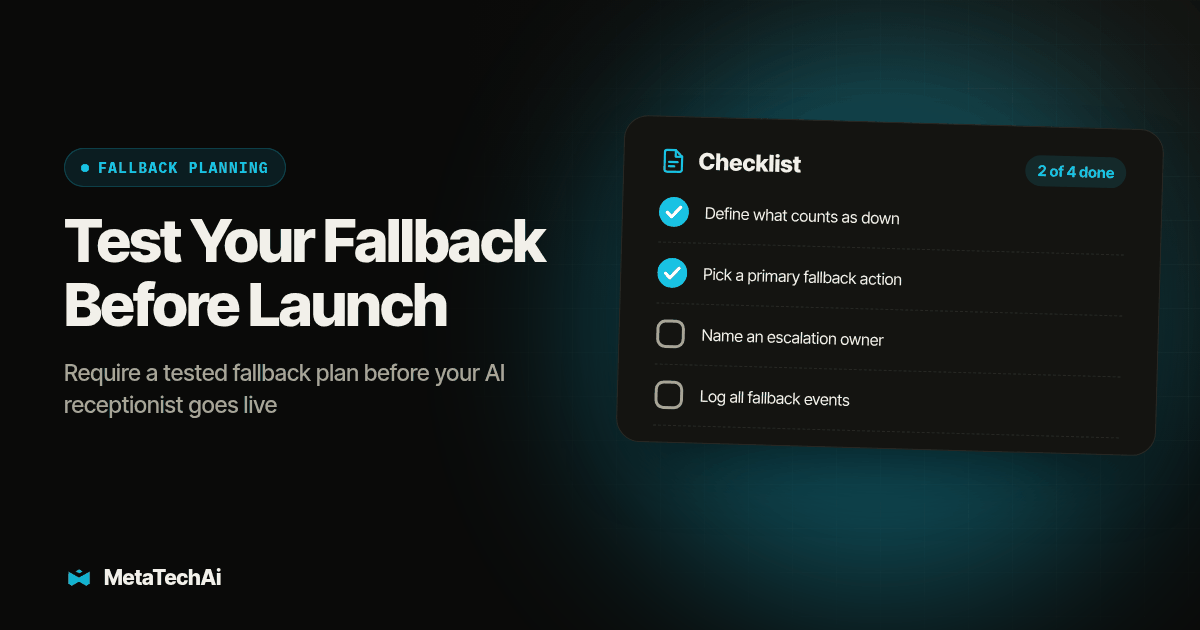
A failover plan is not a paragraph in a vendor contract. It is four specific, testable commitments, that a business can use as acceptance requirements before launch.
- A defined trigger. Write down exactly what counts as "down": no response from the agent within a stated number of seconds, a failed API call, a dropped connection, or a provider status page showing an incident. Vague triggers like "if it's not working" do not get tested and do not get built.
- A named fallback action. Pick one primary fallback per channel. For inbound calls, that is usually simultaneous ring to a cell phone or a small group of reps, a pattern discussed in the RizzDial guide to simultaneous ring across multiple reps as an AI fallback. For chat and text, choose a callback queue or a message capture form with a stated callback window, such as "a team member calls back within one business hour."
- A named escalation owner. One person, by role, gets paged when the fallback fires, not a shared inbox that three people assume someone else is watching. We cover how to assign that single point of accountability inside a broader AI governance framework, and the same rule applies here: no owner means no accountability when it actually fires.
- A logging requirement. Every fallback event writes to the same CRM field a normal AI-handled lead would use, tagged as a fallback event, with a timestamp. If a lead that came in during an outage cannot be found later, the plan failed even if the phone call itself went fine.
Put these four items in a one-page document, attach it to the vendor agreement, and review it the same day you review call volume or booking numbers. A failover plan nobody can find during an actual outage is not a plan.
How Do You Test the Fallback Before You Need It?
Testing matters more than writing the plan down, because an untested fallback is a guess with good formatting. Use this five-step drill before launch and repeat it after a material provider or routing change. It is a proposed acceptance procedure, not a claim that every installation already includes these controls.
- Schedule a controlled rehearsal with the team. Use a test number, test contacts and a staging workflow that mirrors the intended routing. Name the observer, backup rep and person who restores service. Agree on pass criteria and keep customer traffic separate from the rehearsal.
- Simulate one failure at a time. Have the implementation owner make the test endpoint return an error or exceed its configured timeout. Repeat for a failed booking request and an unavailable CRM. Do not revoke production credentials or deliberately break a live customer line. Record which dependency was disabled so each result has a clear cause.
- Call or message the test channel and time the fallback. Confirm the backup phone rings, the queue receives an entry or the voicemail greeting plays. Test an unanswered backup phone too. Twilio's Dial documentation distinguishes outcomes such as busy, no answer and failed; a transfer attempt alone does not prove a person answered. Other platforms need their own equivalent checks.
- Confirm the record survives. Find the test contact, failure reason, timestamp, owner and next action in the CRM. When the CRM itself is unavailable, verify an approved temporary queue retains the record and a person can access it. A fallback cannot depend entirely on the service that just failed.
- Restore the test connection and confirm recovery. Submit a fresh inquiry, reconcile any pending booking and check that no duplicate callback or appointment appears. Verify that the incident owner receives both the failure alert and the recovery result. Save the observed timings and unresolved issues before deciding whether the configuration passes.
Run this drill before launch as part of a proper AI readiness assessment, then put a recurring reminder on the calendar to rerun it every time a provider, model, or number changes. A fallback that worked in March is not proven to work in October.
Who Should Get Paged When the Agent Goes Down?
One person, named by role, not by hope. Name a primary and a backup before launch. In a hypothetical busy office, an unowned alert can leave missed consultations unnoticed until someone compares the call log with the booking calendar.
The primary owner is usually whoever already owns inbound lead response day to day, a sales manager or office manager, not an IT contact who is not in the building when the phone rings. They get the page, they confirm the fallback is actually catching calls, and they decide whether to flip to a fully manual process if the outage runs long. The backup owner exists because the primary is not always reachable either; a pager alert that only reaches one person is itself a single point of failure.
This mirrors the data and architecture layers we map out in AI sales architecture and data security: redundancy only works if a human is wired into the loop at the point where automation stops, and that human has to be named before the outage, not during it. A clear owner also shortens the conversation with a vendor; "who do you page and how fast" is a fair question to ask before any AI phone or chat agent goes live, and a vendor who cannot answer it has not built a failover plan, they have built a feature they hope never gets tested.
Which Fallback Option Fits Which Type of Lead?
Not every inbound channel needs the same fallback. A hot inbound call from a paid ad and an after-hours webform fill are different problems with different acceptable delays.
| Fallback option | What it does | Fits this situation | Risk if skipped |
|---|---|---|---|
| Simultaneous ring to reps' cell phones | Rings a small group of reps at once the moment the AI agent cannot take or transfer the call | Live inbound calls from ads or hot leads where the caller expects a live conversation | The call dies in voicemail or the caller hangs up and calls a competitor |
| Callback queue entry | Captures the lead for a named person or configured workflow to call back within an agreed window | Chat, text, or web form leads that do not expect an instant answer | The lead sits unseen until someone happens to check the inbox |
| Voicemail with a stated callback window | Plays a greeting naming a specific callback window, then logs the message | After-hours or overflow volume where no rep is available regardless of the outage | A vague "we'll call you back" greeting that sets no real expectation and gets ignored |
A business handling both live calls and asynchronous inquiries should consider combining these options, one for live calls during business hours and one for everything else. Picking only one and hoping it covers both channels is how a callback queue ends up handling a hot lead that needed a ringing phone instead.
Does the Conversions Guarantee Still Apply During an Outage?
MetaTechAi installs AI sales and marketing systems for service businesses with sales teams, with a guarantee that conversions go up or the client does not pay. That positioning does not specify outage exclusions, remedies or a measurement window. Put those details in the engagement agreement instead of inferring them from an uptime promise.
Ask how outage periods enter the conversion baseline and reporting window, who owns fallback maintenance, and what evidence determines whether the agreed outcome was reached. Define a confirmed booking separately from an attempted booking, a missed call and a callback request. Review the performance based engagement terms checklist alongside the technical acceptance plan.
A provider incident may be outside the implementation team's control, but fallback design and incident responsibilities still need explicit owners. Ask for a demonstration of the agreed behavior. Do not accept a general guarantee as proof that every dependency has an independent backup or that interrupted conversations can automatically resume.
What Happens to Appointments Already Booked Before the Outage?
Start by identifying the authoritative calendar. If the booking was saved there before the AI service failed, the appointment may still be available to staff even when the AI cannot read it. Verify that access directly. A confirmation spoken during a call is not proof that the calendar accepted the write, and a queued reminder is not proof that the reminder was delivered.
Use three recovery states in your operating worksheet: confirmed in the calendar, requested but not confirmed, and status unknown. For each unresolved request, retain the contact details, requested slot, interaction identifier and assigned reviewer. A person checks calendar availability before confirming anything to the customer. If a write timed out, inspect the calendar first instead of creating the appointment again and risking a duplicate.
Consider a hypothetical service consultation: the caller asks for Thursday afternoon, the calendar request fails, and the agent captures a callback request. The fallback message should say the team needs to confirm availability. It should not say the visit is booked. Once service returns, the assigned rep checks the slot, contacts the customer and records the final result in the same lead history.
Existing appointments also need a practical continuity check. Can staff see the day's schedule without the AI dashboard? Who handles reschedules while automation is paused? Can a pending reminder be stopped after a human changes the appointment? Include those questions in the rehearsal so a working phone fallback does not hide a broken booking workflow.
What Else Do Buyers Ask About AI Failover Plans?
How long does it take to put a tested failover plan in place?
The schedule depends on access to routing controls, the CRM, the calendar and the people handling escalation. Define the scope first, then agree on a test date. A written plan is not complete until the fallback and recovery checks pass.
Does the conversions up or you do not pay guarantee still apply during an outage?
MetaTechAi guarantees that conversions go up or the client does not pay. The engagement agreement must define how outages affect measurement, responsibilities and remedies. Do not assume outage terms that have not been agreed in writing.
Do we need a developer on staff to build this failover ourselves?
Not necessarily. Existing phone and CRM controls may support a simple human fallback. Custom routing, independent event storage or booking reconciliation may require an implementation specialist. Confirm the required access and skills before setting a launch date.
What happens to a lead that comes in while the AI agent is down?
It should enter the tested fallback: a human phone route, a callback queue or voicemail with a stated callback window. Record the contact, owner and next action. If the CRM is unavailable, retain the request in an approved temporary queue and reconcile it after recovery.
Write the requirements down, run the five-step drill, name an owner and pick the fallback that matches each channel. Bring the dependency map and test results to an AI infrastructure planning conversation so the agreed installation includes clear acceptance criteria and a usable recovery procedure.