
How to Budget for AI Sales Tools in 2027
By MetaTechAi ·
TL;DR: Budget for five planning groups: software and usage, implementation and integration, data cleanup, training, and governance with ongoing monitoring. Size each from your own workflow, assign an owner and reserve time to test the system before expanding it.
If you are sizing next year's AI sales tooling line right now, the number the vendor quoted you is the start of the conversation, not the end of it. A service business with a sales team should budget for implementation and integration, data cleanup, training, and ongoing governance and monitoring as separate lines alongside the license fee, sized from the specific gaps in your own CRM and process rather than a vendor's rule of thumb. Skip any one of those lines and you do not save money. You just move the cost to a quarter when it shows up as a problem instead of a plan.
Start the planning conversation with the sales budget owner, the CRM owner and the manager who will supervise the tool. Ask each person what work must happen before a lead can move through the new process safely. Their answers become the scope behind the worksheet, rather than assumptions hidden inside a software quote.
Why Does the License Fee Undercount What an AI Sales Tool Actually Costs?
The license fee describes access to software. It may not include configuring your workflow, correcting records or teaching a rep how to handle an exception. Read the scope beside the quote and identify which tasks belong to the vendor, your team or another implementation partner. A missing task still needs an owner and time in the plan.
Separate fixed commitments from usage that changes with activity. Ask what counts as consumption, what happens when limits are reached and who can approve more capacity. Estimate an ordinary operating period and a busier one using your own lead history. These are planning scenarios, not promises about future volume or returns.
What Cost Categories Belong in Next Year's AI Sales Budget?
Bond Consulting Services' September 2026 budgeting account describes spending beyond licenses, including staff learning, process changes, data preparation and oversight. It is one company's experience, not an industry cost benchmark. For this worksheet, separate the five planning groups into the operating lines below so governance and monitoring each have a named owner.
Implementation and integration is the work of connecting the tool to your CRM, phone system, calendar and whatever data it reads from or writes back to. Ask the vendor to identify included connectors, configuration work and exclusions. Budget separately for any mapping, testing or custom development that your specific workflow still requires.
Data cleanup is the work of getting your CRM, lead records and disposition history into a state the tool can actually use. We cover what that looks like, field by field, in what your CRM needs before an AI sales system can help your team, and the same gaps that block a CRM rollout block an AI sales tool, with a sharper consequence: bad input data does not make the tool slower, it makes the tool confidently wrong.
Training covers getting reps and managers to use the tool as designed, not just getting them a login. Include practice with ordinary leads, incorrect suggestions and handoffs to a person. A manager should check that reps can explain when to accept an output, correct it or stop the workflow before broader rollout.
Governance is the decision work: who approves what the tool can say or do without a human checking first, who reviews exceptions, and who owns the tool when something goes wrong. It is a planning cost, not a software cost, and it consumes staff time even when nobody invoices for it.
Ongoing monitoring and tuning is the recurring work of reviewing performance after launch and adjusting the system when lead mix, staffing or service information changes. Check whether the contract includes that work and what it covers. Assign the remaining review duties internally instead of assuming either a subscription or an implementation fee pays for them.
How Do You Size Each Category Without Inventing a Dollar Figure?
You do not need a vendor's benchmark or an industry average to size this correctly for your own business, and you should not borrow one, because every business's starting point is different. Run these eight steps against your own CRM, your own team and your own current tools before you put a number on anything.
- Start with the license or subscription quote as your documented starting line. Check both committed fees and variable usage assumptions.
- Audit your own CRM for the specific gaps a tool would hit on day one, using the checks in the AI readiness assessment for a service sales team, and size data cleanup to what you find, not a guess.
- List every system the tool has to connect to: CRM, calendar, phone lines, payment or scheduling tools. Size implementation to that count and complexity, not a flat percentage of the license.
- Scope training for the first full quarter after launch, not one kickoff session, as a planning window for practice, feedback and manager review; adjust it to the actual rollout.
- Name the governance owner before you size the governance line. If nobody can say who approves what the tool does unsupervised, that is the finding, and the fix is a planning cost, not a feature you buy.
- Decide who owns ongoing monitoring and how often they check, weekly at first, then on a set cadence, and budget their time the same way you budget a rep's time.
- Add a contingency line sized to your own tolerance for the categories above running long, to cover the specific implementation delays or cleanup risks identified during scoping.
- Put a mid-year review date on the calendar now, before the fiscal year starts, so actual spend gets checked against this worksheet instead of surfacing as a gap in next year's budget meeting.
What Does the Budget Worksheet Look Like Line by Line?
Use this as the structure for the actual budget request, with your own numbers filled in against each line rather than a vendor's estimate.
| Budget line | What it actually covers | How to size it this year | Signal you underbudgeted it |
|---|---|---|---|
| License or subscription | The tool itself, as quoted by the vendor | The vendor's quote, confirmed in writing | Mid-year plan upgrades you did not budget for |
| Implementation and integration | Connecting the tool to your CRM, calendar, phone lines and data | Number and complexity of systems it has to touch | Launch slips past the original go-live date |
| Data cleanup | Fixing the fields, history and ownership data the tool reads from | Findings from your own CRM readiness check, not a guess | The tool makes confident calls on bad or missing data |
| Training and adoption | Getting reps and managers to actually use the tool as designed | A full quarter of onboarding, not one kickoff session | Reps route around the tool and keep working the old way |
| Governance | Naming who approves what the tool can do without a human checking first | Planning time for the named owner, not a license add-on | Nobody can say who approved an exception after the fact |
| Ongoing monitoring and tuning | Watching performance after launch and adjusting as conditions change | A set weekly or monthly review cadence, staffed on a calendar | Results quietly decline and nobody notices until a manager asks |
| Contingency | Covering overruns in the categories above | Your own tolerance for delay, sized against past rollouts | Any category above runs out before the quarter ends |
What Happens When Governance and Monitoring Get Cut From the Budget?
Governance and monitoring can look optional because neither is the feature buyers saw in the demo. Make their deliverables concrete: a written approval boundary, an exception queue, a review meeting and an owner who can pause the workflow. Budgeting those duties makes it possible to assign responsibility when a result needs investigation.
Consider a hypothetical calling workflow that remains active while qualified bookings decline. The invoice alone cannot tell you whether the cause is routing, calendar availability, changing lead quality or the conversation itself. A funded review gives someone time to inspect the records and decide what to test. This is a planning example, not a reported client result.
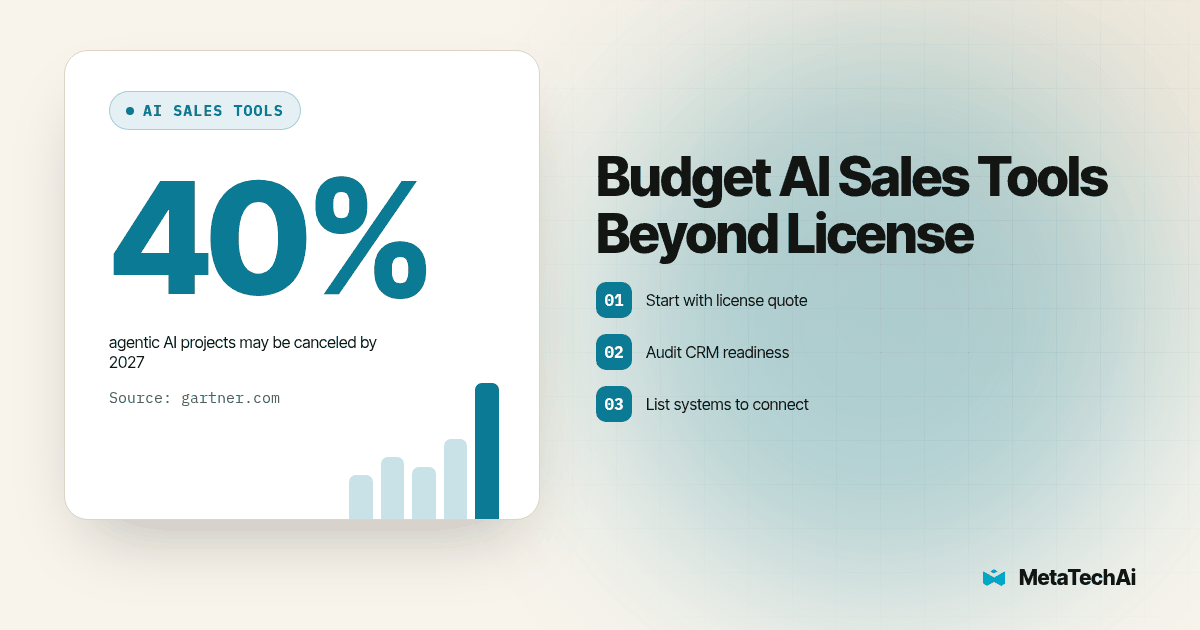
Gartner's June 2025 forecast predicts that over 40 percent of agentic AI projects will be canceled by the end of 2027, citing escalating costs, unclear business value or inadequate risk controls. That is a forecast across agentic projects, not an observed failure rate for service sales tools or proof that one budget line causes failure. Use it as a reason to define review gates, not as a forecast for your business.
How Does This Build on the CRM and Readiness Work You've Already Done?
If you have already run a readiness check or a CRM cleanup ahead of an AI sales rollout, this budget is the next step, not a separate project. The AI readiness assessment for a service sales team scores process, data, ownership, a baseline number and tool fit on a simple scale, and the findings show which implementation and data tasks need estimates next year. A business that scored low on ownership needs a bigger governance line before launch, not a bigger license.
The same logic applies to CRM work. If you have already done the audit in what your CRM needs before an AI sales system can help your team, you already know which fields were a problem, and that list is your data cleanup budget, not a new estimate. Skipping straight to a license quote without carrying that work forward means paying twice to learn what the readiness check already told you.
For a service business that wants this entire structure, the license decision, the integration plan, the data work and the ongoing oversight, scoped and built as one system rather than assembled line by line after the fact, that is the planning work covered in AI infrastructure planning, and it is the same work our managed services team runs under a guarantee tied to conversions, not activity, with monitoring responsibilities written into the scope.
If your sales team also runs outbound calling and you are sizing what that specific channel costs to run well, not just to license, RizzDial's breakdown of what agencies actually pay for AI dialing in 2026 walks through the same beyond-the-license thinking for a calling-specific stack.
What Do Service Business Leaders Ask Before Setting Next Year's AI Budget?
How long should we expect implementation and integration to take once we sign an AI sales tool contract?
Estimate implementation after mapping the systems, required fields, access approvals and acceptance tests. Reserve time in the first quarter for rollout and correction, but treat that as a planning allowance rather than a universal delivery timeline. Ask the implementation owner to identify dependencies and confirm what must pass before live customer contact begins.
Do we need a separate budget line for data cleanup if our CRM project already covered it?
Budget a tool-specific data check even after a CRM project. If that project already verified every field and record the new workflow needs, reuse the evidence and fund only remaining gaps. A tidy reporting dashboard does not establish that lead-source history, disposition codes, ownership and contact restrictions are ready for automated decisions.
Does the AI sales budget need a governance line even if we are not in a regulated industry?
Yes. Governance includes deciding who approves what the tool may say, do and escalate, regardless of whether an industry-specific rule applies. Budget time for that owner to review permissions, exceptions and changes before launch and during operation. The worksheet covers operational ownership; it does not replace any separate review your business requires.
What does it cost us if we skip the ongoing monitoring line and the tool drifts after launch?
The potential cost includes wasted staff effort, missed opportunities and time spent investigating problems late. The amount depends on your workflow and cannot be inferred from a subscription quote. Fund a reviewer to check outcomes and exceptions on a set cadence, with authority to pause the workflow and test corrections when performance changes.
How is budgeting for an AI sales tool different from budgeting for a CRM seat license?
Compare the operating work as well as the billing model. A CRM can also need integration, training and administration, while an AI tool may have fixed fees, usage charges or both. Customer-facing AI adds review of generated responses, permitted actions and changing behavior. Budget those duties explicitly instead of assuming either product is just a seat license.
What Should You Do Before the Fiscal Year Starts?
Pull up the worksheet above and fill in your own numbers before you submit a budget built around a single vendor quote. Run the readiness and CRM checks first if you have not already; their findings turn "implementation" and "data cleanup" from a guess into a defensible number. Name the governance owner and the monitoring cadence in writing, even in draft form, before the budget goes up the chain, since a line item with a named owner is harder to cut than one that just says "oversight."
None of this requires a market rate or a vendor's standard add-on percentage. It requires an honest look at your own CRM, team and tolerance for things going over, sized the same way you would size any investment that has to prove itself against a result rather than an activity.