
AI Voice Agent Booked Nothing? Keep, Fix, or Cancel
By MetaTechAi ·
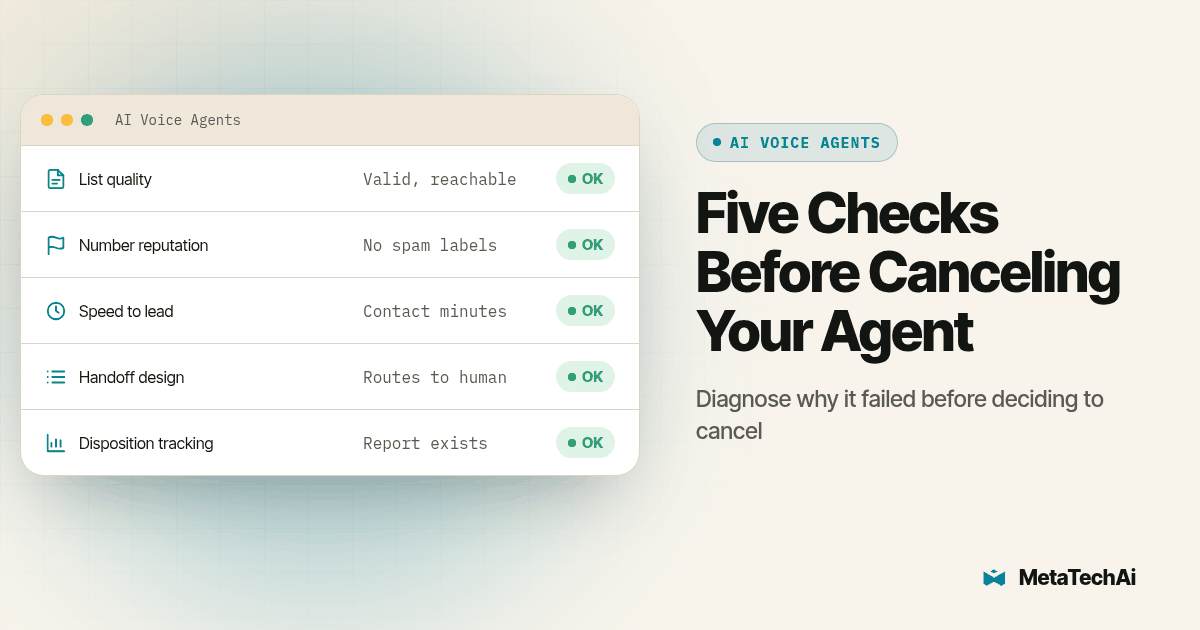
Before you cancel an AI voice agent that booked almost nothing, run a five-part diagnostic: call list quality, number reputation, speed to lead, conversation design with a human handoff point, and whether anyone tracked call dispositions at all. Score each part, then decide keep, fix, or redirect the budget against a conversions-up-or-you-don't-pay standard, not a blanket gut call.
The buyer question supplied for this guide describes an AI calling agent that reportedly booked one meeting in nine months while the bill kept recurring. That is a reason to investigate, not an independently audited performance result. If it sounds like your situation, identify where calls stop progressing before choosing whether to keep, fix, or cancel the system.
Why Did Your AI Voice Agent Book Almost Nothing in Nine Months?
A long period with very few meetings warrants a review of the entire path from eligible lead to confirmed appointment. It does not establish whether the cause is targeting, delivery, the conversation, the offer, calendar availability, or incomplete reporting. Assign one person to trace that path so each finding has an owner and evidence behind it.
Use five diagnostic areas: list quality, number reputation, speed to lead, conversation design, and disposition tracking. Record pass, partial, or fail for each, with a link to the evidence and the person responsible for the next action.
Should You Cancel Before You Know Why It Failed?
Canceling without a diagnostic throws away the one thing nine months of a bad result actually gave you: a long enough sample to find the real cause. If you cancel now, you carry the same unexamined list, the same number reputation, and the same script into whatever you try next, and there is a real chance the new vendor inherits the exact same failure for the exact same unexamined reasons.
Run the diagnostic first. Begin with records you already have, then schedule any missing tests. The review turns "the AI agent does not work" into a specific, fixable finding, or a confirmed reason to walk.
What Is the Five-Part Diagnostic Before You Cancel?
Work through these five checks in order. These are proposed audit checks, not a validated scoring model. The sample sizes below are practical starting points, not statistical proof; expand the review when results vary by lead source or campaign.
- Check list quality and targeting. Pull a random sample of 50 records the agent called in the last month and score each one: valid number, correct contact, right buyer stage, not already a customer or a do-not-call entry. If more than a handful of that sample is dead weight, the agent was never calling people who could book a meeting in the first place, no matter how good the script was.
- Check number reputation and spam labeling. Place calls from the actual outbound business number to consenting test recipients on different mobile networks. Inspect the receiving screen, not the calling phone. Record the displayed label, network, time and whether the call rang. A clean result on one phone does not prove clean delivery everywhere. Twilio's trusted calling documentation explains that caller authentication does not guarantee freedom from blocking or spam labels. Investigate a flag with your provider rather than assuming a replacement number solves the cause.
- Check speed to lead. Pull your CRM timestamps and measure the gap between a lead arriving and the first call attempt, then the first actual conversation. Separate business hours, after-hours inquiries and buyer-requested callbacks. Compare outcomes for similar lead sources instead of importing a headline conversion multiplier from another study. If fresh inquiries wait for hours, inspect routing and ownership before rewriting the conversation. Use a response target your team can support and that respects the buyer's requested timing.
- Check conversation design and the human handoff point. Listen to ten full call recordings end to end, not just the summaries. Watch specifically for settings that choke off a real conversation: short silence timeouts, high interruption sensitivity, or a script with no defined moment where a hesitant lead gets handed to a person instead of looped back into another AI question (JustCall, troubleshooting AI voice agent missed calls). Test a request for a person and a case where that person is unavailable. Confirm that the fallback creates an owned task rather than another untracked call.
- Check whether disposition tracking ever existed. Ask a simple question: for the last 90 days of calls, can anyone produce a report showing how many connected, how many were not interested, how many asked for a callback, and how many booked? If the honest answer is no, nobody can tell you where in the funnel the agent is actually losing meetings, which means every month of "it's not working" was a guess dressed up as a fact.
The fifth check turns a complaint into something you can investigate. Missing dispositions do not prove that no work happened, but they prevent a reliable explanation of where meetings were lost. Reconcile the calendar and CRM before deciding whether the agent failed to book or the reporting failed to count.
How Do You Score Each Part of the Diagnostic?
Score each of the five checks pass, partial, or fail using the records you just pulled. A partial result means the evidence is incomplete or inconsistent. Do not count failures as an automatic cancellation formula: one serious handoff defect can matter more than several minor configuration gaps.
| Diagnostic area | Pass looks like | Fail looks like |
|---|---|---|
| List quality and targeting | Most of the sample is a real, reachable, right-stage contact | Sample is full of bad numbers, wrong contacts, or do-not-call entries |
| Number reputation | Test calls ring without observed spam labels across sampled networks | Caller ID shows Spam Likely or Scam Likely on a receiving test phone |
| Speed to lead | First call attempt lands within minutes of the lead arriving | Leads sit for hours or days before first contact |
| Conversation design and handoff | Hesitant leads get routed to a person at a defined point | Every hesitant lead gets looped back into more AI prompts or dropped |
| Disposition tracking | A 90-day report of outcomes exists and someone reviews it | No one can produce outcome counts for the period in question |
If dialing infrastructure itself is the suspect, a useful companion check is on the calling side specifically: our sister post on measuring AI dialer ROI walks through isolating cost per connected call from cost per booked meeting, which helps distinguish delivery costs from booking outcomes. Proving whether a fix actually worked afterward follows the same discipline we cover in how to prove an AI sales system raised conversions: agree on the metric and the comparison method before you change anything, not after.
What Does Keep, Fix, or Redirect Actually Mean in Practice?
Once the five checks are scored, the decision usually sorts itself into one of three lanes, and the lane depends on how many checks failed and whether the failures are fixable inside the current setup or not.
Keep it, with monitoring added. If tracking is the only gap, continue only with a defined review window and an owner. Passing the other checks does not prove the agent produced useful meetings. Reconcile appointment records, add outcome reporting, and judge whether the evidence supports continued use.
Fix it. Choose a bounded repair when you can identify a cause and verify the change: clean the list, investigate a spam label with the provider, repair delayed routing, or rewrite the human handoff rule. Confirm that the current platform supports the repair and that someone owns the retest. Avoid changing numbers simply to escape a label while leaving the calling behavior unchanged.
Redirect the budget or cancel. Consider this when essential gaps cannot be repaired within the agreed scope, the vendor cannot provide evidence, or a completed repair window still misses the agreed outcome. Export the records and plan continuity before ending access. Our managed AI services for service businesses cover scoped AI sales and marketing work with human oversight. MetaTech's guarantee is that conversions go up or you do not pay. Agree on the conversion definition, baseline, review window and remedy in writing; do not assume the guarantee defines an invoice schedule or every task in this diagnostic.
Whichever lane you land in, the standard stays the same. Conversions go up against an agreed baseline, measured on a set schedule, or the arrangement does not continue as is. That standard, not a mood or a sunk cost, should be what decides whether you keep paying.
What Should You Do This Week?
Start with checks two and three if test recipients and CRM records are available: outbound calls to test phones and a timestamp review. They can reveal delivery and routing gaps before you analyze conversations. Then review targeting, handoff behavior and outcomes. Pause any affected workflow that is contacting people it should exclude while its owner investigates.
Write down what you find for each of the five areas, even the ones that pass, because that document becomes the requirements list for whoever manages this system going forward, whether that is the current vendor under a new accountability structure, a new vendor, or your own team with the right CRM setup supporting it. Our AI infrastructure planning work exists for exactly that handoff: mapping the calling, CRM, and approval workflow around a sales team so the next version of this system has monitoring built in from day one, instead of nine months of silence before anyone looks. If a lead who does answer the phone never gets the follow-up conversation your team expects, check how that boundary should be set in how an AI sales agent should handle customer contact before you rebuild the script from scratch.
How Can You Test a Repair Before Extending the Contract?
Run this proposed acceptance test with test contacts and a controlled calendar before judging commercial results. It is an original procedure for this review, not a reported client outcome. Keep test bookings separate from real sales reporting so the audit does not create the improvement it claims to measure.
- Save the starting evidence. Export the current script, relevant settings, reporting definitions and completed-period outcomes. Record the change you intend to test and the reason for it. If several changes are necessary, document each one so you can explain the result later.
- Trace a normal appointment. Use an authorized test contact who requests an available service and time. Confirm the selected calendar, time zone, contact details and appointment record. A verbal promise by the agent is not a booking until the calendar contains the correct event.
- Trace a handoff exception. Have the test contact ask for a person, then repeat with that person unavailable. Verify who receives the context, what the contact hears, and whether an owned follow-up task exists. A transfer attempt alone does not establish that someone accepted responsibility.
- Reconcile the outcome. Compare the call record, disposition, CRM stage and calendar event for the same contact. Test a cancellation and a duplicate so neither inflates the count. Record discrepancies and the evidence that closes them before marking the repair complete.
- Review a comparable live window. After the mechanical checks pass, monitor eligible leads under the agreed scope. Keep source, offer, calendar capacity and qualification rules visible. Compare booked and kept appointments separately, and identify any changes that prevent a fair comparison with the baseline.
Write a decision note at the end: what failed, what changed, what passed the retest, and which business outcome remains unresolved. A successful technical repair can justify a measured continuation without proving a conversion gain. An unsuccessful repair supplies a concrete reason to revise the scope or cancel instead of repeating an indefinite trial.
What Do Buyers Ask Before They Cancel an AI Voice Agent?
How long should we run an AI voice agent before deciding it has failed?
Use the review window agreed for your sales cycle and eligible lead volume. Test routing, caller display, calendar writes and human handoffs before expanding use. Business outcomes need enough comparable opportunities to mature. A month is not a universal success or failure threshold, and a long history of poor results does not justify another extension without a specific repair plan and evidence checkpoint.
What does a conversions-up-or-you-don't-pay standard actually require in writing?
It requires four things fixed before the clock starts: the metric that counts as a conversion, the baseline you are measuring against, the review window, and what happens if the number does not move. A vendor who will not write those four things down is telling you the engagement was never built to be measured, which is a different problem than the agent simply underperforming.
If we fix the agent instead of canceling, does that mean starting the contract over?
Not necessarily. Ask whether the proposed configuration, script and reporting changes fit the current scope. Some repairs may require additional access or a written scope change; the agreement determines that. Record the work, owner, completion test and review date before accepting a restart. Do not assume a new contract is required, or that every repair is already included.
How much does it cost to switch to a managed AI voice agent service instead of running one ourselves?
The honest answer depends on how much of the five-part diagnostic your current setup already passes, since a managed service is doing the same list, number, speed, script, and tracking work either way. The cost comparison that matters is not switching fees. It is whether you are currently paying for an agent nobody is tuning versus paying for one with a person checking those five things every week.
Can we keep our existing phone numbers and CRM if we move to a different AI voice agent setup?
Check account ownership, administrative access, export rights and number transfer eligibility before choosing a replacement. Do not assume the number or CRM account belongs to you because your business uses it. Ask both providers to confirm the migration path and test calls and CRM records before ending the old service. Keeping a number also does not guarantee that its spam labeling will improve.
The decision at the end of this is not complicated once the diagnostic is done. One meeting in nine months is a symptom, not a verdict on AI voice agents in general. Find which of the five parts actually broke, fix what is fixable, and hold whatever comes next, in-house or managed by us, to a standard where conversions go up or you do not pay for it.