
Real-Time AI Sales Call Coaching: Worth the Risk?
By MetaTechAi ·
Real-time AI call coaching (a "whisper" tool) listens to a live sales call and prompts the rep on pricing, financing, objection rebuttals and missed close attempts while the customer is still on the line. It can flag missed steps before the call ends, but reps tune out generic or mistimed prompts fast, so we only turn it on for a full team after a scoped pilot with a hard cap on prompt volume and a written list of what it is and is not allowed to say.
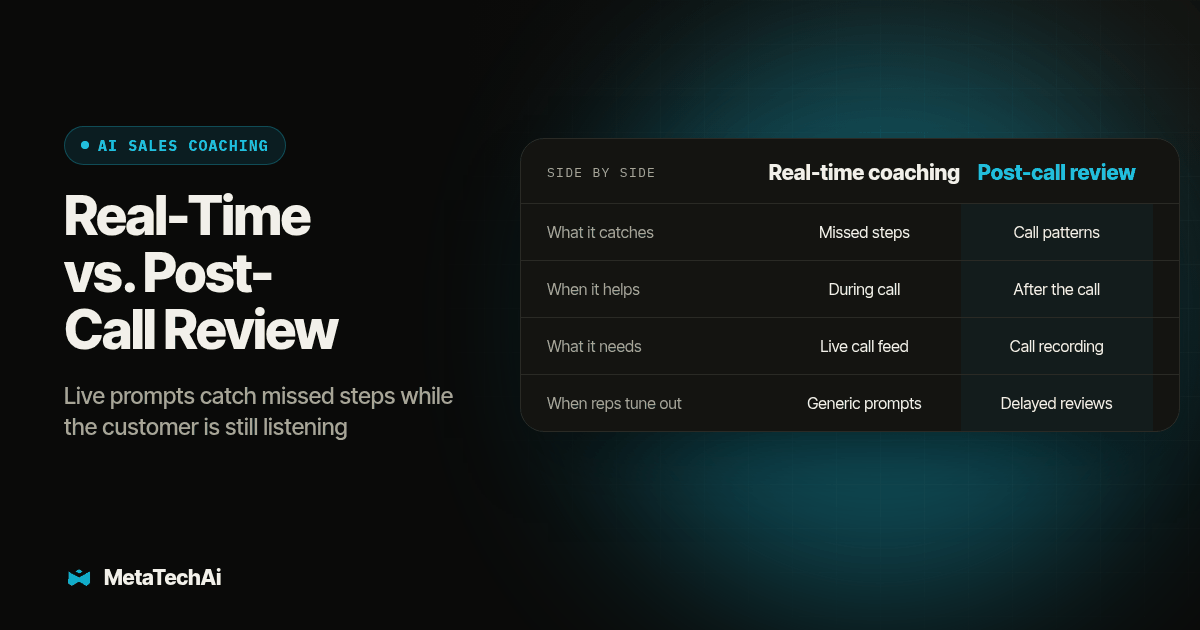
This question matters for service businesses that already run a disciplined post-call review, the kind of worksheet-and-evidence process we laid out in our lost-deal review guide. The follow-up question is: if we can already see what went wrong after the call, why add a tool that talks to the rep during it? Post-call review can reveal a missed financing mention after the conversation, without establishing that this omission caused the loss. A whisper tool can flag the missed mention while the rep is still on the phone, before the customer hangs up. That is a real difference, and it is also exactly the kind of tool reps resent the moment it feels like noise instead of help.
What does real-time AI call coaching actually do during a call?
A whisper coach receives live conversation audio through a supported calling integration and compares it with your sales playbook. Tradesly describes an on-screen teleprompter that follows the business's scripts, helps with price concerns and competing quotes, and suggests relevant memberships or services (Tradesly). Its real-time agent assist page describes live guidance for people answering calls. Those are vendor descriptions of functionality, not evidence that a prompt will improve your team's conversion rate. Confirm the supported call source and display before choosing a pilot.
A SalesAsk press release distributed through Barchart describes a similar approach for contractors and field sales teams through an AI coaching agent called Coach Dean. Instead of reviewing a recording later, Coach Dean is described as prompting reps during the conversation, including recognizing the moment a conversation should turn to financing and prompting the rep to bring it up right then (Barchart). That example matters because it is the exact gap a post-call worksheet cannot close: by the time a reviewer reads the transcript, the financing conversation either happened or it did not.
These descriptions suggest a narrow evaluation checklist: price or financing reminders, relevant objection guidance, and prompts tied to your sales stages. Ask each vendor to demonstrate the specific items you need. A product description does not establish that every tool supports every prompt or can recognize the right moment reliably.
What can a whisper tool flag while a call is still live?
Post-call review, done well, is still the backbone of coaching. It is where you build the evidence worksheet, separate the customer's actual words from the rep's assumption, and decide what to coach, the process we cover in detail in our lost-deal review guide. But it has one structural limit: the call is over. A later review cannot change what happened during the original conversation, although it can guide an appropriate follow-up.
Consider a hypothetical estimate call where the customer says the payment timing is difficult. Your business offers an approved financing option, but the rep moves straight to asking for the sale. A useful prompt would remind the rep to ask whether the customer wants to hear about that option while the concern is still being discussed. The manager can then check the recording afterward to see whether the prompt was relevant, timely and acted on.
The SalesAsk press release on Barchart describes financing reminders as a use case. It also reports customer outcomes, but those promotional claims do not establish what live prompting alone caused. Use the feature description to design a test rather than importing another company's results into your forecast. Compare similar opportunities and keep the original call evidence available to the reviewer.
The practical distinction is timing. Post-call review can identify the same missed step and improve future calls. Live coaching creates an opportunity to address it during this call. Neither approach can guarantee that the customer qualifies for financing, wants the offer or is ready to buy. The rep still needs to listen and decide whether the suggestion fits.
When do reps start tuning out a whisper coach?
Distraction is a central risk to test. A public sales-technique discussion asks whether a real-time AI coach would be useful or annoying. That is a demand signal for this question, not a representative survey or product endorsement. Reps tune out a whisper tool fast when any of three things happen: the prompts fire on things that are not actually relevant to this specific customer, the same generic line appears on every call regardless of context, or the prompt volume is high enough that it becomes one more thing competing for attention while someone is trying to close a sale. A rep mid-pitch does not have spare attention for a tool that treats every call the same way.
The fix is not to avoid real-time coaching. It is to scope what the tool is allowed to say before it ever reaches a live call, and to measure whether reps are actually acting on prompts or quietly ignoring them. That second part is the entire point of the pilot structure below; you are not just testing whether the tool works, you are testing whether your reps will use it once the novelty wears off.
How does real-time whisper coaching compare to post-call review?
| Comparison point | Real-time whisper coaching | Post-call review |
|---|---|---|
| What it catches | A missed price anchor, skipped financing mention, or dropped close attempt, in the moment it happens | Patterns across many calls: which objections recur, which reps skip which steps, why deals are actually lost |
| When it helps | During the call, while the rep can still correct course | After the call, when you are deciding what to coach and what the evidence actually supports |
| What it needs to work | A live audio or video feed, a defined prompt list tied to your sales process, and a hard cap on prompt volume | Call recordings or transcripts, a worksheet that separates evidence from assumption (see our lost-deal review guide), and a manager who reviews it |
| When reps tune it out | Prompts that are generic, repeated on every call, or timed badly against what the customer is actually saying | Reviews that land weeks later, feel like a gotcha, or coach a loss label with no supporting evidence |
| Strongest use | Reinforcing a small number of specific, high-value moments: pricing, financing, named objections, close attempts | Deciding what those moments should even be, and catching process gaps a live prompt list was never built to see |
Read the table as additive, not either-or. The post-call worksheet is where you figure out which three or four moments actually move your close rate. The whisper tool can remind a rep about those moments while the call is happening. Your review must still check whether the reminders arrived on time and whether the rep used them appropriately.
How do we pilot real-time AI coaching before turning it on for every call?
Treat this like any other change to a live sales process: scope it, test it on a small group, and set a go or no-go line before you tell every rep to use it. Use this proposed pilot sequence. The group sizes and time windows below are planning suggestions, not measured setup benchmarks.
- Pick a pilot group of three to five reps, mixing one skeptic and one early adopter. A pilot that only includes enthusiastic reps will not tell you how the tool performs once it meets normal resistance.
- Write the allowed prompt list before the pilot starts. Name the specific moments the tool is permitted to flag (price anchor, financing mention, a named objection, a close attempt at a defined stage) and explicitly exclude anything else. If the vendor's default settings prompt on things outside that list, turn those categories off.
- Set a hard cap on prompts per call. Agree on a number with the pilot reps themselves; a tool that interrupts constantly will get muted regardless of how good any individual prompt is.
- Confirm what customer history the tool can actually see, and verify it against your CRM before the first live call, not after a rep complains that a prompt referenced the wrong account. Vendor integration depth varies widely here.
- Run the pilot for two to four weeks, and track two separate things: whether the prompted moments actually happened on calls (financing mentioned, price anchored, close attempted) and whether reps report ignoring, muting or disabling prompts.
- Compare pilot calls against your existing post-call worksheet. If the evidence worksheet from our lost-deal review process shows the same gaps the whisper tool was supposed to catch, investigate whether detection, timing or rep response failed before expanding it.
- Set the go or no-go line before you see the results. Decide in advance what counts as working (for example, financing mentioned on a defined percentage more calls, with no rise in reported prompt fatigue) so the decision is not made on vibes after the fact.
- Only after a clean pilot, write the rollout plan, including who owns updating the prompt list as your pitch or pricing changes, and how a rep flags a bad or wrong prompt.
Keep that sequence written down. It becomes the onboarding reference for any new rep who joins after the rollout, which ties directly into how we structure AI-assisted sales rep onboarding generally: a new hire should learn the tool as part of the process, not as a separate add-on explained once in a meeting.
What should the prompt list actually include?
Keep it short enough that a rep could recite it from memory. A reasonable starting list for a home service or estimate-based sales team:
- A price anchor before the customer asks, tied to the stage where your process says it belongs.
- A financing or payment-plan mention, if your business offers one, at the point in the pitch where it is relevant.
- One or two named objection rebuttals specific to your product, not generic sales filler.
- A close-attempt prompt when the conversation reaches the stage your process defines as ready to ask for the sale.
- A customer-history flag when the system has a prior quote, service record or open balance the rep should reference.
Anything outside that list should stay off during the pilot. You can always expand it later once you know reps are actually using the first five things.
Why does adoption matter more than the feature list?
A tool that flags everything it is technically capable of flagging is not a better tool, it is a louder one. The reason we built the pilot sequence above around prompt caps and an explicit allowed-prompt list is the same reason we wrote a separate guide on getting reps to actually keep using an AI sales system after launch: the tool that gets used three months in is the one that respected a rep's attention from day one, not the one with the most capabilities on a sales call.
MetaTechAi installs AI sales and marketing systems for service businesses with sales teams, with the guarantee that conversions go up or they don't pay. Agree on the conversion measure and scope before implementation.
If your team is already running a tight lead-to-close process and the gap is specifically moments inside the live call, a scoped real-time coaching pilot is worth running. If the gap is actually earlier, in how fast leads get a response or how consistently follow-up happens, that is a different problem, and our managed AI services start with mapping which stage is actually leaking conversions before recommending any single tool, live coaching included. For a related mechanism on the calling side, RizzDial's write-up on pulling call transcripts into an MCP workflow covers the adjacent question of what to do with a call's content once a tool has already captured it.
What else do service sales managers ask about real-time coaching?
Does real-time AI coaching replace the post-call review we already do?
No. Treat it as an earlier checkpoint, not a replacement. Post-call review still catches patterns across many calls and the reasons deals are lost; a whisper tool only catches what happens inside one call while it is happening. Keep both, and route anything a whisper tool misses back into your existing lost-deal review process.
How much does a whisper coaching tool cost to pilot?
Pricing varies by vendor and call volume, and we are not going to quote a number here that could be stale by the time you read this. Ask any vendor for a month-to-month pilot rate tied to a fixed number of reps and calls before you sign anything longer.
How long does a whisper coaching pilot take to set up?
Budget one to two weeks to connect the dialer or calling platform, write the allowed prompt list, and brief the pilot reps, then run the pilot itself for two to four weeks before deciding whether to expand it. Treat these as planning windows, not vendor guarantees; extend them if integrations or prompt testing need more work.
Does real-time coaching work with the CRM and calling system we already have?
That depends entirely on the vendor and your stack; some tools listen through a specific dialer integration, others need a separate call-recording feed. Confirm the exact integration path and what customer history it can actually see before you commit a team to it, not after.
What happens to the switching cost if we turn this off later?
Switching effort can stay lower if you treat it as an add-on layer rather than rewiring your process around it. Keep your sales process, CRM fields and existing post-call coaching as the system of record, and the whisper tool as an optional prompt layer on top, so removing it does not break anything else.