
Turn One Sales Call Into a Rep SOP
By James Hill, MetaTechAi ·
A transcript records what was said; an SOP tells a new rep what to do when a customer takes the conversation in a different direction. Turn one top rep call into a one-page guide by marking its decision points, writing one instruction for each, then testing it with a new hire on a realistic call before rollout.
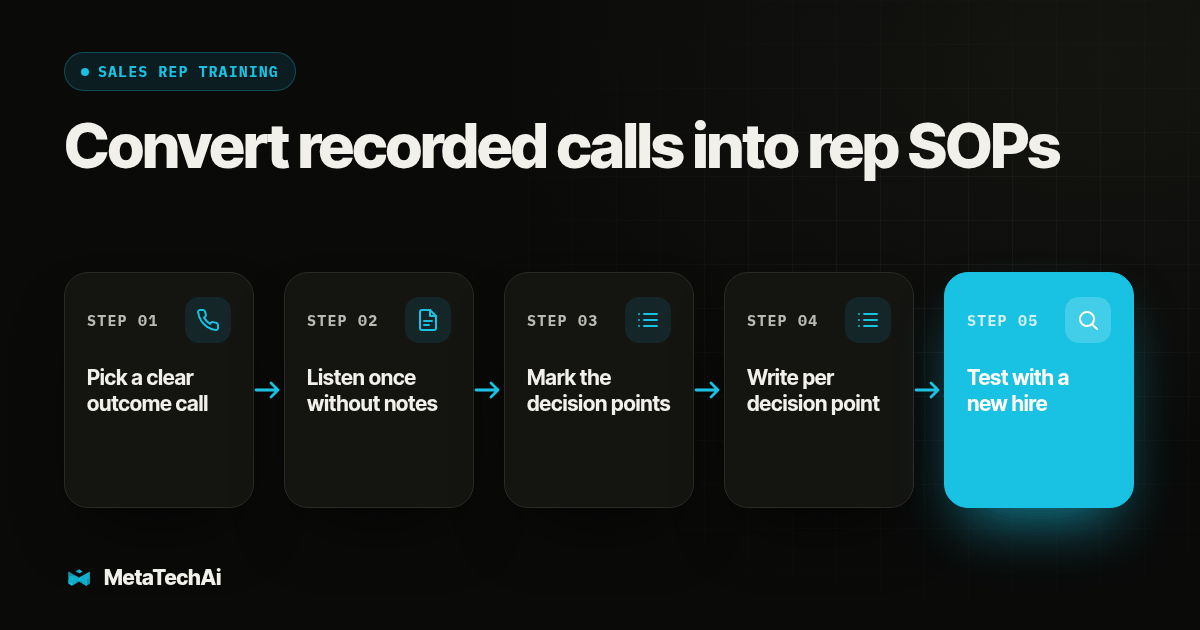
TL;DR: Yes, but a raw transcript is not an SOP; it is just text. Pull one recording from your top rep, find the four or five decision points in the call (opening, qualifying question, the first objection, the close), write one short instruction per decision, and test the result by having a new hire run a real call against it before you roll it out to the whole team.
We install AI sales and marketing systems for service businesses with sales teams. Managers often have a recording of a rep who converts well and want that call turned into something a new hire can learn from. The recording is not the problem. What happens to it next usually is.
Why Doesn't a Call Transcript Work as a Training SOP?
A transcript is a record of what was said, in the order it was said. It is not a record of why the rep said it, what decision each line was answering, or what a different new hire should do when the customer's answer goes a different way. Handing a new rep forty minutes of dialogue and saying "talk like this" asks them to reverse-engineer judgment from raw text, which is exactly the skill they do not have yet.
Our piece on sales rep onboarding in an AI-assisted process covers the broader handoff problem: a new rep needs a short, specific statement of what to do and when to escalate, not a product manual. A transcript fails that test on its own. It has the words but not the decision tree behind them, so a new hire reads it once, nods, and still freezes at the first objection that does not match the script.
Why Are AI-Written SOPs So Long Nobody Follows Them?
Ask a general-purpose AI tool to write a sales SOP from a transcript and it may return several pages: background, context, tone guidance, a long list of possible objections, and a closing checklist. That creates a familiar failure mode for AI SOP generator output. The problem may not be incorrect information; it can be too much information, with no single owner and no single outcome, so nobody opens it on a real call.
The fix is not a better prompt that produces a shorter paragraph. It is a different unit of work. An SOP built from one call should cover one call type, have one owner who maintains it, and aim at one outcome, such as a booked next step or a qualified lead handed to a closer. Everything that does not serve that one outcome belongs in a separate document, not bolted onto the SOP a rep is supposed to glance at mid-call.
How Do You Turn One Recorded Call Into a One-Page SOP?
Run this against one real recording, not a composite of several calls, so every line in the SOP traces back to something a rep actually said and a customer actually did.
- Pick a call with a clean outcome, not just a strong rep. Choose a recording where the call ended in a clear result, booked, qualified, or disqualified for a stated reason, so you have a finish line to build toward, not just good energy throughout.
- Listen once straight through without taking notes. Get the shape of the call before you start dissecting it. Note only the rough minute marks where the conversation visibly changes direction.
- Mark the decision points, not the minutes. A decision point is a moment where the rep chose one path over another: how they opened, the question that qualified or disqualified the lead, the first real objection, and the close. Most calls have four or five of these, rarely more.
- Write one instruction per decision point, in the rep's own language where it matters. At the objection and the close, keep the rep's actual phrasing in quotes. Everywhere else, write the instruction in plain terms: what to ask, what answer moves the call forward, what answer should end it.
- Cut anything true only for that one customer. A reference to the customer's specific business, a joke that landed because of rapport built earlier in the relationship, a detail about their industry that will not repeat, none of that belongs in the SOP. If it would confuse a new hire on a different call, remove it.
- Assign one owner and one outcome, in writing, at the top of the page. Name the manager who updates this SOP when the call pattern changes, and state the single outcome a rep following it is working toward. A document with no owner goes stale the first time your offer or pricing shifts.
- Stop at one page by design, not by trimming later. Build the document to fit on one page from the first draft. If a step will not fit in a sentence or two, it is probably two steps, or it belongs in a separate reference document the SOP links to instead of repeating.
What Should a One-Page Call SOP Include?
Copy this into a blank document and fill it in from the recording before you write a single sentence of narrative instruction. Start with the call type, the specific situation this SOP covers, such as an inbound quote request, a renewal check-in, or a demo follow-up, not "sales calls" in general. Name the owner, the manager who updates this document and who a rep asks when something does not match, and state the outcome, the single result a rep following this SOP is working toward. Record the opening line in the rep's actual phrasing from the recording, in quotes, then the qualifying question, the one question that separates a real opportunity from a dead end, plus what each answer means. Capture the first objection and response, the objection that came up and the rep's response kept close to their original wording, followed by the close, the exact ask the rep made and what a "yes," "no," and "maybe" from the customer each trigger next. Finish with escalate when, the specific situations a new rep should hand off rather than push through alone.
Keep the whole thing to one page. If a draft runs longer, something on it is explaining instead of instructing, and it should move to a separate reference page the SOP points to rather than repeating inline.
How Does a Recorded-Call SOP Compare to a Transcript or a Full Training Course?
| Raw transcript | Full training course | One-page call SOP | |
|---|---|---|---|
| What it is | Every word of the call, unedited | Multi-session curriculum covering the whole sales process | Decision points from one call, rewritten as instructions |
| Time to build | None, already exists | Weeks of planning and recording | One focused session per call type |
| What a new hire does with it | Reads it once, often skips the rest | Watches or attends, then still needs call-specific guidance | Keeps it open during the actual call |
| Maintenance | Never updated, ages with the pitch | Revised rarely, large effort each time | One owner updates it when the pattern changes |
| Right use | Reference for coaching, not for a live call | Foundation skills for the whole role | The specific call type a rep handles today |
None of these three replaces the others. A new rep still needs training and still benefits from hearing full calls during coaching. The one-page SOP fills the gap between those two: something short enough to have open during the call itself.
How Do You Test Whether a New Rep Can Actually Follow It?
Do not ask the new hire whether the SOP makes sense. Ask them to use it. Hand them the one-page document, give them a real or role-played call of the type the SOP covers, and watch where they hesitate, skip a step, or improvise instead of following the instruction in front of them. That gap, between what they read and what they actually do under live pressure, is the only evidence that matters.
This mirrors a broader shift in how workplace AI skills get checked. A recent scenario-based framework for assessing AI judgment at work scores each scenario on a simple scale, zero to two points, across a set of twelve realistic situations, for a top score of twenty-four, precisely because a knowledge quiz does not predict what someone does when a real, ambiguous case shows up (aicompetence.org, 2026). The same logic applies here: a new hire who can recite the SOP from memory and a new hire who follows it correctly on an unscripted call are not the same test, and only the second one tells you the document works.
Run the new hire through two or three scenario calls that resemble the real decision points in the SOP, including at least one where the customer's answer does not match the expected path. If they can follow the document through that variation without a manager stepping in, the SOP is ready for the rest of the team. If they stall at the objection or the close, that section needs another pass, not the new hire.
How Does MetaTechAi Help Build This Without Adding Headcount?
We build these SOPs inside the same engagement that sets up your AI sales system, not as a side project. A manager on your team picks the recording and knows the context; our role is running the decision-point breakdown, writing the one-page draft, and setting up the new-hire test so it happens before rollout instead of after a bad call with a real customer. This work pairs directly with evidence-based coaching pulled from lost-deal reasons, since the same call recordings that reveal why deals are lost are often the source material for the SOP that prevents the next one.
Bring one recording of a call type that matters to you, whatever the audio quality, and the engagement has something concrete to work from instead of a general request to "document our sales process." The work is covered by MetaTechAi's conversion guarantee: conversions go up, or you do not pay. Talk to our team about the call type you want turned into a working SOP first.
What Should You Check After the First New Hire Uses It?
Watch the next real call the new hire handles using the SOP, not a practice run. Confirm they hit the outcome stated at the top of the document, or that they escalated correctly when the call went off the path the SOP covers. If they followed the document and still lost the call, the SOP needs a revision, not the rep.
Revisit the SOP whenever your offer, pricing, or qualifying question changes, since a document built from a call that no longer matches your current pitch will teach a new hire the wrong thing with total confidence. The single named owner from step six is the person responsible for making that update before the next new hire reads it.
What Are the Common Questions About Turning a Sales Call Into an SOP?
How long does it take to turn one recorded sales call into a usable SOP?
Plan on one focused session, not a week-long project. A manager who already knows the call can pull out the decision points, write one instruction per decision, and have a one-page draft ready to test with a new hire the same day, then spend the next few days watching one real attempt and fixing whatever the new hire actually got stuck on.
Do we need special software to do this, or does a CRM call recording work?
A CRM call recording or any recorded line works. You do not need a transcription tool to start. You need a person who will listen to the call once and write down the decisions the rep made, not just the words the rep used. Call recording and conversation intelligence tools help once you are doing this across many calls, but the first SOP can come from one recording and a blank page.
Does a recorded-call SOP replace our sales training program or rep onboarding process?
No. It replaces the blank-prompt SOP or the all-purpose script binder a new rep is handed on day one. Onboarding still needs its own handoff rules, authority limits and ramp schedule. A recorded-call SOP is the specific, one-page instruction for one call type inside that larger onboarding process, not a substitute for it.
Does MetaTechAi charge extra to build these SOPs, or is it part of a regular engagement?
It is part of the same engagement that builds your AI sales system, not a separate line item. We map the call type, build the one-page SOP with your team, and test it with a real new hire as part of managed services, covered by the same guarantee: conversions go up, or you do not pay.
Where Should You Start?
Pull one recording this week, the kind of call a new hire handles often, and run it through the seven steps above before you touch any other training material. If you want the broader version of this method for tasks outside sales calls entirely, AI Guy's guide to turning any recorded business task into an AI SOP covers that wider ground. This piece stays narrow on purpose: one call type, one page, one new hire test, because that is the version a sales team actually keeps open during a real call.
If your conversation intelligence setup is already recording and tagging calls, you already have the raw material sitting in your CRM. The missing step is almost never the recording. It is turning one of them into a page short enough for a new hire to actually read.