
Conversation Intelligence Software Explained
By MetaTechAi ·
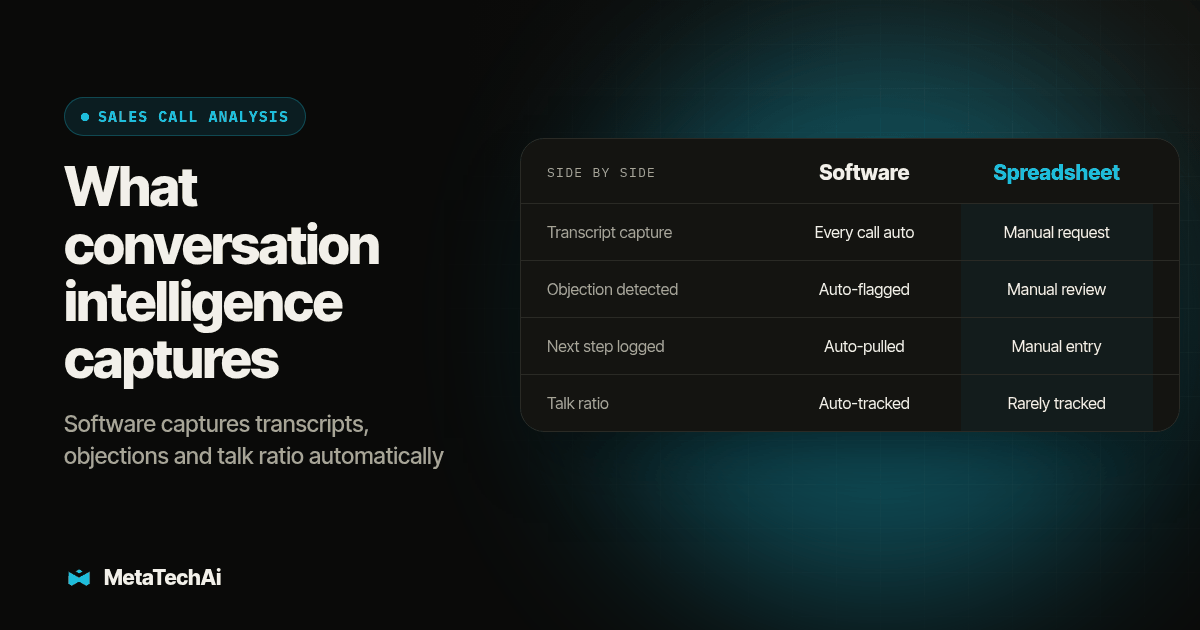
TL;DR: Conversation intelligence software captures transcripts, flags objections and competitor mentions, logs next steps, and measures talk ratio automatically. A manager on a 5 to 15 rep team usually only looks at three or four of those outputs each week anyway, which is exactly what a disciplined spreadsheet and a 30-minute call review can capture by hand. Buy the software when call volume outgrows what one manager can sample manually, not before.
A sales manager asking whether to buy conversation intelligence software is really asking two different questions at once: what does the tool capture, and how much of that capture will anyone actually use. We install AI sales systems for service businesses with sales teams, and the honest answer for a team in the 5 to 15 rep range is that the software captures far more than a manager reviews in a normal week. That gap is the whole buying decision.
What Does Conversation Intelligence Software Actually Capture?
Highspot's rundown of the category describes a tool that "captures, transcribes, and analyzes" sales conversations, pulling out specific signals rather than handing back a plain recording (Highspot). In practice that breaks into five pieces most platforms try to capture on every call:
A full transcript, generated from speech-to-text processing of the recording or live audio feed. Objection and concern flags, triggered when the system recognizes a phrase pattern tied to price, timing, authority or a named competitor. Competitor mentions specifically, called out separately from general objections because a sales leader usually wants to know which rival keeps coming up by name. Talk-time ratio, tracking how much of the call the rep spoke versus the buyer, which Highspot notes gets used to flag when "a seller is dominating the discussion time." And notes, action items and a call summary meant to stand in for a rep's own recap.
For teams running AI voice agents rather than human reps on every call, the same transcript-and-next-step capture happens on the calling side too. RizzDial's breakdown of feeding call transcripts through its MCP connection to Claude and ChatGPT covers that mechanism for voice-agent calls specifically, which is a narrower case than the meeting-and-human-call capture most conversation intelligence platforms are built for.
None of that list is controversial. The harder question, and the one that decides whether a small team should pay for it, is how much of that capture a manager with 5 to 15 reps actually looks at before the next pipeline review.
What Does a Sales Manager Actually Review Each Week?
Here is the gap nobody puts on a pricing page. A platform captures every transcript, every flagged objection and every talk-ratio score on every call, all week long. A manager running a team of eight does not read forty transcripts a week. They look at a short list: calls where the objection-detection flag fired and the deal still stalled, calls with no next step logged at all, and maybe one or two talk-ratio outliers worth a coaching conversation. Everything else in the capture layer sits unread.
We cover what belongs on that short list in detail in our guide to what an AI sales call scorecard should measure: discovery depth, objection handling, next-step commitment and talk ratio, the same four categories a conversation intelligence platform is trying to automate. If you already run live, in-call coaching prompts rather than post-call review, the review habit changes again; our piece on live objection handling during sales calls walks through that narrower, real-time version of the same capture problem.
A manager who already knows which three or four things they check every week is, functionally, running the review a piece of software would automate. The question is whether checking those three or four things by hand, across 5 to 15 reps' calls, still fits inside thirty minutes. For most teams that size, it does, right up until it does not.
How Does Conversation Intelligence Software Compare to a Spreadsheet and a Weekly Call Review?
| What you need | Conversation intelligence software | Spreadsheet plus weekly manual review |
|---|---|---|
| Transcript of every call | Automatic, every call, searchable | Only if someone manually requests or skims a recording |
| Objection detected | Flagged automatically by keyword pattern | Manager notices it live or on a spot-checked listen |
| Next step logged | Pulled from the call automatically into a summary | Manager types it into a spreadsheet column after listening |
| Talk ratio | Measured automatically on every call | Not tracked unless a manager times it by hand, rarely worth doing |
| Setup time | Days to connect; weeks to trust the trigger library | Minutes to build the sheet; no trust-building period needed |
| Where it breaks down | Becomes a second screen nobody opens if nothing writes back to the CRM | Breaks down once call volume exceeds what one person can sample weekly |
| Right fit when | Call volume or rep count has outgrown manual sampling | 5 to 15 reps, a manager who already listens to a sample of calls |
Read the table as a trade, not a verdict. Software captures everything and a human picks what matters from an overwhelming pile. A spreadsheet captures only what a human already decided mattered, which is less data but zero noise. For a small team, less data that a manager actually uses beats more data nobody opens.
At What Team Size Does a Spreadsheet Review Stop Being Enough?
There is not one hard number here, and we would not invent one. What the research on this category does show is a consistent split at roughly the same place. Coverage of small-team conversation intelligence options points to teams of "5 to 20 reps" as the band where a simplified, CRM-adjacent tool fits better than an enterprise platform built for a hundred-person floor (coffee.ai), and separate reporting on enterprise pricing structure describes a seat minimum "typically 15 seats" on at least one major platform, meaning a team smaller than that pays for licenses it will never assign to a person (nimitai.com). Both numbers land in the same neighborhood as the team size where a manual review is still realistic.
The honest signal to watch is not headcount by itself. It is whether one manager can still listen to, or skim the transcript of, a representative sample of each rep's calls every week and catch the three or four things that matter, inside the time they actually have for it. At five reps making a dozen calls a day each, that sample is doable in thirty minutes if the manager knows what to listen for. At fifteen reps running outbound at volume, the same thirty minutes covers a much thinner, less representative slice of the actual call activity, and that is usually the point where the manual process starts missing real problems instead of just taking longer.
How Do You Run a Weekly Call Review Without Buying Software?
Run this process for a month before you decide you need a vendor. It costs nothing but a manager's time, and it forces the same discipline a scoring tool would enforce automatically.
- Pick the same four fields every week. Objection raised (or none), how it was handled, whether a next step with an owner and a date got stated out loud, and a rough talk-ratio call (did the rep dominate, or was it balanced). Write the definitions down before scoring a single call.
- Pull a fixed sample, not a random one. Every rep's strongest call and weakest call from the week, judged by outcome (closed, stalled, lost), plus one call chosen at random so you are not only reviewing the extremes.
- Score it live or from the recording, not from memory. A manager's memory of a call a rep described in the pipeline meeting is not the same as what was actually said.
- Log it in one sheet with one row per call. Columns: rep, date, outcome, objection, next step and date, talk-ratio note, one line of coaching feedback.
- Review the sheet with each rep in a 1:1, not as a group callout. The point is coaching, not a leaderboard; a scorecard used for public ranking before a rep trusts it will get resented, same as it would with software.
- Flag patterns across reps, not single calls. One rep fumbling one objection is a coaching moment. Three reps fumbling the same objection is a messaging problem that needs a better answer written down for the whole team.
- Revisit the four fields monthly. If a field never produces a useful coaching conversation, drop it. If a new pattern keeps showing up in the free-text feedback column, turn it into a fifth tracked field.
Copy this weekly call review template
``` Weekly Call Review Sheet Rep | Date | Outcome | Objection raised | How handled | Next step + date | Talk ratio note | Coaching note
Sample size this week: ___ calls reviewed out of ___ total calls made Pattern across reps this week (if any): ___ Field to add or drop next month: ___ ```
Screenshot: a simple six-column spreadsheet with one filled-in row per call, a conditional-formatting rule highlighting any row where the "next step + date" column is blank in red, so a manager can spot calls with no committed next step at a glance before the weekly 1:1.
When Should You Move From a Spreadsheet to Conversation Intelligence Software?
Three signals tend to show up together when a team outgrows the manual version. Call volume per rep has climbed enough that a representative weekly sample no longer covers a meaningful share of total calls. The manager doing the reviewing has taken on enough additional reps, or enough additional responsibility outside coaching, that the thirty-minute weekly review has quietly become an hour or has quietly stopped happening some weeks. And the spreadsheet itself has started disagreeing with reality, meaning deals the sheet marked as having a solid next step are still stalling at the same rate as deals that did not, which usually means the human scoring has gotten inconsistent across reps or over time.
None of those three signals is about team size alone. A five-rep team making forty calls a day each can outgrow manual review faster than a fifteen-rep team making five calls a day each. Count calls, not just heads, before you decide the spreadsheet has stopped working.
Where Does This Fit Inside a Full AI Infrastructure Build?
A conversation intelligence tool, bought on its own, tends to become exactly the kind of disconnected second screen described above: it captures everything, writes to nowhere a rep already looks, and gets ignored within a month. It works better as one piece of a stack that already has the dialer, the CRM and the manager review cadence wired to the same records. Our AI infrastructure work starts by mapping that full stack first, business tools, data flow and the human approvals that still belong to a person, so a capture layer like this lands inside a system already built to use its output instead of becoming one more login a manager checks for a week and then forgets. If the legal exposure of using any call-scoring output in an actual performance review is the open question, not the capture mechanics, our breakdown of using AI call scores in a performance review covers the disclosure and recordkeeping side of that decision.
What Do Sales Managers Ask About Conversation Intelligence Software?
What does conversation intelligence software cost for a 5 to 15 rep team?
Pricing is not standardized across this category, and most vendors quote by seat count, contract length and how much a buyer pushes back in negotiation, rather than publishing a rate card. Independent pricing breakdowns of the category describe seat minimums well above what a small team needs from some enterprise vendors, while CRM-adjacent tools built for teams under twenty reps skip that minimum entirely (see this 2026 category pricing breakdown: https://nimitai.com/blog/conversation-intelligence-pricing-2026). Get a quote scoped to your actual rep count before you compare two vendors' numbers side by side.
How long does it take to set up conversation intelligence software?
Budget longer than the demo suggests. Connecting the dialer or meeting platform is usually fast, often a day, but building a trigger library tuned to how your buyers actually talk takes real calls to train against, and a manager should check the tool's objection and next-step flags against their own read of a sample of calls before anyone trusts the output. Treat two to four weeks as a realistic window to go from connected to trusted, not from connected to live.
Does conversation intelligence software integrate with the CRM and dialer we already use?
Most tools read from whatever call recording, video meeting or dialer source you already use, so switching your calling platform usually is not required. The part worth confirming before you buy is whether flagged objections, next steps and call summaries write back to the same contact or deal record your reps already work from, rather than sitting in a separate login nobody opens after week one.
Does recording calls for conversation intelligence raise consent issues?
Yes, and that is true whether a human or an AI tool is doing the listening. Recording and monitoring rules vary by state and by the location of each participant on the call, and several states require every party to consent, not just the business initiating it. Confirm the legal basis for recording with qualified counsel before you turn on any capture tool; the Reporters Committee for Freedom of the Press keeps a state-by-state recording guide worth starting from: https://www.rcfp.org/reporters-recording-guide/.
What is the switching cost if we start with a spreadsheet and later move to software?
Lower than people assume, as long as the spreadsheet tracked the same fields a scoring tool would use: the objection raised, whether a next step with an owner and a date got set, and talk ratio if you logged it. A manager who has already been reviewing calls against a consistent set of fields can hand that same rubric to a vendor during a pilot instead of starting from a blank evaluation. The expensive mistake is tracking nothing consistent for a year and then expecting software to retroactively explain why deals died.