
AI Sales Call Scoring: What Should It Measure?
By MetaTechAi ·
TL;DR: AI sales call scoring should measure four things a transcript cannot show on its own: how deep the rep went into discovery, how an objection was actually handled, whether the call ended with a specific next step both sides agreed to, and the talk-to-listen ratio. Score those four, not "did the call happen," and the scorecard becomes a coaching tool instead of a surveillance log.
We get asked about call scoring almost every time a client has already bought a transcription or AI notetaker tool and discovered it does not actually tell them anything. It hands back a clean summary of what was said, sometimes a sentiment tag, and stops there. Nobody on the sales team can look at that summary and say whether the call moved the deal forward or just used up forty minutes. Scoring is the layer that answers that second question, and it only works if you decide, on paper, what "good" looks like before you turn the AI loose on it.
Why Isn't a Transcript Enough to Score a Sales Call?
A transcript or a notetaker summary tells you what happened. It does not tell you whether what happened was useful. A 2026 breakdown of call scorecard tools published by Revenue.io frames the actual evaluation around three things: whether the buyer described the business problem and its real cost, whether the call established who is involved in the decision and what has to happen before one gets made, and whether the parties agreed on a next step with an owner and a timing expectation attached, not just a vague "I'll follow up." None of that shows up in a transcript unless someone, or something, is checking for it on purpose.
Insight7's guide to AI call scoring sorts the work into four buckets: call quality (did the rep follow the process and communicate clearly), customer experience (tone and how the rep responded to concerns), compliance (were required steps completed, which matters most in regulated industries), and agent performance behaviors like discovery, objection handling and talk-to-listen ratio (Insight7). That last bucket, agent performance, is where a service business sales team gets the most coaching value, and it is also the bucket most vendors leave vague because it is harder to automate than a keyword check.
What Should a Service Business Scorecard Actually Measure?
We build scorecards around four categories, and each one needs a plain definition the rep can read before the call, not just after.
The first is discovery depth: did the rep get the buyer to describe the actual problem and what it costs them, or did the rep move to pitching after one surface-level question? Score it 0 if the rep asked zero open questions about the problem, 1 if they got a surface answer and moved on, and 2 if they got the buyer to describe a specific operational impact, such as lost time, lost revenue or a missed deadline, in their own words.
The second is objection handling: did the rep acknowledge the objection and respond to the actual concern, or did they talk past it? Insight7 cites a 21% performance gap in objection handling between agents in an insurance sales analysis, which is a meaningful enough spread that "we handle objections fine" is not something to assume without checking it call by call (Insight7). Score 0 if the objection was ignored or steamrolled, 1 if it was acknowledged but answered generically, and 2 if the rep addressed the specific thing the buyer said.
The third is next-step commitment: did the call end with a named action, a named owner and a date, or did it end with "sounds good, talk soon"? This is the category closest to Revenue.io's third criterion above, and it is the easiest one to score wrong, because reps are good at sounding like they got a commitment. Score 0 for no next step stated, 1 for a next step with no date attached, and 2 for an action, an owner and a date all agreed out loud.
The fourth is talk-to-listen ratio: what share of the call was the rep talking versus the buyer talking? This one is purely mechanical and does not need human judgment the way the other three do, which makes it a good category to let the AI score on its own while a human spot-checks the other three. A rep who talks for most of a discovery call is pitching when they should be listening.
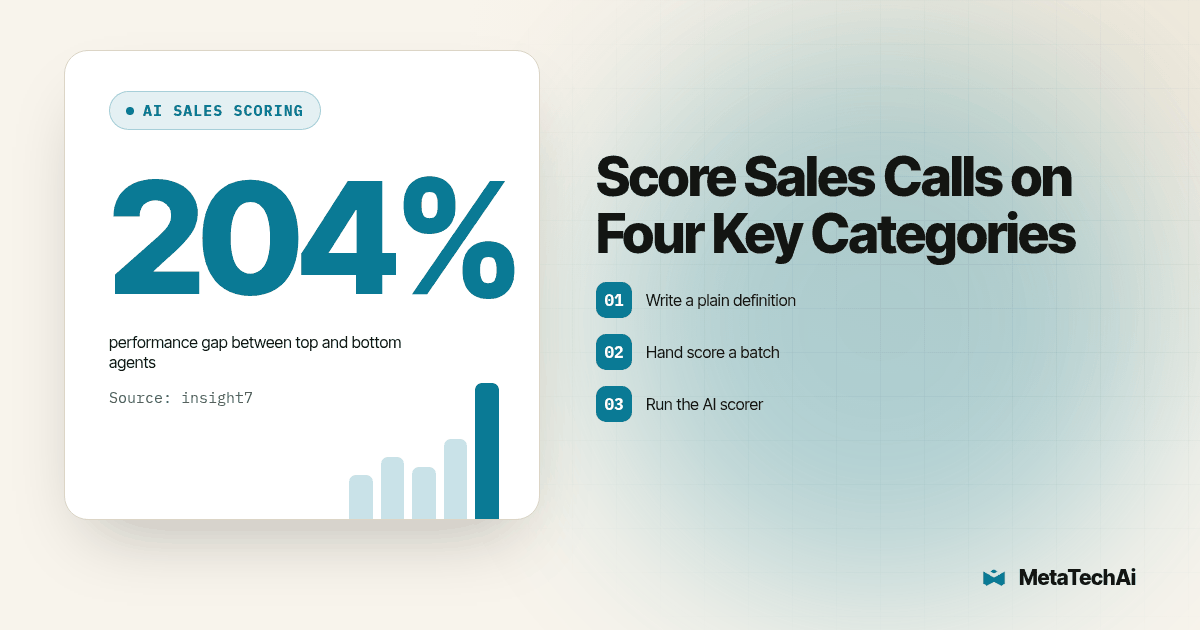
That same Insight7 analysis found a 204% performance gap in funnel execution between top and bottom agents on the same team (Insight7). A gap that size inside one team is the real argument for scoring every call the same way instead of trusting a manager's gut read on who is doing well.
How Do You Roll This Out Without It Becoming Surveillance?
Turning the four category method above into a rollout a team will actually trust comes down to a short sequence:
- Write a plain definition for each of the four scoring categories, describing what a low, partial, and full score looks like, before scoring any real call.
- Hand score a batch of recent calls against those definitions to build a human baseline before the AI runs on anything.
- Run the AI scorer on that same batch and compare its results to the human baseline, resolving any sizable disagreement before trusting it on new calls.
- Launch the scorecard with a single pilot team led by a manager who already gives direct feedback, and let reps see their own scores first.
- Keep scores separate from discipline through one full review cycle, then set a review date before expanding to the next team.
The fastest way to kill a scoring program is to turn it on for the whole team on day one with no explanation, because the first thing a rep hears is "they're watching every call now," not "this is here to help you close more." Tell the team before the tool is live, not after, and explain what the four categories are, why those four and not "everything," and who will see the scores first. Write the 0/1/2 definitions down for each category before you score a single real call; if two managers would score the same call differently, the definition is not specific enough yet.
Hand-score a stack of recent calls yourself first, a few dozen is enough, using those definitions and without AI involved, so you have a human baseline to check the tool against. Then run the AI scorer against that same sample and compare it to your hand-scored baseline. Anywhere the two disagree by more than one point, read the call and figure out which one was right before you trust the tool on new calls.
Pilot on one small team first, not the whole floor, and pick a team that already has a manager who gives direct feedback, so the score has a coach attached to it from day one. Give reps their own scores before managers use them for anything else: a rep should see their own four numbers and the specific moment in the call tied to each one before that score shows up on a leaderboard or a review.
Keep scoring separate from discipline for the first full review cycle. Use the pilot period to tune the categories, not to write anyone up, since a score used for correction before it has been validated will get contested, and rightly so. Set a fixed review date, not an open-ended "we'll keep an eye on it," and decide in advance when the pilot team's manager and the rep will sit down and look at the trend together. Once that cycle is done, expand team by team, repeating the definition check and the hand-scored baseline comparison for any category you add later. A scorecard that only ever gets bigger without ever getting re-checked drifts away from what it was built to measure.
Before the first score goes live, your rollout doc should be able to confirm that each step above actually happened: the categories and 0/1/2 definitions are written and shared with the team, a stack of recent calls has been hand-scored by a manager as a baseline, the AI scores have been checked against that baseline with any disagreements reviewed, a single pilot team has been selected rather than the whole floor, reps can see their own scores before anyone else uses them, scoring is kept separate from discipline through the first review cycle, a fixed review date is set with the pilot manager and reps, and an expansion plan exists for team two that repeats the same baseline check.
Diagram: a horizontal scorecard mockup for one call showing four rows (Discovery Depth, Objection Handling, Next-Step Commitment, Talk-to-Listen Ratio), each with a 0/1/2 score, a one-line quote pulled from the transcript as evidence for that score, and a timestamp link back to the moment in the recording.
We build this exact setup as part of our managed services work: we configure the categories against your actual sales process, run the hand-scored baseline check with your sales manager, and keep tuning the definitions after launch instead of handing you a dashboard and walking away.
How Does This Compare to Whisper Coaching and Lead Scoring?
Service businesses often already run one or both of the other two AI layers in this space, and it helps to know where each one stops doing its job and the next one starts.
| Tool | When it runs | What it measures | What it's for | Risk if misused |
|---|---|---|---|---|
| Post-call scorecard (this article) | After the call ends | Discovery depth, objection handling, next-step commitment, talk-to-listen ratio | Coaching trend over time across a whole team | Used for discipline before the scoring is validated against a human baseline |
| Whisper / live call coaching | During the live call | Pricing, financing and objection prompts tied to the moment they're needed | In-call nudges for a rep who is about to miss a step | Generic or mistimed prompts the rep learns to tune out |
| AI lead scoring | Before the call, on the record itself | Fit and likelihood to convert based on lead data | Deciding which leads a rep calls first | Trusted without checking the data quality or the explanation behind the number |
These are not competing tools, they are sequential ones. Lead scoring decides who gets called. Whisper coaching helps the rep during that call. The scorecard looks back at the call afterward and tells you whether the pattern on that call is a one-off or something the rep does every time. We cover the live-coaching layer in our guide to real-time AI call coaching and the lead-scoring layer in our breakdown of what to verify before trusting an AI lead score. Both of those pieces run into the same underlying problem this one does: a number without a visible reason attached does not earn a rep's trust, and it should not earn yours either.
A scorecard also only tells you what happened on calls that actually got recorded and scored, which is a smaller set than every call your team makes. If you are trying to figure out why a specific deal died and the scorecard shows a clean call, that gap is usually a lost-deal reason the CRM never captured accurately. We wrote a full workflow for separating a verified lost-deal reason from a guess in our guide to evidence-based lost-deal coaching, and it pairs directly with the scorecard above: the scorecard tells you how the call went, the lost-deal worksheet tells you why the deal didn't.
Where Does Call Recording Consent Fit Into This?
None of the four categories above can be scored without a recording or a transcript to score against, which means the consent question comes before the scoring question, not after. Recording rules differ by state, and several require every party on the call to consent, not just the business side initiating it. RizzDial, the AI calling platform from MetaTechAi, covers the state-by-state consent requirements for AI sales calls specifically in its guide to call recording consent, which is worth reading before you finalize which calls go into your scoring pilot, especially if your team calls across multiple states.
What Else Do Service Business Owners Ask About Call Scoring?
How long does it take to set up an AI call scorecard for a service business sales team?
Budget two to three weeks for a real pilot, not a weekend. Week one is picking the four categories and writing down what a 0, 1 and 2 look like for each. Week two is scoring a sample of recent calls by hand and checking that against what the AI produces. Week three is running the live pilot with one small team before anyone else sees a score.
Does call scoring work with the CRM and dialer we already use, or do we need to switch tools?
Most call-scoring layers read from whatever recording or transcript source you already have, so the dialer or voice platform usually stays the same. The CRM side needs one thing confirmed before launch: that call outcomes, next steps and pipeline stage changes write back to the same record the score is attached to, otherwise the score sits in a separate tool nobody checks.
Is AI call scoring affected by call recording consent laws?
Yes, because a scorecard needs a recording or a transcript to run against, and consent rules for that recording do not change because AI is doing the scoring instead of a manager. Several states require all parties to consent to a recorded call, not just one, so confirm your recording basis before you build a scoring program on top of it. See our breakdown of call recording consent requirements for AI sales calls.
How much does AI call scoring cost, and is it a separate line item from what we already pay for?
It depends on whether you are buying a standalone scoring tool or building scoring into a system you already run, which changes the number enough that we will not quote a figure here. Talk to our team and we will size it against your current stack instead of guessing at a price that does not match your setup.