
Can You Use AI Call Scores in a Performance Review?
By MetaTechAi ·
TL;DR: Yes, AI call scores can inform a performance review, but using them does not remove an employer's duties to prevent discrimination, give any required notice and preserve relevant records. Requirements depend on the employee's location, the tool and the decision it influences. Treat the score as reviewable evidence, with a documented human decision, rather than automatic grounds for discipline.
A sales manager may buy a call-scoring tool for coaching and then realize a score is about to enter a formal review cycle. That change matters: the same output now influences someone's employment record. This guide compares selected rules as of October 24, 2026 and gives a rollout procedure for a service business sales team. Use it to prepare an employment-counsel review, not as a legal determination that your particular use is permitted.
Why Isn't "We Already Disclosed We Use AI Tools" Enough Cover?
A general handbook sentence saying the company "may use AI and other technology tools" does not establish that every later use meets applicable notice requirements. Illinois's Human Rights Act amendment, effective January 1, 2026, prohibits discriminatory AI use in covered employment decisions and separately requires employee notice (Crowell & Moring, Illinois AI employment update). The practical question is whether your notice and actual workflow address the use at issue. A dated, specific explanation helps employees understand when a coaching score also becomes review evidence.
The other reason a blanket disclosure fails is that it does not create a record. If a rep later disputes a review, "we told everyone in 2023 that we might use AI someday" is a weak answer next to a dated notice naming the specific scoring tool, what it measures and when that notice went out. Build the record at rollout, while it's easy, not after a dispute makes you reconstruct it.
Which States Require Disclosure Before an AI Score Can Factor Into a Review?
Notice, discrimination and retention duties are separate questions. This comparison covers selected state and local rules, rather than every employment or privacy obligation that could apply to your team.
| Jurisdiction | Rule | Status | What to check before using a score in a review |
|---|---|---|---|
| Illinois | Human Rights Act amendment, HB 3773 | Effective January 1, 2026 | Employee notice and prohibition on discriminatory AI use in covered employment decisions; confirm current implementing rules (Crowell & Moring) |
| California | FEHA automated decision system regulations | Effective October 1, 2025 | Antidiscrimination protections and at least four-year retention of covered employment records, including automated-decision data; these regulations do not establish the general tool-specific notice described in some summaries (California CRD) |
| Texas | Responsible Artificial Intelligence Governance Act, HB 149 | Effective January 1, 2026 | Prohibits AI developed or deployed with intent to unlawfully discriminate; does not create a general private-employer AI review notice duty. Attorney general enforcement includes a 60-day opportunity to cure (enacted text) |
| Colorado | SB26-189, replacing the earlier AI Act framework | Substantive requirements begin January 1, 2027 | Covered technology materially influencing consequential employment decisions brings notice, adverse-outcome explanation and human-review requirements; check definitions and exemptions (Colorado General Assembly) |
| New York City | Local Law 144 | Enforcement began July 5, 2023 | Covered hiring and promotion tools require a recent independent bias audit, published audit information and notice. This is not a general discipline or discharge rule (NYC DCWP) |
Read that table as a scoping aid, not clearance to proceed. Have counsel identify all applicable rules for each worker and decision; location alone may not settle coverage, and a missing state does not mean there is no exposure. Our MetaTechAi piece on state AI disclosure laws for sales chatbots covers a related but separate set of consumer-facing rules about whether AI must identify itself to a buyer. Employment-side rules protect the employee being assessed, not simply the customer on the other end of the call.
What Exactly Has to Be Disclosed, and to Whom?
Separate a useful notice template from a statutory requirement. As an operating practice, describe the tool, its purpose, the recordings or transcripts it uses, the decisions it may inform and a contact for questions. California's cited FEHA regulations address discrimination and records; they do not impose this general notice template or a retroactive AI notice requirement. Other privacy obligations need their own assessment. Illinois delegates notice details to rulemaking, and its proposed rules were postponed in June 2026 (Seyfarth, rulemaking update). Verify the current rule status before deciding the required wording or timing.
For your internal rollout, identify every rep whose calls will be scored and explain the intended use before scores enter formal reviews. Keep proof of delivery. Revisit that explanation when changing vendors, adding categories or extending coaching into discipline. These are recommended controls, not a claim that every jurisdiction requires identical recipients, timing or a new notice for every configuration change. Confirm legally required notices separately, including any specific hiring or promotion requirements when the same tool serves multiple purposes.
How Long Do You Have to Keep the Records?
California requires covered employment records, including automated-decision data, to be retained for at least four years (California CRD). Have counsel set a retention schedule that also accounts for other applicable rules and any pending dispute. Four years is not a universal limit or a rule that every business should apply to every recording. Keep the evidence required for a decision while addressing access restrictions, privacy obligations and deletion rules for data that no longer needs to be retained.
What to actually keep: the version of the notice each employee received and the date it went out, the scoring categories and their definitions as they existed at that time, the AI-generated score and the human reviewer's decision for any review that used it, and a record of any dispute or correction a rep raised. A dashboard snapshot from the vendor's app is not a record if the vendor's retention period is shorter than yours or if your contract ends and the data goes with it; export what you need to keep into your own system before you need it.
Where Do AI Call-Scoring Vendors Still Leave a Business Exposed?
Buying a compliant-sounding tool does not transfer the legal duty to the vendor. A few specific gaps show up often enough to check for by name.
First, inspect how the vendor contract allocates responsibilities for notice, testing, exports and employee requests. Buying a tool does not remove your obligations as the employer making the decision. A marketing statement about "compliant AI" is not enough to establish that your particular review process meets them.
Second, compare vendor retention with your required retention schedule. For example, if a dashboard only retains recent scores, establish a secure export process before older evidence disappears. Test that an exported record can still be connected to the employee, rubric version, underlying evidence and final human decision after your vendor account closes.
Third, "bias tested" in a sales deck is not proof of the independent audit required for a covered NYC hiring or promotion tool. Ask for the audit itself, its date, scope and applicability. Do not assume Colorado's superseded high-risk AI impact-assessment framework describes SB26-189. Use the enacted framework linked in the table to scope that state's obligations.
Fourth, ask how the vendor communicates scoring changes. If an update reweights "objection handling" or "talk-to-listen ratio," your explanation to employees and human baseline may need review. Record the version used for each consequential decision. We cover the baseline-comparison step separately in our guide to what an AI call scorecard should actually measure.
What's the Compliance Checklist Before a Score Can Factor Into a Review or Discipline Decision?
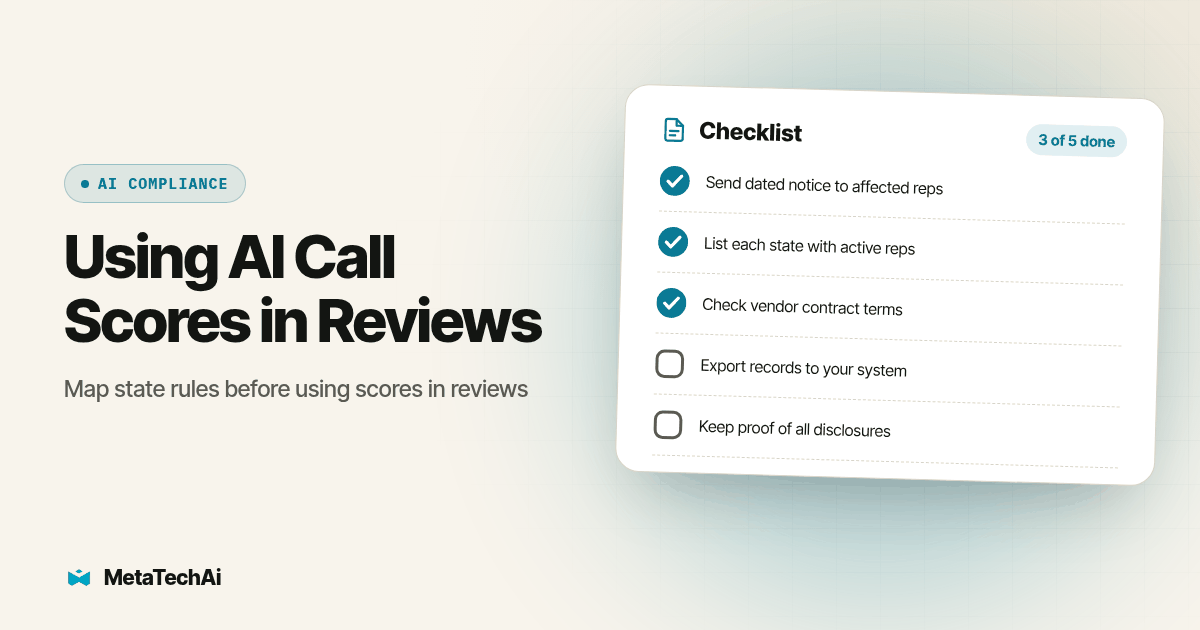
Run this original rollout procedure before an AI score enters a formal review. It combines legal scoping with recommended operating controls; it is not a substitute for checking the rules applicable to your business:
- List every state where a scored rep actually works, not just where your company is registered. Remote and hybrid sales teams mean this is rarely just your headquarters state.
- Have counsel map each location and decision to applicable rules using the table above as a starting point, and flag any rep location with a disclosure duty, a discrimination standard, or both.
- Prepare a clear notice for legal review, naming the tool, its general purpose, the data it collects and the decisions it feeds, even for reps in states with a lighter rule. Use jurisdiction-specific additions where required; do not assume one template satisfies every rule.
- Send the notice before the tool starts affecting a formal decision, not after a rep is already reviewed under it, and date-stamp the delivery.
- Document the business reason the score factors into the review, tied to the job's actual requirements, so the decision is defensible as job-related rather than an unexplained number.
- Set a documented appeal step a rep can use to flag a disputed score before it's finalized in a review file.
- Confirm your retention plan covers the notice, score, decision and any dispute for the applicable period, exported from the vendor's system into your own if the vendor's own retention is shorter.
- Re-run this checklist any time you change vendors, add a scoring category, or extend the tool from coaching-only use into formal reviews or discipline.
Before signing off, run a dry review with a recorded call you are authorized to use. Have a manager score it without seeing the AI result, then compare the two explanations against the same rubric. Correct a deliberately inaccurate transcript in a test copy and verify that the dispute process preserves both the original score and the correction. Confirm that a manager can exclude the score without losing the audit trail. Record failures and rerun the affected checks before authorizing review use. This tests your workflow; it does not establish that the model is free of discriminatory effects.
Copy-paste starting point for the written notice itself, to adapt with your own tool name and legal review:
We use [tool name], an AI-based call scoring system, to evaluate recorded sales calls. It measures [list categories, e.g., discovery depth, objection handling, next-step commitment, talk-to-listen ratio] based on call recordings and transcripts. Scores from this tool may factor into performance reviews and related employment decisions. You can request more information about how this tool works and what data it uses by contacting [named contact/role].
Rollout decision: Map the rep's work location and decision, confirm applicable rules, document required notice and checks, then authorize review use. If a required step is missing, hold the score out of the formal decision until the gap is resolved.
This is the same discipline we lay out in our broader AI governance framework for a service sales team: name the tool, name the owner, write down the rule it has to follow, and set a trigger for when the checklist runs again. A call-scoring rollout is one specific case of that framework, not a separate program.
How Does Call Recording Consent Fit Into This?
None of the disclosure or recordkeeping steps above matter if the underlying recording was never lawfully made in the first place. A call score needs a recording or transcript to run against, and several states require consent from every party on the call, not just the business side that started it. RizzDial, the AI calling platform from MetaTechAi, covers the state-by-state consent requirements for AI sales calls in its guide to call recording consent, which is worth checking before you finalize which recorded calls feed your scoring program, especially if your reps call across state lines. Consent is the step before the notice step above, not a substitute for it.
What Else Do Service Business Sales Managers Ask About This?
Does this only apply if we use the AI score to fire someone, or does coaching count too?
The relevant rules can cover employment decisions beyond termination. Illinois's amended Human Rights Act covers promotion, discharge and the general terms and conditions of employment, and California's regulations apply to any automated decision system that helps make a decision about an employee, including performance evaluation and promotion recommendations. If you only ever use the score for private, informal coaching conversations that never touch a formal review, a file, or a pay or role decision, you are in a narrower and lower-risk category, but write that limitation down and keep it true in practice, not just on paper.
We're already using AI call scores today. How fast do we need to get compliant?
Review your current use now against the effective dates and scope in the table. Illinois and Texas provisions are already effective, as are California's cited regulations. California's FEHA rules do not create the general retroactive AI notice requirement sometimes attributed to them. Texas has a statutory cure process for enforcement, but that is not permission to postpone compliance. Document gaps and agree on corrective steps with counsel before the next review cycle.
If we switch AI call-scoring vendors, does that reset our compliance work?
Partly. A new vendor calls for reassessing notice requirements and updating employee information if the tool, purpose or data use changes, a new entry in your AI inventory, and a fresh comparison between the new tool's output and your human baseline before you trust it on live reviews. It does not reset your record-retention clock for scores and decisions already made under the old vendor; keep those records for the full retention period regardless of which tool produced them.
Can a sales rep dispute an AI-generated call score before it goes in their file?
Build in a dispute step even where a law does not strictly require one. Colorado's framework gives workers a path to an explanation and a human review of a consequential decision once its substantive provisions are in force, and giving a rep a chance to flag a scoring error before it affects a review protects you from a defensible complaint turning into a documented pattern. A short, written appeal process, reviewed by a manager within a set number of business days, is cheap insurance against a much more expensive dispute later.
Does MetaTechAi's conversions-up-or-you-don't-pay guarantee cover this legal risk?
No. The guarantee is about sales conversion outcomes from the systems we build and run. Compliance review for employment-law disclosure, record-keeping and discrimination risk is a separate scope item that belongs in your engagement terms and, where the stakes are real, in front of your own employment counsel. MetaTechAi installs AI sales and marketing systems for service businesses with sales teams. Any implementation documentation should follow requirements agreed with your employment counsel; the conversion guarantee is not a legal compliance guarantee. If your sales system needs this kind of review before it goes further, talk to our managed services team and we'll scope it alongside the rest of the rollout.