
Should Reps Keep Commission on AI-Booked Meetings?
By MetaTechAi ·
Don't cut a closer's commission when an AI system books the meeting instead of a human. Reps who believe an AI-sourced meeting pays less will quietly stop working those meetings, which breaks the system before it has a chance to prove itself. Pay the closer the normal rate and fund the AI layer from the SDR or lead-generation budget, or a team bonus tied to a conversion lift, not from an individual rep's paycheck.
A service business rolling out an AI appointment-setting or missed-call-back system may ask the same question a few weeks in: does the rep still get full credit when AI, not a person, put the meeting on the calendar? The honest answer is yes, keep the commission the same, and solve the funding question somewhere else entirely. MetaTech installs AI sales and marketing systems for service businesses with sales teams. A rollout plan should account for rep incentives as well as the technology: a calendar full of meetings is useful only if people are willing and able to work them.
Should a rep's commission change when AI books the appointment?
No. Treat an AI-booked meeting the same as a meeting a human SDR booked, a meeting that came from a referral, or a meeting a rep hunted down themselves: if the closer shows up and closes it, they get the commission the plan already promises them. The source of the meeting is a lead-generation detail, not a reason to pay the closer less for doing the same closing work.
This matters more than it sounds like it should, because reps notice fast when a new lead type pays differently, even informally. If a manager hints that AI-booked meetings are "lower effort" or "cheaper leads," some reps will hear that as a signal the company expects to pay less for them eventually, and they adjust their behavior before any policy change is ever announced.
Why do reps quietly stop working AI-booked meetings if they think the payout is smaller?
Reps protect their time the same way any commissioned worker does: by routing effort toward whatever they believe pays the most per hour. If a rep suspects an AI-booked meeting carries a lower commission, or might in the future, the rational response is to under-prepare for it, show up late, or push it to the bottom of the call list in favor of a meeting they're sure pays full rate.
That concern deserves a written answer. SalesCookie's discussion of commission trust describes disputes over ownership, split credit and ambiguous plans. It is vendor guidance about compensation operations, not a controlled test of commission cuts on AI-booked meetings. The useful lesson for this rollout is to remove ambiguity before the first appointment reaches a closer.
SyncGTM's compensation guide discusses pay for sales roles in the AI market. Those roles are not equivalent to service-business reps receiving AI-booked appointments, so its benchmarks do not establish what your team should earn. Decide your rule from the work your closer still performs: understanding the customer, checking fit, preparing a proposal and earning the sale.
The underlying incentive question also appears in a sales-team owner's discussion about appointment-setter compensation. The owner asks how to reward setters for qualified opportunities when they do not close deals. That is direct evidence of a buyer concern about separating booking from closing, not proof of an AI compensation consensus or a search-volume estimate.
Where should the money for the AI layer actually come from?
Fund it like you'd fund any other lead-generation cost, not like a tax on the closer. An AI appointment-setting or missed-call-back system is doing SDR-style work: qualifying, following up, getting a time on the calendar. Most service businesses already have a budget line for that kind of work, whether it's an SDR's salary, an ads budget, or a vendor for live transfers. The AI layer belongs in that same bucket.
| Funding source | What it signals to the rep | Fits well when | Watch for |
|---|---|---|---|
| Cut from the closer's own commission | "AI is competing with me for my paycheck" | Almost never a good default | Risk that reps deprioritize AI-booked meetings |
| New SDR or lead-generation budget line | "AI replaced or extended an SDR, not me" | Businesses adding AI booking as a net-new lead source | Needs its own line item so it doesn't get raided to cover other costs |
| Team-wide bonus pool tied to a measured conversion lift | "We all do better when the system works" | Teams of three or more reps sharing a pipeline | Needs an agreed, auditable conversion number before the bonus pays out, see our guidance on proving an AI sales system raised conversions |
Keep two separate records: the lead-generation budget pays for appointment setting, while the existing commission plan determines what the closer earns on an eligible closed deal. Reconcile both against the same CRM opportunity without deducting the tool cost from that rep's payout.
If the AI layer you're rolling out is a voice agent or a missed-call-back system that answers and qualifies inbound calls, the setup decisions you make there (what it's allowed to promise, when it hands off to a human) shape how reps experience the handoff. RizzDial's guide to buying and launching an AI receptionist walks through those decisions for a team adding that kind of system for the first time (RizzDial, AI receptionist buying and launch guide).
How do you build a commission policy reps will actually trust?
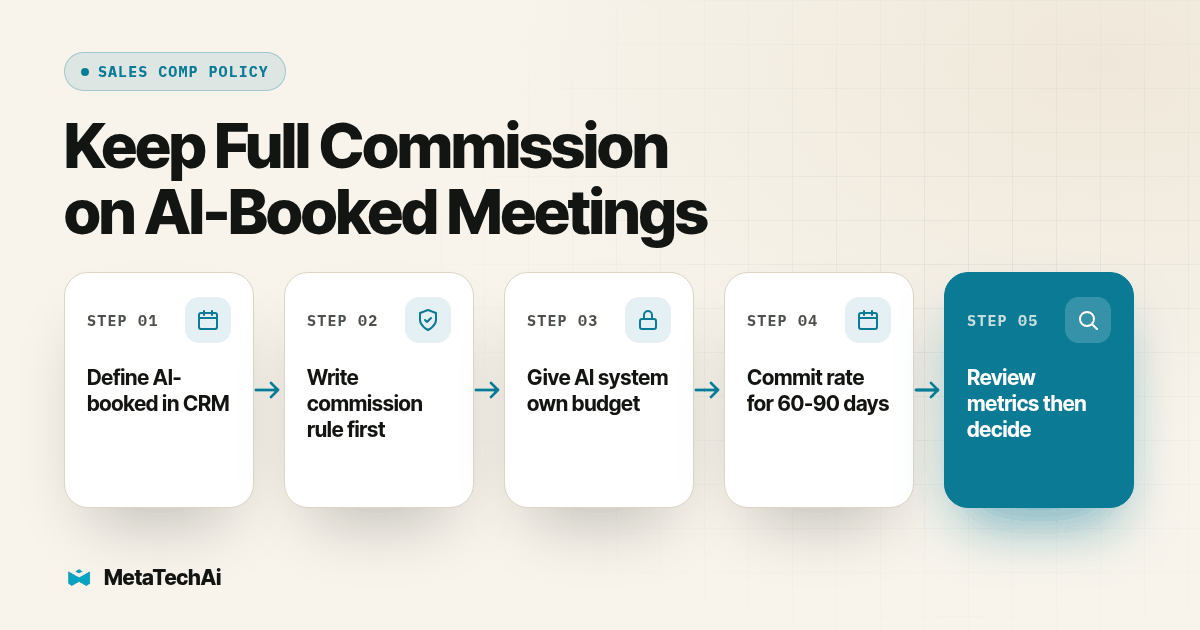
Use this sequence before the first AI-booked meeting reaches a rep's calendar, not after the first dispute.
- Write down what counts as "AI-booked" in your own CRM.
Define it precisely: did the AI set the exact appointment time, did it only qualify the lead before a human booked the slot, or did it just answer a missed call and hand off? Different systems earn different labels. If you can't point to a field or a tag that marks a meeting as AI-booked, you don't have a policy, you have a guess every time someone asks.
- Decide the commission rule in writing before rollout, not during the first dispute.
Put one sentence in the comp plan: "A meeting qualifies for full commission regardless of whether a human or an AI system booked it, when it meets the existing plan's closed-deal and payment conditions." Circulate it to the whole team before the AI goes live, not after the first closer asks why a meeting on their calendar feels different.
- Separate the AI layer's cost from the commission pool entirely.
Give the AI system its own budget line, as described above, and say so out loud to the team. Reps are less likely to assume a hidden rate cut is coming if they've already been told where the money for the tool comes from.
- Hold the rate for a defined trial window.
Pick 60 to 90 days and commit, in writing, not to touch rep pay during that window no matter what the early results show. A policy that can change the moment the numbers look good or bad isn't a policy reps will plan their effort around.
- Give reps a way to flag a bad AI-booked meeting without losing pay over it.
Some AI-booked meetings will be low quality: a mismatched need, a bad time slot, a lead that wasn't ready. Let reps mark those honestly in the CRM without worrying it will be read as laziness. Keep meeting-quality feedback separate from commission eligibility. Paying commission on closed deals does not require penalizing a rep for reporting an unsuitable appointment; otherwise, you risk encouraging cherry-picking, something we cover in more depth in our guide to getting reps to keep using an AI sales system after launch.
- Review real numbers at the end of the trial window, then decide.
Look at show rates, close rates and rep feedback for AI-booked meetings against every other source. Change the policy only with that evidence in hand, and only after talking to the reps who worked those meetings, not just the dashboard.
What does a one-page commission policy memo look like?
Use this as a starting template. Fill in the brackets, keep it to one page, and send it to every closer before the AI system starts booking meetings.
AI-Booked Meeting Commission Policy, [Company Name], effective [date]
- Scope: This policy covers meetings booked by [name of AI system/tool] between [start date] and [review date, 60 to 90 days out].
- Commission rule: A closer earns the same commission on an AI-booked meeting as on any other eligible closed deal, calculated under the existing comp plan with no separate rate.
- Funding: The cost of the AI system is paid from [SDR budget / lead-generation budget / team bonus pool], not from any individual rep's commission.
- Tracking: Meetings booked by the AI system are tagged [field/tag name] in [CRM name] so results can be reviewed separately from other sources.
- Flagging low-quality meetings: A rep may mark an AI-booked meeting as mismatched or low quality in [CRM field] without it counting against them.
- Review date: On [date], we will review show rate, close rate and rep feedback for AI-booked meetings against all other sources, and any policy change will be communicated at least [X] days in advance.
- Who approved this: [Owner/sales manager name and title]
What do owners get wrong when AI starts booking meetings?
One mistake is going quiet instead of writing anything down. An owner installs the AI system, watches the calendar fill up, and never actually tells the sales team what it means for pay. Reps fill that silence with their own assumption, usually the worst-case one, and by the time the owner notices reps are skipping AI-booked meetings, the trust gap is already open.
Another is treating the AI system like it talks to customers the way a rep does, without first deciding what it's allowed to say and do on its own. That decision belongs upstream of the commission question: a system that promises something a closer then has to walk back on the call will poison a rep's willingness to trust any meeting it books, no matter how commission is structured. Our breakdown of where an AI sales agent should stop and hand off to a rep is the place to settle that before the commission memo goes out.
A third mistake is moving too slowly on response time once the AI starts generating more booked meetings than the team expected. A faster top of funnel doesn't help if the meetings sit un-worked because nobody adjusted staffing or routing for the new volume; see our guide on how fast a sales team should answer an inbound lead for the response-time side of that problem.
How does commission policy connect to a guarantee that conversions go up or you don't pay?
Commission policy is not a side issue to an AI sales rollout, it's one of the load-bearing pieces. A guarantee tied to conversions only means something if the people closing the deals are actually working every meeting the system produces at full effort, and that only happens if they trust the pay stays the same regardless of where the meeting came from. Include that trust in the rollout plan for managed AI sales and marketing services, because a conversion guarantee that the sales team quietly works around isn't a guarantee anyone can measure. If you're weighing whether to change comp plans before or after a launch, that's a conversation worth having with us directly through managed AI sales services before the first AI-booked meeting ever reaches a closer's calendar.
What do owners ask about paying reps on AI-booked appointments?
Will AI-booked meetings quietly cut my top rep's commission?
Not if you want that rep to actually show up prepared. The practical rule is to pay the closer's normal, full commission on an AI-booked meeting, the same as on any other meeting that reaches a closed deal, and fund the AI layer from somewhere other than that commission.
Where should the budget for an AI booking or missed-call-back system come from if not the rep's commission?
Treat it as a lead-generation cost, the same bucket you'd use for an SDR, an ads budget or a call center vendor, or fund it from a team bonus pool tied to a conversion lift everyone can see. Either way, it should not come out of an individual closer's payout.
Do SDRs and closers need different rules for AI-booked meetings?
Usually yes. A closer's commission structure should stay untouched because the AI is replacing or extending SDR-style prospecting work, not the closer's selling work, so the conversation about commission belongs on the SDR side of the house, not the closer's.
How long should we run a new AI commission policy before locking it in?
Give it a defined trial window, 60 to 90 days is a reasonable starting point, and commit in writing not to change rep pay during that window no matter what the early numbers look like, so reps have a real reason to trust the test.