
Should AI Set the Price on a Service Quote, or Draft It?
By MetaTechAi ·
Let AI calculate and draft a service quote from approved rates and scope, then require a named person to confirm it before sending. Human review should check the inputs, discounts and current quote version. The procedure below is a recommended control for service sales teams, not a claim that every quote needs the same review time.
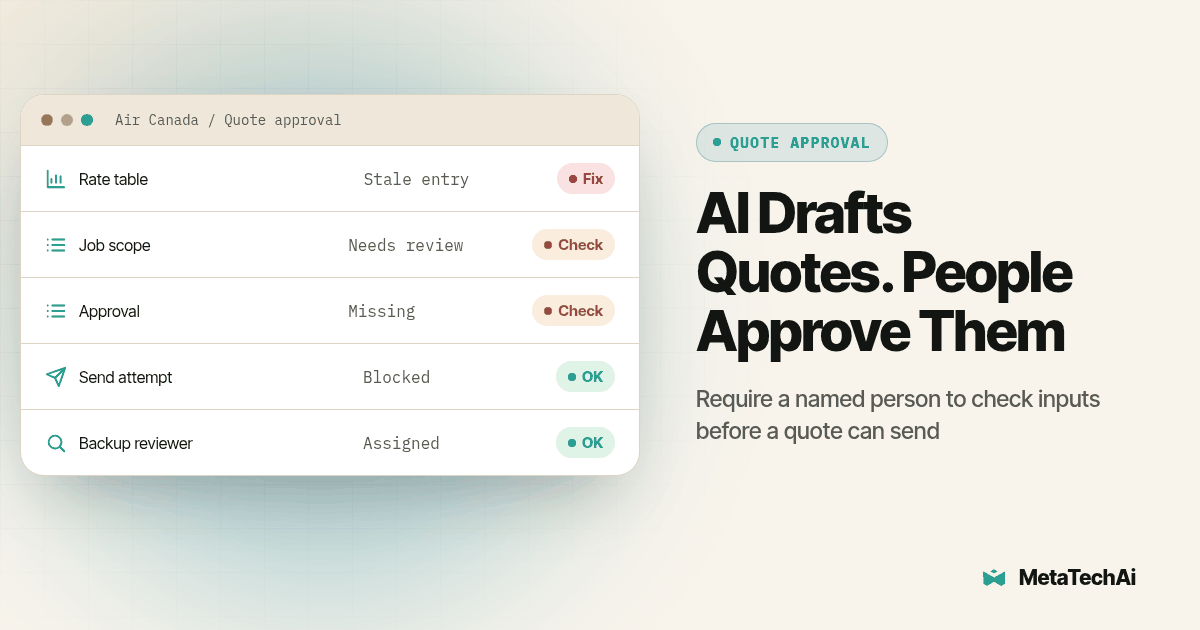
A service business whose AI sales system already drafts quotes has a practical decision to make: who is authorized to release the number? A plausible draft can still use the wrong scope or outdated rules. Set a clear boundary: AI prepares the calculation, and a named person checks the evidence before the quote reaches a customer.
What Actually Happened in the Air Canada Chatbot Case?
In late 2022, a customer asked Air Canada's website chatbot about bereavement fares after a family death. The chatbot told him he could book a full fare ticket and apply for a bereavement discount retroactively within 90 days. That answer was wrong. Air Canada's actual policy required the bereavement request before travel, not after. The customer relied on the chatbot's answer, booked the flight, and was later denied the refund.
Air Canada argued the chatbot was "a separate legal entity responsible for its own actions." The British Columbia Civil Resolution Tribunal rejected that argument outright and held Air Canada liable for the chatbot's statement, ordering damages (Moffatt v. Air Canada, 2024 BCCRT 149, CanLII). The tribunal's reasoning was simple: a company's website, whether a static page or an interactive chatbot, is still the company's representation to the customer. The American Bar Association analysis explains the finding of negligent misrepresentation and the importance of controls over customer-facing information.
That case was about a stated policy, not a calculated service price, so it does not establish a universal rule for service quotes. Our operational inference is narrower: check customer-facing representations before release. Whether a particular quote creates legal obligations depends on the facts and applicable law.
Why Does This Matter More for a Price Than for Most Other AI Output?
A price is the one line on a quote a customer acts on immediately. They sign, they tell a spouse, they compare it to a competitor's number, and they may plan the work around that quoted amount. An AI-drafted first paragraph in a follow-up email is reversible with an apology. An AI-set price that was wrong is a conversation about who pays the difference, and in the worst case, a dispute that looks a lot like the one Air Canada lost.
We see three ways a drafted price goes wrong before a person checks it:
- Stale rate table. The AI pulled last quarter's pricing or missed a rate change that went into the system two days ago.
- Scope mismatch. The AI priced the job description in the CRM, which does not match what the rep actually saw on site, like unexpected access issues or a larger square footage.
- Unauthorized discount stacking. The AI applied a referral discount and a seasonal promo together when your rules only allow one, because nothing in its rules said they were exclusive.
A reviewer with current job information can check each of these problems before release. Automated validation can also flag missing fields and conflicting rules, but it cannot establish that an unverified site observation is correct. Give the reviewer evidence beyond the draft total.
What Boundary Should a Service Business Set Between AI and a Person?
Here is the rule we recommend putting in writing: AI calculates and drafts the price from the service rules; a named person signs off before it is sent. Three parts make that boundary work in practice, not just on paper.
- AI owns the math, not the judgment call. It pulls the current rate table, applies the written discount rules in order, and produces a draft number with the inputs it used shown alongside it, not just the final figure.
- One named person owns the sign off, by role, not by inbox. A shared queue that three people assume someone else is watching is not a sign off step; it is where quotes go to die. The sign off owner is usually the sales rep who ran the visit, with a manager as the named backup.
- The sign off has a stated turnaround. Set a measured turnaround target: the approver gets paged the moment a draft is ready, glances at the inputs against what they saw on site, and taps confirm or corrects it. If your current workflow cannot hit that, the turnaround is the thing to fix before you blame the sign off step itself.
How Do You Set Up and Test This Sign Off Step?
Here is an original procedure to test before an AI-drafted quote goes live, written so your team can copy it directly.
- Write down which fields the AI is allowed to calculate. List the exact inputs: rate table version, labor hours, materials, applicable discount codes. Anything outside that list should block the draft from auto-generating, not guess.
- Name the sign off owner and a backup, by role. Put both names in the workflow configuration, not in a policy document nobody opens. The backup exists because the primary approver is not reachable every time a quote is ready.
- Set the approver's turnaround target in writing. State it in minutes for in-person and phone quotes, same business day for asynchronous ones. A target that is never written down never gets measured.
- Build the alert that pages the approver the moment a draft is ready. A draft sitting in a queue with no alert is the same as no sign off step at all.
- Require the approver to see the AI's inputs, not just its output. Show the rate table version, the scope it priced, and any discounts it applied, side by side with the final number, so the approver is checking the math, not just trusting the total.
- Run a deliberate test before launch. Feed the system a known bad input, like a stale rate table entry or a scope that does not match a sample job, and confirm the approver actually catches it before the quote can send. If the test quote goes out anyway, the sign off step is decorative, not real.
- Log every sign off decision with a timestamp. Record who confirmed or corrected each quote and what, if anything, they changed. That log is what lets you measure whether the step is actually catching errors, and it is your evidence if a customer ever disputes a price later. Keep the test isolated from customer delivery. Use a sample job and a test recipient, then attempt to send while approval is missing. The expected result is a blocked send with a visible reason and an assigned owner. Repeat after changing the scope on an already approved draft: the earlier approval must not authorize the changed document.
Test the backup path too. Make the primary reviewer unavailable and verify that the backup receives the same inputs and current version. Record expected and actual results for each attempt. If an alert fails or a changed quote can bypass review, pause that path until the team fixes it and repeats the test. These are acceptance criteria, not reported performance results.
- Review the log monthly for patterns. If one rep is correcting the AI's draft on the same type of job every time, that is a rule in the AI's math that needs fixing, not a rep problem.
For the approval screen, show the drafted price beside the rate table version, scope and applied discount codes. Label the actions "Confirm and send" and "Edit before sending," and display the named approver. This is a suggested screen layout, not a screenshot of a shipped feature.
Who Should Own the Price on Different Kinds of Quotes?
Not every quote carries the same risk, and the right amount of human attention scales with that risk, not with how busy the sales floor is that day.
| Quote type | AI's role | Person's role | Why |
|---|---|---|---|
| Standard job, rate table applies cleanly | Calculate and draft the full price | Check the inputs and confirm before release | Low ambiguity; the approver is mainly catching stale data or a typo in scope |
| Custom or multi-line job with discretionary pricing | Calculate a draft from the rate table, flag any line it could not price confidently | Review the flagged lines directly, adjust before confirming | Higher chance the AI's rules do not cover an edge case in the job |
| Revised quote after a scope change | Recalculate from the new scope, show the delta from the prior version | Confirm the revision ties back to what the customer actually approved changing | This is where our quote revision workflow already requires a person to verify which version the customer accepted; the price confirmation step runs alongside that check, not instead of it |
| Quote with multiple decision makers | Calculate and draft one price shown to every decision maker | Confirm the same number reaches every stakeholder named in the deal, per our guidance on keeping every decision maker in the loop | A price that quietly differs between two decision makers on the same deal is a trust problem even if each number was individually correct |
How Does This Fit Into the Rest of the Quote Workflow?
Setting the price is one step inside a longer process, and it only works if the steps around it are solid too. We cover what happens once a customer approves a quote in our piece on turning an approved quote into a ready job: the handoff to operations depends on the number that was actually confirmed, not whatever the AI first calculated.
The same logic that applies to pricing applies to other customer-facing documents an AI touches before a person reviews them. Our sister site covers a parallel case worth reading if your sales team uses AI anywhere near legal or financial commitments: using AI to review a contract before you sign it walks through exactly what an AI reviewer catches and what it still misses, which is the same gap a price sign off step exists to close.
What Should You Do With a Draft Price Right Now?
Pull up the last five quotes your AI sales system drafted. For each one, ask: who confirmed this price before it went to the customer, and how long did that take them? If the honest answer is "nobody, it just sent," you have the exact gap this article describes, not a hypothetical one.
Set the three-part boundary this week: list the fields AI is allowed to calculate, name a sign off owner and backup by role, and write down the turnaround target. Then run the deliberate bad-input test before you consider the fix complete. If your AI sales system cannot show an approver the inputs behind its draft, that is the first thing to fix, because an approver who cannot see the math is not actually confirming anything.
MetaTechAi installs AI sales and marketing systems for service businesses with sales teams, with the guarantee that conversions go up or the client does not pay. Scope the quote approval boundary and acceptance tests explicitly in the engagement. If you want us to test your current setup against the bad-input drill above, that is exactly the kind of work we scope inside managed AI sales and marketing services.
What Else Do Buyers Ask About AI and Quote Pricing?
Does letting AI draft a price mean the quote goes out faster?
AI can reduce repeated data entry when approved rates and job details are available. The total turnaround also depends on integration quality and reviewer availability. Measure drafting time and approval time separately during a pilot rather than promising that every quote will be ready in seconds.
What does this cost to set up if we already have an AI sales system?
If your AI sales system already drafts quotes, start by checking its workflow and permissions. Some tools can support an approval gate through configuration; others may need integration work. Scope the change, reviewer alerts and escalation tests in a managed engagement before deciding what implementation is required.
Does this slow down a quote that a customer wants right now, on the phone or at the door?
Review adds a step before release. Set a turnaround target appropriate to the job, alert the approver when the draft is ready and name a backup. If nobody can review promptly, tell the customer when to expect the confirmed quote instead of sending an unchecked number.
What should we do if the AI's draft price and the rep's gut number disagree?
Treat the gap as a flag, not a tiebreaker in either direction. The approver should check which inputs the AI used, like the rate table, discount rules and scope, and compare them to what the rep saw in person, then correct whichever side used the wrong input before the quote goes out.
Is this really about legal liability, or is it a sales process question?
Both. The Air Canada tribunal decision concerned inaccurate bereavement policy information, not an AI-generated service quote. It illustrates accountability for customer-facing statements. Our recommendation to review a draft price is a sales control for catching input errors and unauthorized discounts, not a universal legal requirement derived from that case.