
Should You Put an Expiration Date on a Year-End Quote?
By James Hill, MetaTechAi ·
Yes, a service business should put an expiration date on a year-end quote when the date is tied to a real buyer or capacity constraint. Make it specific, state what expires, and record the date, reason, and responsible rep in the CRM so the team can turn a deadline into a decision, extension, or closeout.
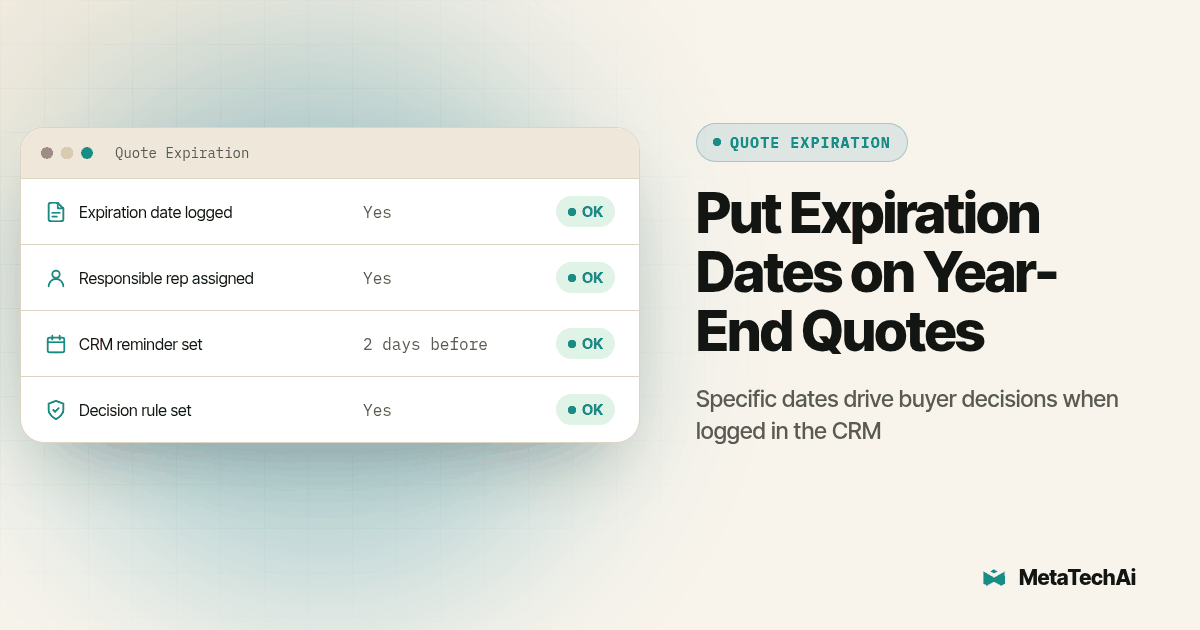
For a service business, year-end quote expiration is an operational decision as much as a sales decision. The date itself does little unless it is specific, tied to a real constraint, and visible to the team after the rep who sent the quote goes on vacation.
Does a dated quote expiration actually raise your close rate, or just add friction?
It raises the odds of a decision, which is not quite the same thing as raising the odds of a yes, and that distinction matters more than most pricing advice admits. A buyer reading "end of year pricing" with no date attached has no reason to treat it as real; it reads the same as every other salesperson's version of that line. A buyer reading "this pricing is valid through December 19" is looking at a specific, checkable claim, and specific claims get acted on faster than vague ones, according to sales consultant Dayna Rothman's year-end playbook, which draws the exact contrast between the two phrasings (Tomba, 2026).
The same source puts a number on the Q4 calendar problem that makes urgency tempting in the first place: once you strip out Thanksgiving week, the days teams take off, and the slow final week, there are roughly fifteen real selling days left in December for most B2B teams (Tomba, 2026). That is the actual pressure a dated quote is responding to. It is not that buyers hate deadlines; it is that your own team has almost no runway left to chase an undated one.
Should the date attach to the price, the scope, or both?
Attach it to the concession, not to your standard price. If you are offering a discount, a bonus service visit, or a waived fee to get the signature before year end, that concession is what should expire on the stated date, while your normal price stays the normal price indefinitely. Rothman's framing for this is blunt: "trade, don't give," meaning a price break should be exchanged for something specific, like a longer service term or an earlier start date, rather than handed out because the calendar changed (Tomba, 2026).
This separation protects you on both ends. If the buyer signs by the deadline, they got the deal you intended. If they come back in February wanting the same number, you are not negotiating against your own prior offer, because the quote never said the standard price expired, only the concession did. Keep both numbers visible on the document itself: the regular rate, and the dated reduction next to it, not folded into a single lower number that erases the distinction once the PDF gets forwarded around a buying committee.
How do you set a year-end quote expiration without pushing the buyer away?
Here is the sequence we walk a client sales team through before their first dated quote goes out this quarter:
- Pick a trigger date tied to something real: a holiday install schedule cutoff, a tax-year deadline that matters to the buyer, or your own capacity limit for starting new jobs before January. A date tied to nothing reads as a sales tactic, because it is one.
- Separate the standard price from the concession on the document, with the concession's expiration stated once, in plain language, next to the number it affects.
- State the reason for the date in one sentence the buyer can verify or at least believe: "to lock in a December start before our install calendar fills for the new year," not "limited time offer."
- Set a CRM reminder two business days before the date, assigned to the rep who owns the deal, not a shared queue nobody checks over the holidays.
- Decide in advance what happens the day after expiration: does the concession simply end, or does the rep call before marking it expired. Pick one and write it down so every rep handles it the same way.
- Log any extension request the same way you would log a buyer-requested hold: a reason, a new date, and the rep accountable for the next step, which is exactly the record structure our guide to following up on a quote when the buyer asked you to wait already walks through in more depth.
What happens on January 2 if the buyer still has not signed?
Two different things can be true, and your CRM needs to tell them apart. The first is a quote that expired because the deadline simply passed with no response; that one needs a fresh conversation and, usually, a fresh number, since the old concession is gone. The second is a quote the buyer explicitly asked you to hold, "call me back the second week of January" is a real answer, not silence, and it should be recorded as a hold with a return date rather than treated as a dead deal.
Conflating the two is where forecasts get unreliable. A rep who marks every undated gap as "pending" is hiding the difference between a buyer who is still deciding and a buyer who already told you when to call back. Our guide to reviewing CRM close date changes before trusting a forecast covers the broader version of this problem: a close date that keeps sliding without a recorded reason is not a forecasting input, it is a question nobody has answered yet.
Dated deadline, vague year-end pricing, or no deadline at all: which protects your forecast?
| Approach | What the buyer actually hears | Effect on your pipeline | Risk if nothing changes |
|---|---|---|---|
| Specific dated expiration ("valid through December 19") | A real, checkable reason to decide now | Forces a yes, a no, or a logged hold before year end | Low, as long as the date is logged somewhere besides the PDF |
| Vague "end of year pricing," no date | Generic sales language, easy to ignore | Quote sits untouched; no forcing function | Deal drifts into Q1 with a stale, unremembered price |
| No deadline mentioned at all | No urgency signal either way | Buyer decides on their own timeline, which may be never | Highest: nothing distinguishes "still deciding" from "forgot about it" |
How do you keep the expiration date from getting lost over the holidays?
This is the part most teams skip, and it is the part that actually determines whether a dated quote works. A deadline that exists only in a buyer's email thread is a deadline only the buyer remembers, and buyers forget. A separate pattern shows up constantly in partner-driven B2B deals during Q4: a verbal promise like "we'll get you a revised quote after the holiday" gets made on a call and never logged anywhere, so nobody on the selling side can act on it once the person who made the promise is out of office (HeftIQ, 2026). An expiration date with the same lack of a paper trail fails the same way, just in the other direction: the date passes, nobody notices, and the discount quietly becomes permanent because no one followed up to retract it.
The fix is the same record you would use for a buyer-requested hold, applied to an expiration instead. Put the date, the reason, and the responsible rep in a CRM field a manager can query, not only in the body of the quote document.
Copy this into your quote template and your CRM before your next year-end proposal: - Standard price (states clearly that this does not expire) - Year-end concession amount or terms, stated separately from the standard price - Expiration date for the concession, with the reason in one sentence - CRM field: expiration date, queryable by a manager, not buried in notes - CRM field: responsible rep, assigned the day the quote goes out - CRM reminder: two business days before expiration, routed to the rep, not a shared inbox - Decision rule for the day after expiration: auto-close, or rep call first; pick one - Hold record for any extension request: new date, stated reason, responsible rep
What should you measure after you start dating quotes?
Track three numbers for the quotes you date this quarter versus the ones you did not: the share that get a response (sign, decline, or logged hold) before the deadline instead of going silent, the share of "logged hold" requests that actually convert when the new date arrives, and how many expired concessions a rep had to walk back because nobody caught the date. The third number is the one that tells you whether your CRM reminder step from the checklist above is actually working, or just looks good on paper.
One more gap shows up every December: reps take real time off, and a buyer calling to ask about their expiring quote does not always reach a live person. If your team runs lighter over the holidays and inbound calls about expiring quotes are going to voicemail, RizzDial's guide to buying an AI receptionist walks through testing call coverage before you commit to it, so a missed call does not quietly undo the urgency you just spent a quote template building.
Our managed services team builds this exact hold-and-expiration workflow into a client's CRM as part of standing up an AI sales system, and the guarantee is conversions go up or the client does not pay, measured against the workflow we agree to track, not against a generic pricing claim like the ones this article is warning you away from.
What do service sales teams ask before they start dating quotes?
Does putting an expiration date on a quote risk losing the deal if the buyer genuinely needs more time?
Not if you treat the date as a decision point instead of a cutoff. When a buyer asks for more time before the date passes, you grant the extension and log it as a buyer-requested hold with a new return date and an owner, the same record structure our guide to following up after a buyer asks you to wait already covers. The deal does not die; the undated version just never forced anyone to say so out loud.
Should the expiration date match the calendar year end, or our fiscal year end?
Match it to whichever date actually changes something for the buyer or for you, not the one that sounds more official. A homeowner cares about a tax deadline or a holiday schedule, not your fiscal close. A commercial buyer renewing on their own fiscal calendar cares about their budget cycle, not yours. Pick the date tied to a real constraint and say what the constraint is.
If the buyer asks for an extension right after we set a deadline, doesn't that defeat the point of dating the quote?
No, because the point of the date was never to force a yes by December 31. It was to force a decision, extend, decline, or sign, instead of letting the quote sit untouched into a new fiscal year with a stale price nobody remembers agreeing to. An extension request is a decision. A quote nobody mentions again until March is the outcome you were trying to prevent.
Do you charge extra to build this hold-and-expiration workflow into our CRM, or is it part of a standard MetaTechAi setup?
That depends on the CRM, proposal process, and what is included in the agreed implementation. Before work starts, write down which fields, reminders, stop rules, and exception handling are in scope. If a wider template rebuild is needed, treat it as a separate scope decision and document it before the team relies on it.