
AI Adoption Gap 2026: What Happens If You Wait?
By James Hill, MetaTechAi ·
Current surveys show AI is already part of many service businesses’ operations, but adoption alone does not prove that lead follow-up or conversion improved. Audit your own lead records for response time, second touches, and CRM handoffs, then choose one workflow to test against a baseline before deciding whether to wait.
In brief: Current industry survey data puts meaningful AI use among service businesses somewhere between about 25% and just over 50%, depending on how the question is asked and which workflows count (tradevulcan.com, getjobber.com). The surveys show that AI use is already common in parts of the service market, but they do not prove that adopters convert more leads because of AI. Waiting another year does not freeze your position: competitors can keep improving their lead response and follow-up while you are still deciding what to change.
How many service businesses are actually using AI for sales follow-up right now?
The honest answer is "it depends which survey you read," and that gap between surveys is itself the story. TradeVulcan's Q4 2026 home services forecast cites ServiceTitan data showing "only about 25% said they were currently using it," then cites a separate Housecall Pro survey in the same piece showing 48% actively using AI (tradevulcan.com). Jobber's 2026 Home Service Trends Report puts the number even higher: 52% of blue collar business owners say they now use AI in their operations, with 88% of high-confidence business owners using it compared with just 27% of low-confidence owners (getjobber.com).
Three surveys, three different numbers, and none of them are wrong. They are measuring different things. "Using AI" in one survey means a contractor tried an AI scheduling assistant once. In another, it means AI runs inside their day-to-day lead response and booking workflow. That distinction matters more than the headline number, because it is the difference between a business that bought a tool and a business that changed how it handles a lead.
We read this spread as evidence that adoption depends on what each survey counts, not as one precise market estimate. The TradeVulcan and Jobber figures describe different samples and definitions, so they should not be combined into a single share of businesses using AI specifically for sales follow-up. They do show that AI use is a current operating question for service businesses, rather than a distant forecast.
What does the adoption gap actually cost a business that waits?
Jobber's same report breaks adoption down by trade, and the pattern is uncomfortable if you run an HVAC company: HVAC leads every trade in self-reported AI use at 81.5%, ahead of plumbing (65%), electrical (64%), and cleaning (50%) (getjobber.com). But HVAC pros are also the slowest group at actually responding to leads within an hour, at just 11%, while cleaning companies respond within an hour 26% of the time despite lower AI adoption (getjobber.com).
Read those two numbers together and the lesson is not "adopt AI." It is "adopting AI does not automatically fix speed to lead." A trade can lead the industry in AI tool use and still be the worst performer on the one number that predicts whether a lead converts. That is exactly the piecemeal-adoption trap: a scheduling bot or an AI note-taker gets turned on, somebody checks a box in a survey, and the actual bottleneck, how fast a human or an AI agent responds to a new lead, never gets touched.
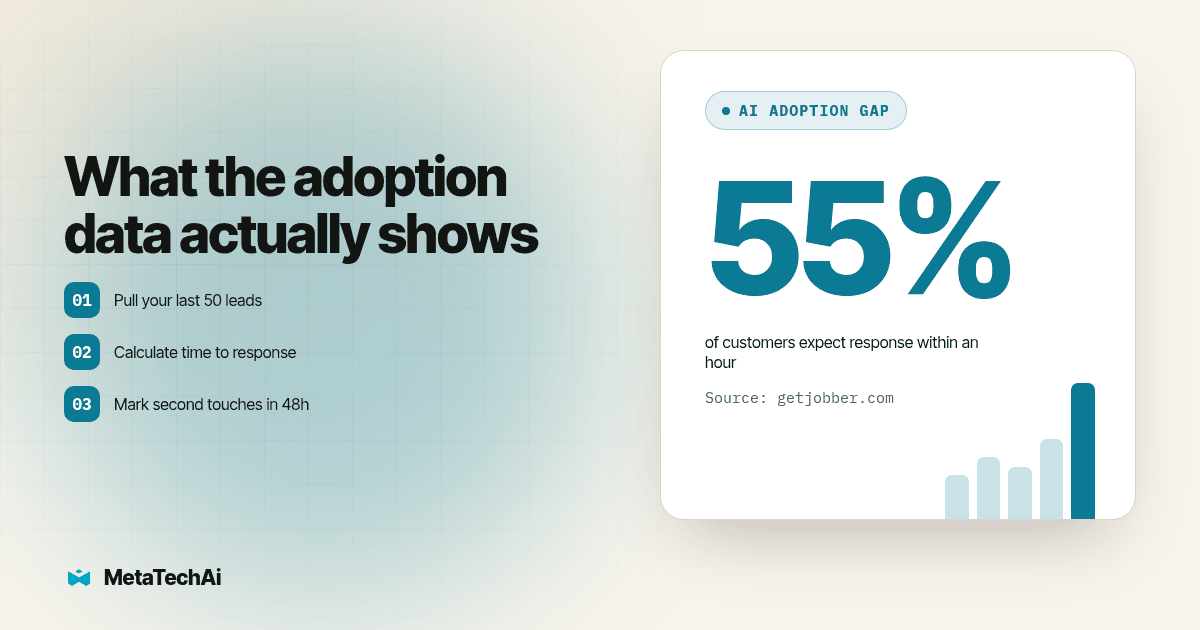
The same report shows the customer side of that gap. Over 55% of customers expect a response within an hour, and 28% expect an immediate reply, but only 20% of pros actually respond within the hour and 60% respond same-day (getjobber.com). That is the competitive exposure in plain numbers: most service businesses are answering on their own clock, while most of their customers are already shopping on a one-hour clock, and some are shopping on an immediate one.
TradeVulcan's forecast adds one more data point worth sitting with: of the businesses that have adopted AI, 40% said it helped them respond faster and lose fewer leads (tradevulcan.com). The remaining respondents did not report that specific benefit in the cited result; that does not establish that they saw no benefit at all. Buying an AI tool and installing an AI-driven follow-up system are not the same purchase, and only one of them shows up in a faster response time.
Why does piecemeal self-adoption rarely close the gap?
Most service businesses that "add AI" do it the same way they add any software: one person on the team finds a tool, turns it on for their own corner of the job, and nobody revisits whether it actually changed an outcome. We see three predictable failure points when that happens. The tool sits next to the CRM instead of inside it: an AI scheduling assistant or chatbot that does not write back to the CRM a rep already works in just becomes one more tab to check, and reps stop checking it within a few weeks. Nobody owns the follow-up cadence: a single AI feature can answer a chat message or transcribe a call, but if no one defines when follow-up starts, how many touches happen, and when it stops, the lead still goes cold between steps. And there is no measurement loop: Jobber's own confidence split, 88% AI use among high-confidence owners versus 27% among low-confidence owners (getjobber.com), shows an association between reported business confidence and AI use; it does not establish that AI use caused that confidence. A tool turned on once and never checked again does not build that trust, so it does not get the attention it needs to actually work.
None of those three problems get solved by adding a second tool. They get solved by designing lead response, qualification, and follow-up as one connected workflow with a single owner, which is a different project than installing an app.
How do you audit your own adoption gap before deciding to wait?
Run this on your own lead data before assuming you are fine, or assuming you need to rebuild everything. It takes under an hour with CRM access.
- Pull your last 50 inbound leads from your CRM or call log. Export them with timestamp of first contact and timestamp of inquiry.
- Calculate time-to-first-contact for each one. Subtract inquiry time from first-contact time. Sort the list from fastest to slowest.
- Mark which leads got a second touch within a couple of days of first contact. If your CRM does not log this cleanly, check call logs or text threads by hand for this sample; this itself is a signal that your follow-up tracking has a gap.
- Count how many leads never got a second touch at all. This is your follow-up gap, not your response-time gap, and the two are different problems with different fixes.
- Compare your median time-to-first-contact against the one-hour expectation line. Over 55% of customers expect a reply inside an hour (getjobber.com); if your median is well past that, you have a measurable, closeable gap, not a vague feeling.
- Check whether any current AI tool you already pay for touches this workflow at all. If you have an AI note-taker or chatbot but it never appears in the 50-lead sample above, you have adopted AI without closing the actual gap, matching the HVAC pattern above.
- Decide the one workflow you would fix first: first response speed, second-touch consistency, or quote follow-up after a no. Fixing all three at once is how pilots stall; fixing one first is how they ship.
- Set a baseline number before you change anything: your current median response time and your current percentage of leads with a confirmed second touch. You cannot prove a conversion guarantee did anything without a number to compare it to.
Keep that baseline. It is the only way to know later whether a change actually moved the number that matters, instead of just feeling busier.
What actually changes between self-adopted tools and an installed, guaranteed system?
| Piecemeal self-adoption | Installed managed system | |
|---|---|---|
| What gets turned on | One feature inside a tool you already pay for (chatbot, scheduling assistant, note-taker) | Lead response, qualification, follow-up cadence, and CRM handoff designed as one workflow |
| Who owns it | Whoever found the tool, usually as a side task | A defined owner with monitoring and tuning built into the engagement |
| CRM behavior | Often sits next to the CRM, not inside it; reps check a second tab | Writes back to the CRM fields reps already use for pipeline stage and lead source |
| Measurement | Rarely baselined; "we use AI" becomes the only metric | Baseline pulled before launch, tracked against the same number afterward |
| Risk if it does not work | Sunk cost in a subscription nobody uses after a month | Tied to a guarantee: conversions go up or you do not pay |
| Typical outcome per the adoption data above | Counted among the "using AI" adoption figures cited earlier, but not necessarily among the faster-response figures | Built specifically to move the response-time and second-touch numbers, not just the adoption checkbox |
This is not a claim that every self-adopted tool fails. Some businesses genuinely get value from a single well-placed AI feature. It is a claim that the data above shows a measurable split between businesses that count as "AI adopters" and businesses that have actually closed their speed-to-lead gap, and those are not the same group.
What do we install when a service business wants to close this gap?
We run this as a managed engagement, not a tool you configure yourself. The scope depends on where your audit above points, but the pieces are consistent. Lead response comes first: an AI voice or text agent answers and qualifies a new lead inside the window your customers actually expect, so the business is not competing on the owner's schedule while customers shop on a one-hour clock. Follow-up cadence comes next: a defined sequence of touches after the first contact, with stop rules, so a quote does not sit untouched the way the HVAC-versus-cleaning gap above suggests it often does. CRM handoff ties it together: every step writes back to the CRM your sales team already works in, so reps see pipeline stage, lead source, and quote status in one place instead of a second tab they stop checking. And monitoring and tuning keep it honest: we track the same baseline numbers your audit above produces, so a conversion guarantee has something real to measure against, not a vague sense that the system is "working."
The reason we lead with a guarantee, conversions go up or you do not pay, is that it forces exactly the baseline-and-measure discipline most piecemeal adoption skips. You cannot bill for an outcome you never measured.
What do service businesses ask about closing this adoption gap?
How much does an AI sales follow-up system cost?
It depends on scope: how many workflows you turn on (lead response, quote follow-up, rebooking), how much CRM cleanup is needed first, and how much human review the plan keeps in place. We do not publish a flat number because a single-workflow pilot and a full calling-plus-follow-up build are different quotes. Ask for a scope and a quote before committing past a single pilot, and ask whether the engagement is tied to a conversion guarantee rather than billed for activity.
How long does it take to go live with a managed AI sales system?
There is no fixed timeline we can promise in writing, because it depends on your CRM, your current tools, and how many approval rules you want before AI calls or texts a lead. A single workflow with clean data moves faster than a full calling-plus-follow-up build on a CRM that needs field cleanup first. Map the workflow and the data before you set a launch date.
What does an AI sales follow-up system actually integrate with?
A managed system has to read and write to the CRM your sales team already works in, not a separate dashboard nobody opens. That means lead source fields, pipeline stages, quote status, and calendar availability all stay in sync with what a rep sees when they open a record. If a tool cannot write back to your CRM, your reps end up checking two systems, which defeats the point of automating follow-up in the first place.
Is self-adopted AI the same as a managed AI sales system?
No. Self-adopted AI usually means one person turns on a chatbot, an AI scheduling add-on, or an AI note-taker inside a tool they already pay for. A managed system is installed end to end across lead response, qualification, follow-up cadence, and CRM handoff, with monitoring and a guarantee that conversions go up or you do not pay. The first approach adds a feature; the second is designed to change the sales motion.
What happens if I wait another year to add AI to sales follow-up?
You keep competing against competitors who already respond faster and follow up more consistently, and the gap between self-adopted tools and a fully installed system tends to widen, not close, because the businesses who adopt first keep tuning their workflow while you are still deciding. Waiting is not neutral. It is choosing to stay on the slower side of a gap that is already measurable today.
Pull your own 50-lead sample using the how many leads can a sales rep handle math first if you are not sure your team has the capacity to even act on faster responses once you have them; speed to lead only helps if someone or something is ready to pick up the resulting conversation. If you are weighing whether now or after the holidays is the right time to test any of this, our slow-season pilot timing guide walks through a seven-step test plan using your own seasonal data instead of guessing. And if your sales team is already losing deals to no-shows rather than slow follow-up, the gap shows up earlier in the pipeline than this article covers; see our no-show and sit-rate breakdown for that specific failure point.
On the calling side, RizzDial's breakdown of the home service follow-up gap covers the manual-versus-AI-calling math in more depth if speed to lead on inbound calls specifically is your bottleneck.
Closing this gap starts with the audit above, not with buying a tool. If the numbers show you are on the slow side of the response-time line, talk to our managed services team about scoping a pilot built around your own baseline, with the guarantee attached from day one.