
Should You Pilot an AI Sales System in Slow Season?
By James Hill, MetaTechAi ·
If your own records show that late November and December are quieter, that window can be a lower-risk time to pilot an AI sales or follow-up system. Measure response time, whether freed-up rep hours went to older leads in your CRM, and whether your team and data are ready for January. Treat revenue and close rate as longer-term outcomes unless your normal sales cycle gives you enough comparable observations to assess them.
Service-business owners have to decide whether to start a new workflow before the holidays or wait until the new year. The right timing depends on their own lead history, staffing, office closures, and sales cycle. When the business has a genuine seasonal dip, a narrowly scoped test can give the team time to find workflow problems before volume rises. Here is how we think through the timing, and the specific things we tell clients to track instead of revenue.
Is the slow season really the right time to start a pilot?
Yes, for the same reason a restaurant tests a new ordering system on a Tuesday instead of a Friday night. Lower volume means a mistake affects fewer leads, and your team has the attention to notice problems before they compound. SMBCEO's 2026 guidance on slow holiday periods makes the same case for small businesses generally: the author calls the slowdown "an ideal time to introduce automation because you have more room to experiment," and points out that sales pipelines have a delay, so outreach and follow-up work done now pays off weeks or months later, right when January volume arrives.
That delay matters more than it sounds. A pilot that starts producing booked meetings in week six is not a pilot that failed; it is a pilot on a normal sales-cycle clock. A team that waits until January gives up any available setup time before that month. Depending on its workflow and sales cycle, the live test may then overlap with a busier period.
When can a slower month lower the risk of testing automation?
Three possible advantages depend on the business actually having a seasonal dip.
First, your reps may have more room to train if your own schedule is lighter now than during peak periods. That is the window to train a team on a new tool without pulling them off paying work. We have had a client tell us flatly that a vendor shipped a new tool and nobody trained their team on it, so adoption died before the first week ended. Slow season is the time to fix that failure mode, not January.
Second, mistakes are cheaper. If a routing rule misfires or a follow-up sequence sends at the wrong cadence, fewer leads may be affected during a genuinely quieter period. Confirm this against your lead records rather than assuming the calendar is quieter for your business.
Third, a quieter period can give your team room to inspect the workflow. It does not automatically create a clean comparison: lead mix, staffing, holidays, and channel activity can change too. Record those conditions beside the baseline so later results are interpreted in context.
What should a slow-season pilot actually measure, step by step?
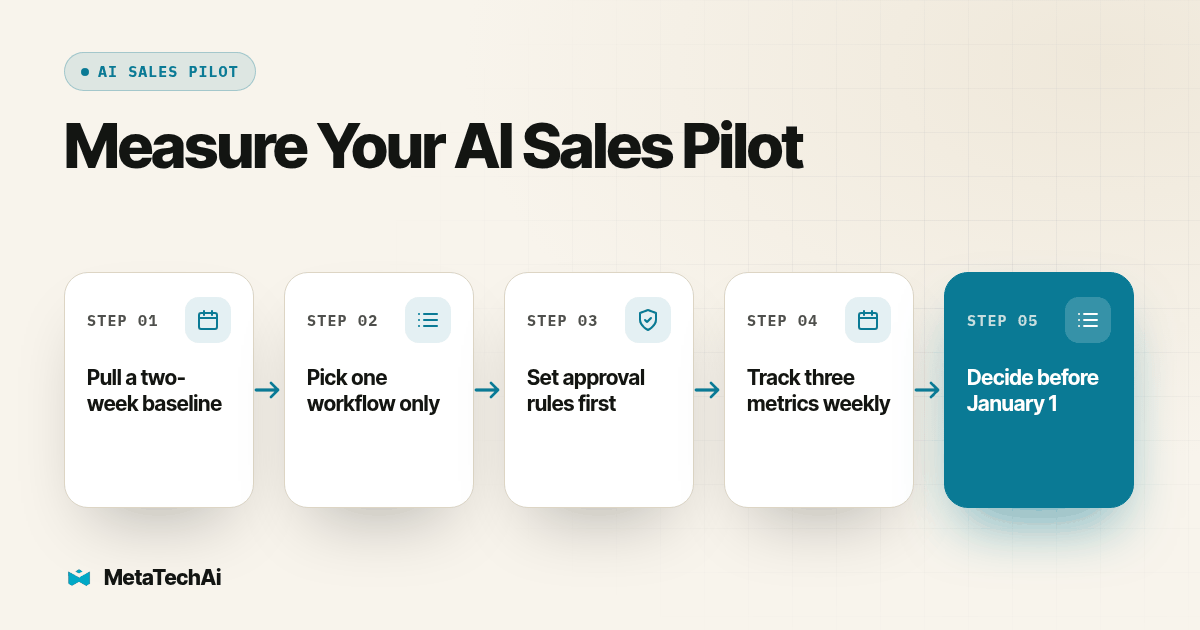
Not revenue, and not yet. Here is the procedure we run with clients between now and the new year:
- Pull a two-week baseline before turning anything on. Count inbound leads, time to first contact, and older leads with no recorded follow-up. Choose the lookback window from your normal sales cycle and document it. Do this by hand if you have to; it is the number everything else gets measured against.
- Pick one workflow, not three. Lead response, follow-up on stalled leads, or appointment booking. Resist turning on everything at once just because the calendar is quiet; a narrow pilot is also a faster pilot to debug.
- Set a written approval rule before the first live lead. Decide what the system can do without a human (send the first message, propose a time) and what requires a person (a refund request, a complaint, anything the system cannot answer with confidence).
- Run it through the agreed live-test period, marking office closures and any planned pause. Track three numbers weekly: average time to first contact, the count of previously stalled leads that got a follow-up they would not have otherwise received, and any case that needed a human override.
- Build in a real holiday-week pause. Decide in writing whether the workflow runs lighter or stops entirely over the days your office is actually closed, so you are not debugging a live system on a day nobody is watching it.
- Score the pilot against the baseline, not against a feeling. Did time to first contact drop. Did stalled leads actually get touched. Did your team use the new reports, or quietly go back to their old habits.
- Set the review date before launch, allowing enough time for the chosen workflow and sales cycle. Keep, expand, or cut the pilot on the evidence above, so your team walks into the rush already knowing which parts of the system to trust.
How does this differ from the standard 30-day or 90-day pilot clock?
It is the same discipline on a shorter, calendar-anchored window. Our 30-day AI sales coaching pilot plan and our 90-day implementation roadmap with decision gates both assume you can run a full cycle without a hard stop in the middle. A slow-season pilot does not get that luxury: holiday closures and a January busy period may interrupt the clock, so define a baseline and review date that fit your actual calendar.
That is not a reason to skip the discipline, just to compress it. The same logic our AI SDR pilot failure checklist uses for email outreach applies here too: a busy dashboard does not tell you whether the pilot worked. Count the specific leads that got touched because of the pilot, and the specific hours reps spent on something other than cold dials, because freed-up rep time only counts if someone can point to where it went.
If part of your lead response already includes voice calling, the same cheaper-mistake logic applies to who answers when a rep does not pick up. RizzDial's proprietary voicemail detection runs in 0.66 milliseconds, built to connect a live caller to a real person faster instead of letting the call die into voicemail, and testing that handoff in a quiet month is a lot less stressful than testing it for the first time during a January lead spike (book a RizzDial demo).
What happens if you wait and start the pilot in January instead?
You trade a quiet test window for a crowded one, and you lose the lead time the pipeline delay would have given you.
| What you're deciding | Pilot in slow season (now through December) | Pilot starting in January |
|---|---|---|
| Lead volume during the test | May be lower if your own records show a seasonal dip | May rise if January is a busy period in your own records |
| Rep bandwidth for training | Training may fit if rep schedules are lighter | Training may compete with work if rep schedules are busier |
| Time to first useful result | Earlier follow-up may mature before the busy period, depending on your sales cycle | A test started then may overlap with the busy period |
| CRM and baseline cleanup | Can be scheduled ahead of the busy period | May compete with live work and response demands |
| Decision clarity | Seasonality still needs to be recorded; fewer leads do not guarantee a clean comparison | Record volume and lead mix so seasonal changes are not attributed to the pilot |
Waiting is not free. It is a trade, and for most service businesses the slow months are the cheaper side of that trade.
What do service-business owners actually ask us about timing a pilot?
What does a slow season pilot of a managed AI sales system cost?
It depends on scope: how many workflows you turn on, how much CRM cleanup is needed first, and how much human monitoring the agreed plan includes. We do not publish a flat number because a one-workflow lead response pilot and a full calling-plus-follow-up build are different quotes. Ask for a scope and a quote before committing past a single pilot workflow, and ask whether the engagement is tied to our conversion guarantee, where conversions go up or you do not pay for that work.
How long does it take to get a pilot live before January hits?
Budget one to two weeks to map the workflow, pull a baseline from your CRM, and agree on approval rules, before the pilot clock even starts. Starting in late November, that puts a working pilot in front of real leads by early to mid December, which still leaves a few weeks of slow-season data before the January rush arrives.
Does the pilot work with the CRM and calendar we already use?
That depends on your current setup, not the calendar. We map the trigger, the source records, and the CRM fields the workflow needs to touch before we turn anything on, and unresolved contact permissions or ownership conflicts get fixed before customer-facing automation goes live, slow season or not.
Do holiday blackout dates or office closures complicate a slow-season pilot?
They add a pause, not a restart. Build a short holiday-week pause into the pilot plan (your office may close on Thanksgiving, Christmas, New Year's, or other dates), and decide in advance whether automated follow-up keeps running on a lighter cadence during those days or stops entirely. Standard calling and texting consent and quiet-hours rules still apply during the holidays exactly as they do the rest of the year.
If the pilot does not work, how hard is it to unwind before our busy season starts?
If you scoped it to one workflow, as we recommend, unwinding means turning off that workflow and handing the leads back to the normal process, which should be a documented, tested shutdown step that your workflow owner can carry out promptly. The CRM baseline and the written rules you built stay useful for the next tool you test, so cutting a pilot in December does not mean losing the year-end cleanup work you did to set it up.
Where does this fit if you're not sure a pilot is the right move at all?
Everything above assumes you have already decided to test something. If you are still weighing whether your team's real problem is lead response speed, stalled follow-up, or something further upstream, that diagnosis should happen before you pick a pilot window, slow season or not. That is the first conversation we have under our managed AI services: naming the one workflow worth testing, pulling the baseline, and agreeing on what result decides whether it stays. The season just decides when the clock on that test should start, and when the business has a verified seasonal dip, starting before the busy period can give the team time to test and adjust while lead volume is manageable.
What does a slow season pilot of a managed AI sales system cost?
It depends on scope: how many workflows you turn on, how much CRM cleanup is needed first, and how much human monitoring the agreed plan includes. We do not publish a flat number because a one-workflow lead response pilot and a full calling-plus-follow-up build are different quotes. Ask for a scope and a quote before committing past a single pilot workflow, and ask whether the engagement is tied to our conversion guarantee, where conversions go up or you do not pay for that work.
How long does it take to get a pilot live before January hits?
There is no reliable universal timeline. Map the workflow, check CRM fields and permissions, establish a baseline, and agree on approval rules before scheduling the live test. The work depends on your current tools, data, integrations, and review needs, so set the start date after that scope is understood.
Does the pilot work with the CRM and calendar we already use?
That depends on your current setup, not the calendar. We map the trigger, the source records, and the CRM fields the workflow needs to touch before we turn anything on, and unresolved contact permissions or ownership conflicts get fixed before customer-facing automation goes live, slow season or not.
Do holiday blackout dates or office closures complicate a slow-season pilot?
They can if the workflow has no pause rule or named monitor. List the actual office closure dates, then decide whether follow-up slows or stops while the team is away. Record who handles replies that still arrive, and check that consent, opt-out, and quiet-hours rules continue to apply. Do not assume every business closes on the same dates or that holiday staffing is the same across teams.
If the pilot does not work, how hard is it to unwind before our busy season starts?
Agree on the shutdown steps before launch: who can pause the workflow, how open leads return to the normal process, and how activity is retained in the CRM. Test those steps before live use. The baseline and written operating rules can remain useful even if you stop the pilot.