
AI SDR Pilots: Why They Fail and What to Check
By MetaTechAi ·
AI SDR pilots can fail when the target list is too broad, sending problems go unchecked, or AI replies make promises the business cannot support. Before launch, define one buyer segment, verify sending controls, require human review and agree on a conversion measure. Use the checklist and test procedure below to decide whether to expand, hold or stop.
An AI sales development representative, or AI SDR, helps with prospect research, outreach and follow-up. This guide focuses on email outreach for service businesses with sales teams. Tool capabilities vary, so verify which actions the proposed system can actually perform and which still belong to a rep.
A busy dashboard does not tell you whether the pilot works. Messages can go out while the wrong people receive them, qualified replies sit unassigned, or appointments reach reps without useful context. Start with a written acceptance test rather than treating message volume as evidence of progress.
Why Do So Many AI SDR Pilots Get Canceled?
A pilot becomes difficult to justify when its activity cannot be connected to qualified sales conversations. That can happen at several points: the list does not match the offer, recipients do not receive or want the message, the AI gives an unsupported answer, or the rep never accepts the handoff. Each needs a different fix.
Do not use a universal cancellation percentage as your business case. The available secondary compilations do not establish how a comparable service business will perform. Instead, record your current outreach process and decide which result the pilot must improve. Compare the same buyer segment and qualification definition before drawing a conclusion.
Generated answers deserve a separate check. NIST's Generative AI Profile identifies confabulation, confidently presented false content, as a risk. Our practical recommendation is to test replies against approved business information and route unsupported questions to a person. This is a control to evaluate, not evidence of a particular AI SDR failure rate.
How Wide Is Your Target List, and Why Does That Affect Your Pilot?
A target list such as "decision-makers at service businesses" can contain buyers with unrelated needs. One runs a single location and handles sales personally. Another manages several locations and needs approval from a purchasing team. A shared industry label does not make their buying process the same.
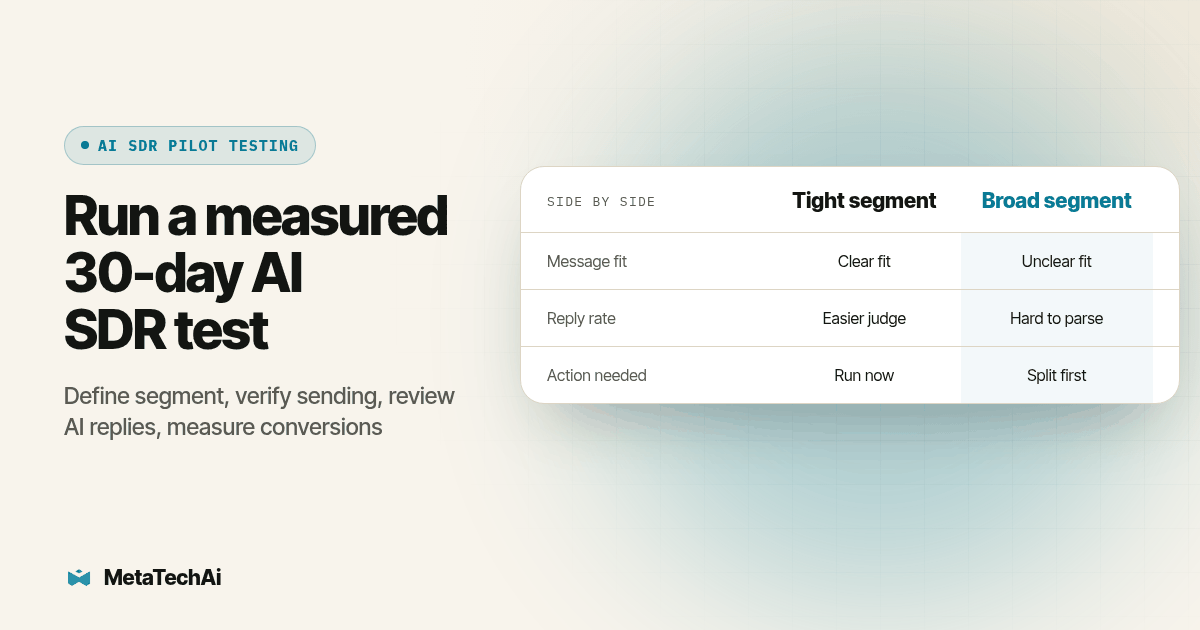
For this pilot, define one role, one company-size band and one shared problem. Then review actual records against that definition. The comparison below is a planning framework, not a measured reply-rate benchmark.
| Targeting approach | What to inspect | What it means for your pilot |
|---|---|---|
| Tight segment: one role and shared problem | Whether the recipient owns the problem your offer solves | Easier to judge whether the message fits that situation |
| Broad segment: unrelated roles or needs | Whether several offers are hidden inside one list | Split the list before interpreting a combined reply rate |
| Existing customers mixed with new prospects | CRM identity, open opportunities and prior conversations | Exclude or route separately so outreach does not ignore the relationship |
Ask a sales rep to explain why each sampled company belongs in the test. If the only answer is that it matched a database filter, the list needs another review. Record exclusions as well as inclusions so the next import does not quietly widen the audience.
What Does Domain Reputation Damage Actually Change?
Poor sending practices can affect whether future messages reach recipients. Google's email sender guidelines describe authentication, spam-rate monitoring and domain and IP reputation. They also recommend gradual increases in sending volume rather than sudden spikes. These guidelines concern delivery to personal Gmail accounts; check the requirements of other receiving providers separately.
Map the proposed sending domain, authentication and infrastructure with the person responsible for company email. A dedicated domain or subdomain can help separate operations, but do not treat it as a guarantee that your main domain is insulated. Shared infrastructure and provider decisions still matter. Moving to another domain is not a substitute for fixing unwanted outreach.
Our pilot worksheet should identify the sender, the audience, the suppression list and the person authorized to pause delivery. Capture available delivery evidence before launch. If reputation data is unavailable, record that limitation instead of interpreting an empty dashboard as a clean result. No setup can promise inbox placement or a fixed recovery time.
What Should You Check Before You Sign an AI SDR Contract?
Copy this checklist and run it against any AI SDR vendor, including us, before a single prospect gets contacted.
- Confirm the ICP definition in writing. Ask the vendor to show you the exact title, company size and industry filters the list will use. If it spans more than one clearly different buyer type, narrow it before launch, not after the reply rate comes in low.
- Review the sending domain and infrastructure. Document whether a dedicated domain or subdomain is appropriate, verify authentication and identify shared infrastructure. Require the email administrator to approve the setup without promising complete reputation isolation.
- Get the sending ramp in writing. Agree on a controlled launch, review points and pause conditions. Avoid treating a warm-up service or a calendar date as proof that the sender is ready for more volume.
- Set a human review window on AI-drafted replies. Every AI response to a prospect's question should sit in a review queue for a stated number of hours before it goes out, at least for the first two weeks, so an off-brand or hallucinated answer gets caught before it reaches a buyer.
- Name the escalation trigger. Define, by message count or by day, exactly when a live rep takes over a thread instead of the AI continuing it. "When it seems like it needs a human" is not a trigger; "after the second reply from the prospect" is.
- Name a single metrics owner with a weekly cadence. Reply rate, bounce rate and spam complaint rate get reviewed weekly, by one named person, not discovered a month later in a quarterly report.
- Negotiate a written exit checkpoint. If deliverability or reply rate falls below a stated floor inside the first 30 or 60 days, the agreement should state whether you can pause or exit and what obligations remain. Do not assume that right exists unless it is agreed.
- Test a data sample before the full list loads. As a proposed review exercise, pull up to 100 records from the vendor's source list and check them against your CRM for duplicate accounts, wrong titles and existing customers before the AI ever contacts them.
- Require every AI-sent message and reply to log to your CRM. Same record, same tagging convention a human rep's outreach would use, so a lead never exists only inside the vendor's own dashboard.
- Tie the engagement to conversions, not activity. A vendor who reports "messages sent" and "opens" as the headline metric is reporting effort. A vendor who reports qualified meetings booked and the conversion rate behind them is reporting results.
How Do You Test an AI SDR Pilot During the First 30 Days?
The checklist establishes the proposed controls. This original 30-day procedure tests whether they work. Its dates are review checkpoints we recommend, not a claim that every sales cycle produces reliable revenue evidence within a month.
- Launch with a small, single-segment batch. Choose a batch your team can inspect and support in one tight ICP segment. Hold expansion while you review the first responses. The appropriate size depends on sending history, permissions and available rep capacity; it is not a universal statistical threshold.
- Check reply rate, bounce rate and spam complaint rate daily, not weekly, for the first 14 days. Sending problems compound fast; a daily check catches a reputation slide while it is still a small one.
- Read every AI-drafted reply to a prospect's question before it becomes a reusable template. Look specifically for invented claims, pricing the AI was never told to quote, and a tone that does not match how your team actually talks to buyers.
- Run a sender reputation check before launch and again at day 14. Use available provider telemetry and delivery logs, recording gaps where a low-volume sender has insufficient data. A test inbox alone does not prove placement for every recipient.
- Audit the contacted list against your CRM at day 14. Confirm no existing customers or duplicate accounts got contacted as new prospects, and record any exception before loading another batch.
- Hold a scheduled cancel-or-continue meeting at day 30, with the actual numbers in front of you. Decide whether to expand the ICP, hold at the current segment, or stop, before the contract auto-renews into a longer term or higher volume tier.
If your outbound mix includes AI voice calling alongside email, run the same discipline against that channel too. RizzDial's guide on what to require from AI call center software covers the calling-specific version of this same pre-launch review, since the failure points for a dialer and sender reputation for email are not the same thing.
What Happens If You Skip the Checklist and the Pilot Already Failed?
Pause the failing path, preserve its logs and identify where the result disappeared. If sends failed, review sender evidence. If people replied but no qualified meeting followed, inspect the conversation and rep handoff. If meetings happened but opportunities did not progress, review qualification and sales execution before changing the outreach copy.
Our accountability audit for an underperforming AI vendor helps connect responsibilities to evidence. For calling, use the keep-fix-or-cancel review for a stalled AI voice agent. Both start with the same question this checklist asks before launch: what is the system accountable for, and who can show the result?
MetaTechAi installs AI sales and marketing systems for service businesses with sales teams. Our guarantee is that conversions go up or you do not pay. In a managed AI services engagement, agree on the conversion measure, baseline, measurement window and covered work before installation. Scope the pilot controls explicitly rather than assuming every vendor tool or outreach channel is covered.
What Evidence Should the Day-30 Review Use?
Bring the actual counts alongside each rate: contacted prospects, delivery failures, replies, qualified replies, meetings held and opportunities accepted by a rep. Define the denominator for every calculation. Separate positive interest from objections, automated replies and requests to stop. A rising total reply rate can hide an audience that wants no further contact.
Keep a small acceptance-test log with the input, expected action, actual action, owner and retest result. Before contacting prospects, use test recipients to submit an unsupported service question, an existing-customer record, a request to stop and a meeting request with no available rep. The expected results are escalation, correct routing, suppression and a visible exception. Confirm those outcomes in the CRM as well as the sending tool.
Choose expand only when the agreed controls pass and the evidence supports another limited batch. Choose hold when delivery works but qualification or follow-up needs correction. Choose stop when a serious control fails or nobody can account for the records. Insufficient observations justify a narrower follow-up test, not a confident success claim. Keep revenue review aligned with the actual sales cycle.
What Else Do Buyers Ask Before Starting an AI SDR Pilot?
How long should an AI SDR pilot run before the data actually means something?
Use day 30 as a proposed operating review, not a universal minimum or proof of revenue impact. Check delivery, reply quality and rep handoffs early. Judge pipeline and revenue over a window that reflects your sales cycle and the number of qualified opportunities observed.
Can domain reputation damage from a bad AI SDR pilot be undone?
Recovery is possible in some situations, but no fixed timeline or inbox-placement outcome can be promised. Pause the problematic sending, investigate authentication and recipient feedback, and work with the email administrator. A separate sending domain does not guarantee complete protection for company email.
Does MetaTech's AI SDR work come with the conversions-up-or-you-don't-pay guarantee?
MetaTechAi guarantees to increase your conversions, or you don't pay. Agree on the conversion measure and covered system before installation. Put the baseline, measurement window and remedy in writing; do not assume every third-party tool or pilot expense is covered.
What's the difference between an AI SDR and an AI voice agent for outbound calling?
An AI SDR can support prospect research, email outreach and follow-up, depending on the tool. An AI voice agent places or answers phone calls. Verify the actual channel and permissions in scope, then test its delivery, conversation quality and human handoff separately.
How many prospects need to go through an AI SDR pilot before the reply rate is reliable?
There is no universal contact count that makes a reply rate reliable. It depends on the underlying rate, audience variation and the precision needed for a decision. Start with a controlled segment, report counts alongside rates and avoid expanding solely because a small batch received a few replies.
Run the ten-item checklist before you sign, then use the 30-day review to decide whether to expand, hold or stop. If you want help defining the pilot and its conversion measure, talk to our team.