
Is Your Team Pitching a Tax Credit That Already Expired?
By James Hill, MetaTechAi ·
The federal Section 25C HVAC credit and Section 25D residential clean energy credit ended for 2026, and Section 30C for EV charging ended June 30, 2026. Audit recent calls for stale deadline language, correct the script, and verify any state or utility incentive before a rep makes a new claim.
Did the Federal HVAC and Solar Tax Credits Actually Expire Before 2026?
Yes. IRS guidance says Section 25C is unavailable for property placed in service after December 31, 2025, and Section 25D is unavailable for expenditures after that date (IRS guidance on energy credit termination dates). Section 25C, the federal energy efficient home improvement credit, covered qualifying equipment placed in service through December 31, 2025. After that date, it is unavailable for new qualifying property regardless of when the paperwork was signed (e320air). "Placed in service" is the detail that trips up a sales script built around signature dates: it means the unit is installed and actually running in the home, not sitting in a warehouse or listed on a signed proposal. A furnace a contractor has not yet installed does not count, even if the customer paid a deposit on December 30.
Section 25D, the federal credit for residential solar and battery installations, ended for expenditures made after December 31, 2025. The credit had covered 30 percent of qualifying costs, but the termination date changed under the 2025 federal law (CPA Practice Advisor).
A third federal credit, Section 30C for EV chargers, ran a little longer but also ended, on June 30, 2026, under the same IRS guidance and even while it was active it only applied in specific eligible census tracts rather than everywhere (realcostiq). If your reps bundle a "green upgrade" pitch across HVAC, solar and EV charging, all three federal pieces of that pitch are gone for 2026 installs, not just one of them.
Why Are Reps Still Using a Pitch That Is a Year Out of Date?
Often nobody formally retires the old language. A deadline feels credible because it was true in 2025, so reps keep repeating it. Scripts are usually revisited after a complaint, a lost deal, or a manager happens to hear the wrong call.
Year-end is when sales teams lean hardest on urgency. A rep working from last November’s script has no built-in signal that the underlying rule changed in January. Without an active call review, the pitch can continue after the law stops applying.
What Expired at the Federal Level, and What Should You Check Locally Instead?
Here is the split that matters for a sales script: federal is closed, local is still worth checking before you remove the urgency entirely. The Department of Energy says Home Energy Rebates are available in select states and directs households to check program status and eligibility with their state or territory energy office (DOE Home Energy Rebates status).
| What a rep might say | Status in late 2026 | What to check instead |
|---|---|---|
| "Buy before December 31 for the federal HVAC tax credit" (Section 25C) | Expired. Covered equipment placed in service through December 31, 2025. Property placed in service after that date does not qualify, even if the contract was signed earlier (e320air). | State tax credits, utility rebates, and income scaled federal rebate programs that are separate from 25C and still running in some states. Availability is set by state and program, not by a national deadline. |
| "Lock in the 30 percent federal solar tax credit before it is gone" (Section 25D) | Expired December 31, 2025, with no phase down window (CPA Practice Advisor). | State level solar credits that some states still run on their own percentage basis, plus solar renewable energy certificate markets in a handful of states and net metering credit for exported power (realcostiq). |
| "The EV charger credit still applies if you bundle it in" (Section 30C) | Ended June 30, 2026, and even while active it only applied in specific eligible census tracts (realcostiq). | State level EV incentives, which vary widely and need to be checked per state rather than assumed. |
The honest version of the pitch in 2026 is not "there is no tax savings left," because that is not always true either. It is "the federal credit you are thinking of expired, and the one that might apply now depends entirely on where you live." A rep who cannot tell the difference between those two statements should not be making either claim on a recorded call.
How Do You Audit Your Team's Calls for This Pitch This Week?
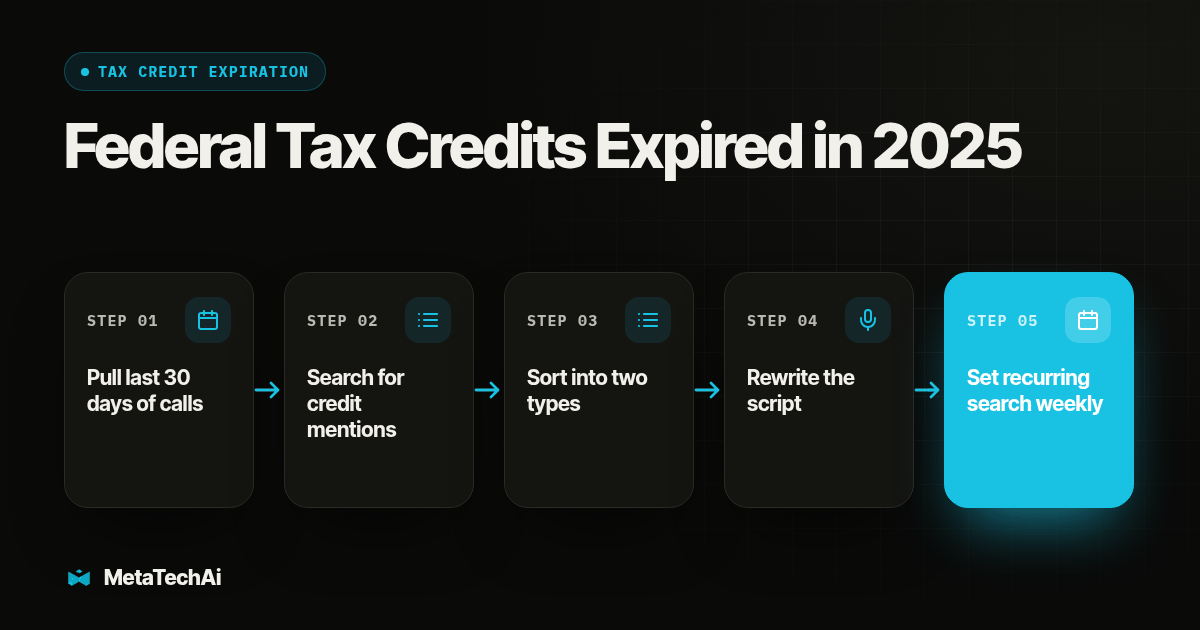
You do not need new software to start. You need last month's call data and thirty focused minutes. Run it in this order:
- Pull every call transcript or recording from the last 30 days where a rep discussed pricing, financing or a close date, since that is where urgency language shows up.
- Search the transcripts for the exact phrases your old script used: "tax credit," "before the credit expires," "qualifies for the credit," and "before year end" paired with any mention of install timing.
- For every match, read the surrounding sentence, not just the flagged phrase. A rep saying "ask your accountant about tax credits" is different from a rep saying "this qualifies for the federal credit if you sign by December 31."
- Sort the matches into two piles: generic mentions that suggested the customer check with a professional, and specific promises that stated a federal credit applies to a 2026 install.
- For every specific promise, note the rep, the call date and whether the customer has already closed or is still in the pipeline, since an open deal needs a correction call before it closes on a false premise.
- Rewrite the script line using the corrected framing below, and send it to every rep the same day you find the first violation, not after a full audit cycle finishes.
- Set a recurring version of this same search (weekly or on every new recorded call, depending on your call volume) so a stale claim cannot run for eleven months before anyone notices again.
What Should a Rep Say Instead of the Old Pitch?
Paste this into whatever your reps already use for talk tracks and have every rep acknowledge the change in writing, not just hear about it in a team meeting.
Old line (retire this): "If you sign before the end of the year, you'll qualify for the federal tax credit on this."
Corrected line: "The federal credit that covered this kind of work is no longer available for eligible property placed in service or expenditures made after December 31, 2025, so I can't promise that one applies anymore. What I can do is check whether your state or utility has its own rebate or credit right now, and I'll give you that answer in writing before you decide anything, not just tell you on the call."
Manager checklist before this goes live: Confirm the state and utility programs your installers actually serve, write down where a rep can verify current local programs, decide who signs off if a rep wants to mention a specific local credit by name on a call, and date the rollout so you can tell, a year from now, which reps were trained after this correction went out and which were not.
Date the correction and assign an owner so the next program change has a clear review path.
How Does This Get Caught Automatically Going Forward?
A one-time audit addresses past calls but does not prevent the old line from returning. For service businesses with a sales team, our managed AI systems can apply a phrase watch list to recorded calls so managers can review matches (our managed AI services).
Conversation intelligence platforms can use phrase pattern flags to find wording tied to price, timing, authority, or a named competitor across recorded calls (how conversation intelligence software actually works for a small sales team). A claim about a specific tax law changing a specific install's cost is just another pattern worth watching for, and it belongs on the same list as a pricing objection or a stale competitor comparison.
If you are shopping for or renewing call monitoring, require this kind of custom flag in writing before you sign (what to require from call monitoring software). And if your team runs AI voice agents alongside or instead of human reps on some of these calls, the same review applies to those transcripts too. RizzDial's setup for pulling call transcripts and call history into a custom AI agent over MCP or the REST API is one way a team feeds voice agent calls into the same kind of ongoing phrase review (RizzDial's guide to call transcript access over MCP).
A phrase flag catches an individual call. A governance framework should define who owns the claim, who is notified when a boundary is crossed, and who can pause a workflow that repeats a bad promise (an AI governance framework a sales team will actually follow).
What Do Sales Managers Ask Us About Catching Outdated Claims?
Did the federal tax credit for HVAC equipment and solar installs really expire before 2026?
Yes. The federal Section 25C credit for HVAC efficiency upgrades covered equipment placed in service through December 31, 2025. Section 25D for residential solar and battery expenditures ended after December 31, 2025. Nothing qualifying under either credit can be claimed for a 2026 installation or expenditure; a signed contract by itself does not establish eligibility.
If the federal credit is gone, is there anything left to legitimately offer a customer in 2026?
Often yes, just not at the federal level. States, utilities and some income based rebate programs still run their own incentives, and what is active depends on where the customer lives. Check the current programs for a specific zip code before you let a rep use any version of a tax savings claim on a call.
How does a managed AI call review system catch a rep still using an expired tax credit pitch?
The same way it catches a mention of a competitor name or a pricing objection: a phrase pattern flag watches every call for specific wording tied to tax credits, savings deadlines and install dates, and surfaces any match for a manager to review instead of waiting for a customer complaint or a state inquiry to surface it first.
We already use a different call monitoring or CRM tool. Do we have to replace it to add this kind of flag?
No. A flagged phrase rule like this sits on top of whatever system is already recording and transcribing your calls, and it does not require ripping out your current CRM or dialer. The real requirement is that your current tool can record the call types you actually run and let you define a custom phrase flag, which is worth confirming before you assume it already can.
What Should You Do About This Today?
Run the seven-step audit above against last month's calls before you read anything else on your to-do list this week. If you find even one rep still citing the federal credit as live, send the corrected script the same day, log who received it, and flag the open deals that heard the old line so someone can call the customer back with accurate numbers before the deal closes on a promise that was never true. Then decide whether that correction becomes a standing phrase flag on every future call or a document that quietly goes stale the same way the original script did. The first option costs you an afternoon. The second one costs you the next expired law nobody catches until a customer does.