
How to Compare AI Automation Agencies Before You Sign
By James Hill, MetaTechAi ·
Compare every AI automation agency proposal against the same written evidence: production results, ownership, pilot exit terms, guarantee language, and post-launch support. A weighted scorecard makes the choice less dependent on a polished demo and more grounded in how the system will operate after signing.
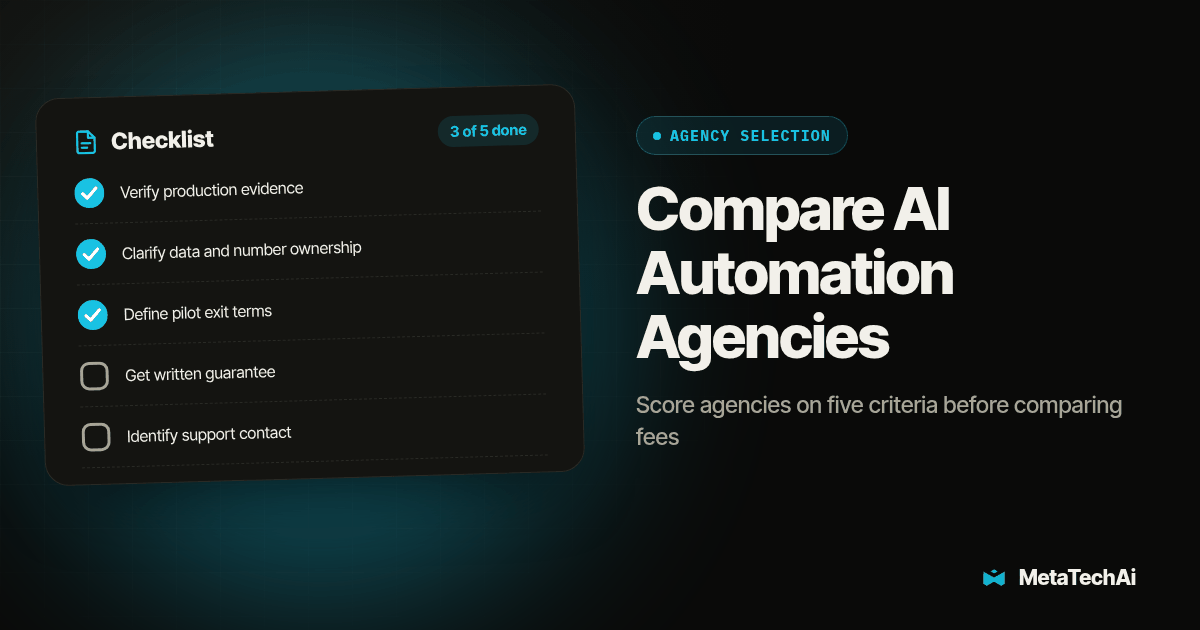
TL;DR: Score every AI automation agency proposal on the same five categories: production evidence over demo polish, who owns your data and number, how the pilot actually ends, what the guarantee covers in writing, and who answers the phone after handoff. Weight those five, not the demo, and the choice between two or three quotes gets a lot less subjective.
By the time a service business has two or three AI automation proposals sitting in the inbox, demos can start to blur together. One may show a voice agent booking an appointment, while another shows a bot answering a lead quickly. Both can look polished during a rehearsed presentation. The problem is that a demo is built to be shown once, under favorable conditions. Production systems have to survive a bad phone line, a lead who gives a fake callback number, and a Friday afternoon when nobody on staff is watching the dashboard. That gap between rehearsal and day-to-day operation is where buyers need evidence.
What Should You Actually Compare Across Three AI Automation Agency Quotes?
Start by setting the demo aside entirely and pulling out whatever documentation each agency actually sent you in writing: the scope of work, the pilot terms, the exit clause, and anything resembling a guarantee. If one agency's proposal is three paragraphs and a price, and another runs four pages with named milestones, that gap alone tells you something about how the engagement will run once the contract is signed.
If you have not yet written down what you need before taking these calls, our guide to preparing an automation brief covers that step; it assumes you are still shopping. This article assumes the opposite: you already have quotes in hand and need a way to rank them that does not come down to which salesperson you liked more. And if you are earlier than that, still deciding whether a full agency engagement is the right move at all versus bringing in an independent consultant for a narrower scope, AI Guy's guide to hiring an AI consultant walks through that fork before you request proposals at all.
The five categories below cover what separates agencies that deliver from agencies that demo well: production evidence, ownership, pilot structure, guarantee terms, and support after handoff. Score each proposal on all five before you look at price, because price only means something once you know what you are actually buying.
Why Does the Flashiest Demo Lose to the Dullest Proposal So Often?
Demos answer one question: can this agency build something that works once, on a script they wrote, with a lead who behaves the way they expect. It does not answer whether the system holds up against a caller who mumbles, a CRM field that is blank, or a lead who calls back three weeks later expecting the agent to remember the conversation. One framework published October 10, 2026 for comparing AI automation vendors weights demonstrated results at 30 percent of the total score, the single largest category, specifically because polished demos and reference calls get ranked on a "ladder" where contracts and permission matrices outrank marketing case studies every time (agenticmarketingpro.com).
In practice, that means asking each agency for one thing a demo cannot fake: a reference client in a business roughly your size and complexity, and permission to actually call them. Ask that reference what broke in the first 90 days, not whether they are happy overall. Specific failures and how the agency responded give you evidence you can use. An agency that gets defensive about a reference call, or offers only a logo and a quote pulled from a case study page, leaves you with little evidence beyond the demo.
Our own breakdown of how to tell if a sales vendor's "AI" claim is real goes deeper on testing the technology itself once you are past this stage; use it as the next filter after the reference call, not instead of it.
Who Ends Up Owning Your Data, Your CRM, and Your Phone Number?
This is the category most buyers skip because it sounds like a legal detail rather than a business decision. It is not a detail. If the agency provisions your outbound number inside its own platform, builds your lead scoring logic as a black box only it can edit, and stores call transcripts somewhere you cannot export, you have not bought a tool. You have signed a lease, and the agency is the landlord.
Three things need a plain answer in writing before you sign: who holds the number if you leave, who can export the full call and text history in a usable format, and whether the scoring and routing logic lives somewhere you can see and edit, or only the agency can touch it. Proposals that answer all three with specifics are telling you ownership was part of how the system got built, not an afterthought negotiated later if you push. One that answers with reassurance instead, something like "you'll always have access," without naming the export format or the number porting process, has not actually answered the question.
What Pilot Terms Separate a Real Test From a 90-Day Sales Funnel?
Every agency will offer a pilot. The terms of that pilot tell you whether it is designed to prove the system works or designed to get you comfortable enough to sign the full contract regardless of what the pilot shows. Real pilots have a fixed scope, a fixed end date, and a defined pass or fail line agreed before they start, not evaluated afterward by the agency that ran them.
Another proposal-evaluation framework, published March 4, 2026 for comparing technical vendors, recommends eliminating any agency scoring below a 6 out of 10 on technical expertise or relevant portfolio before comparing anything else, treating that as a non-negotiable floor rather than one input among many (sfailabs.com). The same discipline applies to a pilot: decide your pass line before the pilot starts, not after you have seen the number and are tempted to move the goalposts because you already invested six weeks.
Ask specifically what happens if the pilot fails the agreed line. Does the contract end with no further obligation, does it roll automatically into the full term, or is there a murky "we'll work it out" clause that leaves you negotiating from a position where you have already told your team the new system is coming. Get that answer in writing before the pilot starts, because it is much harder to negotiate exit terms after six weeks of sunk cost than before.
What Does a Conversion Guarantee Actually Have to Promise in Writing?
Guarantees are only as good as the thing they measure and the remedy they name if that measure is not met. "We guarantee results" is not a guarantee; it is a sentence. One worth signing names the specific metric (booked appointments, qualified leads handed to a rep, closed deals, whichever one matches what you are actually buying), the measurement window, and exactly what happens if the number is not hit: a refund, a contract extension at no charge, or an exit with no penalty.
This is the standard we hold our own managed engagements to on the managed AI services page: we agree on the conversion measure before installation, then the business does not pay if the installed system fails to increase it. The same measure should be clear in any proposal guarantee. Use that same structure to test what you have on the table. If a proposal's guarantee language cannot survive being rewritten as "metric, window, remedy" in one sentence, it is marketing copy sitting next to a price, not a commitment. One buyer's guide frames the whole comparison the same way: score fit and ownership, not a feature matrix (aiautomationdb.com). A feature list tells you what the platform can do in theory; it does not tell you whether this particular agency will still be accountable six months after signature, which is the question a guarantee is actually supposed to answer.
What Happens the Day After Handoff, When Something Breaks at 6 PM on a Friday?
Launch day gets a project manager, a kickoff call, and full attention. The six months after launch get whatever support tier is written in the fine print, and that tier is usually where agencies differentiate the least obviously and the most meaningfully. Ask who actually answers when the AI agent starts mishandling a specific lead type, whether that is a named person with a response time commitment or a shared inbox with no stated turnaround.
Ask too what happens when your business changes: a new service line, a new territory, a change in how your CRM pipeline stages work. Does the agency charge for every change as a new project, bundle a fixed number of change requests into the retainer, or treat ongoing tuning as part of what you are already paying for. Vague answers on this point tend to get expensive fast once you are already dependent on the system and renegotiating from a weaker position than you have today.
How Do You Turn These Five Categories Into One Scorecard You Can Actually Use?
Here is the numbered procedure we actually run when a client has quotes in hand and needs a decision, not another round of demos.
- Pull the written proposal, pilot terms, and any guarantee language for every agency into one folder. Do not rely on memory of the sales call.
- List the five categories above as rows: production evidence, ownership, pilot structure, guarantee terms, and post-handoff support.
- Assign each category a weight that reflects your actual risk, not an even split. Businesses with a complex CRM should weight ownership higher; those already burned by a vague guarantee should weight that category higher instead.
- Score each agency 0 to 10 on each category using only what is in writing, never what was said out loud on a call.
- Multiply each score by its weight and total the result for each agency.
- Call the reference client each agency provided and ask what broke in the first 90 days, then adjust the production evidence score if the answer contradicts the proposal.
- Rank the agencies by weighted total, then check price last, against the agency you would actually choose if price were equal.
Copy this table into your own notes and replace the example scores with your own agencies:
| Category | Weight (out of 100) | Agency A (example) | Agency B (example) | Agency C (example) |
|---|---|---|---|---|
| Production evidence over demo polish | 30 | 7 | 9 | 4 |
| Data, CRM and number ownership | 20 | 5 | 8 | 9 |
| Pilot structure and exit criteria | 20 | 8 | 6 | 3 |
| Guarantee terms (metric, window, remedy) | 15 | 4 | 9 | 5 |
| Support and response after handoff | 15 | 6 | 7 | 8 |
| Weighted total | 100 | 6.20 | 7.90 | 5.55 |
In this example, Agency B wins even though Agency A may have run the smoother demo and Agency C may have quoted the lowest fee, because B held up better on the categories that predict whether the relationship survives past the first quarter. That is the entire point of scoring before you compare price: it keeps the decision anchored to what the system will actually do for your sales team, not to which proposal was the most pleasant to read.
If you want a second set of eyes on the quotes you already have, talk to our team and we will walk through the scorecard with you against your specific proposals.
What Do Service Business Owners Ask Before They Sign With an AI Automation Agency?
What price structure should I expect across different agency proposals?
Expect at least two different structures in the same stack of quotes: a flat project fee, a monthly retainer, or a result-based share of what the system books or closes. Compare the structure and what triggers it, not just which number is lower, because a cheaper retainer with no accountability tied to it can cost more over a year than a higher fee with a real guarantee attached.
How long should a pilot run before we trust the result?
Long enough to cover one full sales cycle for your business, not a fixed pilot length borrowed from a software trial. If the pilot ends before a full cycle has run, you may not have evidence that the system handled the complete buyer path.
Which integrations are non-negotiable in a proposal?
Your CRM, your calling or texting number, and whatever system holds the record of each lead's source. If a proposal treats any of those three as a nice-to-have add-on instead of a day-one requirement, that is a sign the agency built its demo around its own stack, not yours.
How do we check if an agency's compliance claims are real?
Ask for the specific document, not the word. Real answers name the carrier rule, the consent record format, or the audit log structure, while vague answers just repeat the compliance word back to you without naming anything you could go verify.
What does it actually cost us to switch agencies if this one does not work out?
Ask before you sign, not after: can you export your call recordings, transcripts, lead scoring history and CRM field mappings in a format a new vendor could load, and how many business days does that export take. If the proposal has no answer to that question, assume the honest answer is that switching later will mean starting over.