
Is Your AI Sales Vendor Actually Running AI?
By James Hill, MetaTechAi ·
AI washing means a vendor markets AI capabilities that its system does not actually perform. To check an AI sales vendor, ask it to trace a real lead through the system, show what the model decided, document failures and identify which steps a person performs. Compare those records with the vendor’s specific claims before you sign or renew.
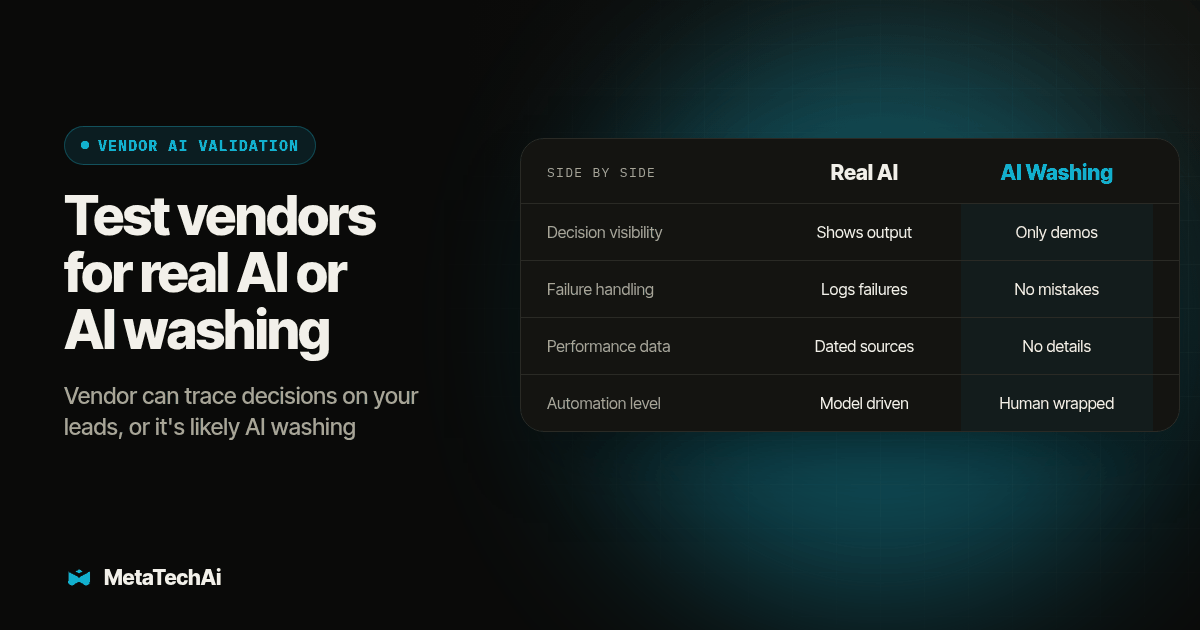
TL;DR: "AI washing" is now a named regulatory problem, not just a buyer's suspicion. The SEC fined two investment advisers in March 2024 for marketing AI capabilities they did not actually have. Use the comparison table and the five-step test below to find out whether your AI sales vendor is running real automation or a human quietly doing the work behind a chat widget.
We install AI sales and marketing systems for service businesses with sales teams, and more of our discovery calls now start with the same worry: "the last vendor called itself AI, and we're not sure it ever was." That worry has a name now. In March 2024, the SEC brought its first enforcement actions specifically naming "AI washing," and the playbook those two companies used (real-sounding language, no way to verify it, nobody asking until it was too late) is the same playbook a sales or calling vendor can run on a service business. Below is the buyer framework we use internally before we trust a vendor's AI claims, including our own.
What is "AI washing" and why does it have a regulator's name now?
AI washing describes a company that markets a product as AI-driven when the underlying system does not do what the marketing says. It is the AI-era version of greenwashing: the label targets whatever claim buyers currently reward, not what the product actually does. The term moved from internet shorthand to formal enforcement language on March 18, 2024, when the Securities and Exchange Commission settled charges against two registered investment advisers, Delphia (USA) Inc. and Global Predictions Inc., for making false and misleading statements about their use of artificial intelligence (SEC, March 2024).
Nobody needs to be a registered investment adviser for this pattern to apply. A sales vendor selling "AI qualification" or "AI voice agents" to a service business is making the same kind of verifiable, falsifiable claim: does the system actually do the thing, on real data, the way it's described? The SEC cases are useful precisely because they are public, documented, and penalized, which means you do not have to take our word for what AI washing looks like. You can read the actual findings.
What did the SEC actually prove, and why does it matter to a sales vendor buyer?
Both cases involved specific, checkable claims that did not hold up once regulators looked at what the systems actually did.
Delphia told clients and prospective clients that it could "analyze the collective data shared by its members to make intelligent investment" decisions and that it could "predict which companies and trends are about to make it big." The SEC found Delphia never actually incorporated client data into its algorithms in any meaningful way, despite that language appearing in its marketing. Global Predictions claimed its platform "incorporated [e]xpert AI driven forecasts" and marketed itself as the "first regulated AI financial advisor," a claim it could not substantiate with documentation when asked. Delphia and Global Predictions each agreed to pay a separate civil penalty to settle the charges, which included violations of the Investment Advisers Act's marketing and compliance rules (Mayer Brown, April 2024).
Notice what actually triggered the penalty in both cases: it was not that the companies used AI badly. It was that they described a specific capability (incorporating client data, generating AI-driven forecasts) that, when checked, was not true. That is the exact test a service business can run on its own vendor, without a securities regulator: does the vendor's specific claim about what the AI does match what you can actually observe it doing on your own leads?
Real AI versus AI washing: what's the actual difference on a sales call?
Here is the comparison we walk clients through when they're deciding whether to renew or replace an AI sales vendor. None of these signals require you to understand machine learning. They require you to ask for something specific and see whether the vendor can produce it.
| Signal | Real AI automation | AI-washing red flag |
|---|---|---|
| Decision visibility | Vendor can show you the model's actual output or transcript on one specific, named call or lead, unedited | Vendor only offers a polished demo reel or a hypothetical "here's how it would work" walkthrough |
| Failure handling | Vendor explains what happens when the model gets something wrong, like a dropped handoff or a misread intent, and shows a log of it happening | Vendor says the system "doesn't really make mistakes" or has no process for reviewing wrong outputs |
| Source of results | Performance numbers come with a dated source and a defined measurement window you can check against your own CRM | Numbers are stated flatly ("highly accurate," "cuts response time way down") with no source, date, or method |
| Human-in-the-loop disclosure | Vendor tells you plainly which steps are model decisions and which are a person reviewing or writing the output | Vendor markets a human-reviewed or human-staffed step as fully autonomous without disclosing the person |
| Claim specificity | Claims are narrow and checkable ("flags intent X from call transcripts," "routes based on field Y") | Claims are broad and unfalsifiable ("AI-powered," "intelligent," "predictive") with no way to test a single instance |
| Response to being asked | Vendor answers direct technical questions about the model, data, or process without changing the subject | Vendor redirects to testimonials, logos, or a different, more impressive-sounding claim |
The thread running through every row: real AI automation survives a specific question. AI washing survives only a vague one.
How do you actually test your AI sales vendor, step by step?
Run this before you renew, and run it before you sign anything new. It takes one call with your current sales manager and one with the vendor.
- Pick one real lead or call from the last 30 days, not a vendor-selected example. Choose it yourself from your own CRM or call log, specifically because you don't know in advance how it went.
- Ask the vendor to walk you through what the system did on that exact lead, in order: what it read, what it decided, what it sent or said, and why. A real system can trace this. A human wearing an "AI" label usually cannot, because there's no decision log to point to.
- Ask what happened the last time the system got that type of lead wrong, and ask to see the correction or escalation record for it. Every real automated system misfires sometimes; the question is whether there's a record of it and a defined next step.
- Request the source and date behind every performance number in their pitch deck, matched against your own tracked outcomes for the same period. If a number can't be tied to a dated, named source, treat it as a claim, not a fact, until it is.
- Ask directly which steps in your specific workflow are model-driven and which are a person, by name of the step, not in general terms. A vendor running a hybrid human-plus-AI service should be able to answer this in one sentence per step.
If a vendor can walk through all five without stalling, redirecting, or asking for more time to "pull that together," you're likely looking at real automation. If more than one step produces a vague answer or a request to circle back, that's worth treating as a signal, not an accident.
What should you actually ask for, in writing, before you sign or renew?
Use this as a message to send your current or prospective vendor. Keep it short enough that dodging it is obvious.
Copy this before your next vendor call or renewal:
1. Show me one real, unedited transcript or call log from the last 30 days, selected by us, not by you.
2. Walk me through what the system decided on that specific lead and why.
3. Show me a case where the system got something wrong and what happened after.
4. Send the source and date behind every performance number in your materials.
5. Name which steps in our workflow are model decisions and which are a person.
6. If you have a compliance or security certification claim, send the actual certificate or audit letter, not a badge.
A vendor running real automation can usually answer most of this on the same call, because the answers already exist in their own logs. A vendor that cannot produce the requested evidence should explain what is missing and when it can be reviewed. Until then, treat the capability as unverified.
Should you cancel a vendor over this, or is there a middle step first?
Not automatically. Finding one vague answer on the checklist above is a reason to ask a sharper follow-up question, not a reason to terminate a contract the same afternoon. The useful next step is usually the same ROI audit we recommend before any AI sales vendor renewal, which checks the vendor's own performance claims against your actual pipeline data rather than their dashboard. Our guide on verifying an AI sales vendor's ROI claims before buying walks through exactly how to run that comparison, and it pairs directly with the washing test above: one checks whether the system is real, the other checks whether its results are real.
If the vendor's answers raise a genuine switching question, read the contract before you decide anything. Our vendor lock-in contract red flags guide covers the auto-renewal terms, data-export restrictions, and termination fees that turn "we found a problem" into "we're stuck paying for it anyway." A vendor confident in its own technology rarely needs those terms to keep a client.
Where does this leave the "off the shelf versus custom" decision?
Vague, unfalsifiable AI claims show up more often in generic, one-size-fits-all tools than in a system built around your actual workflow, mostly because a generic tool has to market to everyone with the same broad language. That is not a universal rule, but it is a pattern worth knowing before you compare options. If you are weighing a packaged platform against something built specifically for your sales process, our breakdown of custom AI agents versus off-the-shelf tools for service businesses covers that tradeoff directly, including where a generic tool is genuinely the right call.
Our managed services team runs the vendor test above as a standard part of any AI sales system we stand up or take over, including the systems we build ourselves. We'd rather you hold us to the same five questions than take our word for it, and our guarantee (conversions go up or you don't pay) only means something if you can actually verify what the system did to get there.
Is "AI agent" even a term with a fixed meaning, or does every vendor define it differently?
It's worth settling that question before you evaluate any vendor's claims against it, because "AI agent" gets used loosely enough that two vendors can mean completely different things by it. AI Guy's plain-language explainer on what an AI agent actually is is a useful baseline definition to hold a vendor's pitch against: if what they're selling doesn't match the basic mechanics of an agent (it reads input, makes a decision based on rules or a model, and takes an action), the "AI agent" label is doing marketing work, not technical work.
What do service businesses ask most before trusting an AI sales vendor's claims?
What does AI washing actually mean, in plain terms?
It means a company describes a product as AI-driven when the real work is done by a human, a basic script, or a model that never touches the data the company claims it uses. The term comes from the same pattern as greenwashing: the label is about the technology, not the environment, but the dishonesty works the same way. The SEC used the term in March 2024 when it charged two investment advisers for exactly this, and the pattern applies just as directly to a sales or calling vendor marketing itself to a service business.
What should a vendor show us before we sign, and how long should that take?
Ask for a live or recorded call where you can see the model's actual decision on a real lead, not a curated demo script. A vendor running real automation should be able to explain what evidence is available, who can access it, and what privacy limits apply. If the evidence is unavailable, ask why and agree on a documented next step before treating the claim as verified.
Does this apply to vendors that are upfront about using human agents plus AI tools?
No, and that distinction matters. A vendor that tells you up front which parts are human and which parts are model-driven is not AI washing, it is a hybrid service, and plenty of those work well. The problem is a vendor that markets the human-staffed parts as autonomous AI without disclosing the human in the loop. Ask directly which specific steps in your workflow are model decisions and which are a person reading a script or editing an output, and expect a straight answer.
What is the switching cost if we find out partway through a contract that the AI claims don't hold up?
It depends on what the contract actually locked you into, which is why the vendor's contract terms matter as much as its sales deck. Before you sign anything, review auto-renewal terms, data-export restrictions, and termination fees so you understand the cost of leaving.
Can a vendor claim HIPAA or compliance certifications to prove its AI is legitimate?
A compliance certification proves the vendor meets a specific security or privacy standard; it does not prove the AI claims about decision-making, accuracy, or automation are true. Treat certification claims and AI-capability claims as two separate things to verify, and ask for the actual certificate or audit letter rather than a badge on a website, since vendors have been penalized for wording a compliance claim more broadly than what was actually earned.