
AI Vendor Lock-In: Red Flags to Check Before You Sign
By MetaTechAi ·
A service business can tell an AI sales vendor is building in lock-in by reading three parts of the draft contract before signing anything: the minimum term and renewal clause, the data-export and cancellation terms, and the integration language that describes how your prompts, scripts and lead data are stored. If any of those three sections are vague, silent, or written entirely in the vendor's favor, that is the signal to negotiate before you sign, not after you are a customer trying to leave. Use this review when scoping managed AI services for a service business with a sales team, and keep the answers alongside the proposed agreement.
Why Does an AI Sales Vendor Contract Create Lock-In in the First Place?
AI vendor lock-in is not usually intentional sabotage. It is what happens when a vendor's product gets built one way, and that way happens to make leaving expensive. A 2026 guide from Master of Code on avoiding AI vendor lock-in names the contract components to check directly: data ownership and export rights, who owns the prompts and configuration your team builds, advance notice before a model is retired, and notice of changes to pricing and terms (Master of Code, 2026). The same guide draws a line between where your data is stored and whether you can actually get it out, noting that a compliant storage location "does not make migration easy if those assets cannot be exported in a useful format." None of that requires bad intent from the vendor. It is simply how the product and the pricing were designed, and unless you read for it, you will not notice until you try to leave.
A separate buyer checklist from RedHub.ai, 2026 raises the same concern through questions about workflow portability and model dependency. Its discussion is evidence that this pre-signature question is being addressed publicly, not evidence of how frequently buyers encounter it. For your review, ask for a demonstration of what can move and a written explanation of what must be rebuilt. A supplier's general description of portability cannot answer that question for your particular workflow.
Those two sources describe the same failure from different angles: one lives in the contract language, the other lives in how the product is architected. A service business reviewing a vendor needs to check both.
Which Contract Terms Are the Clearest Lock-In Red Flags?
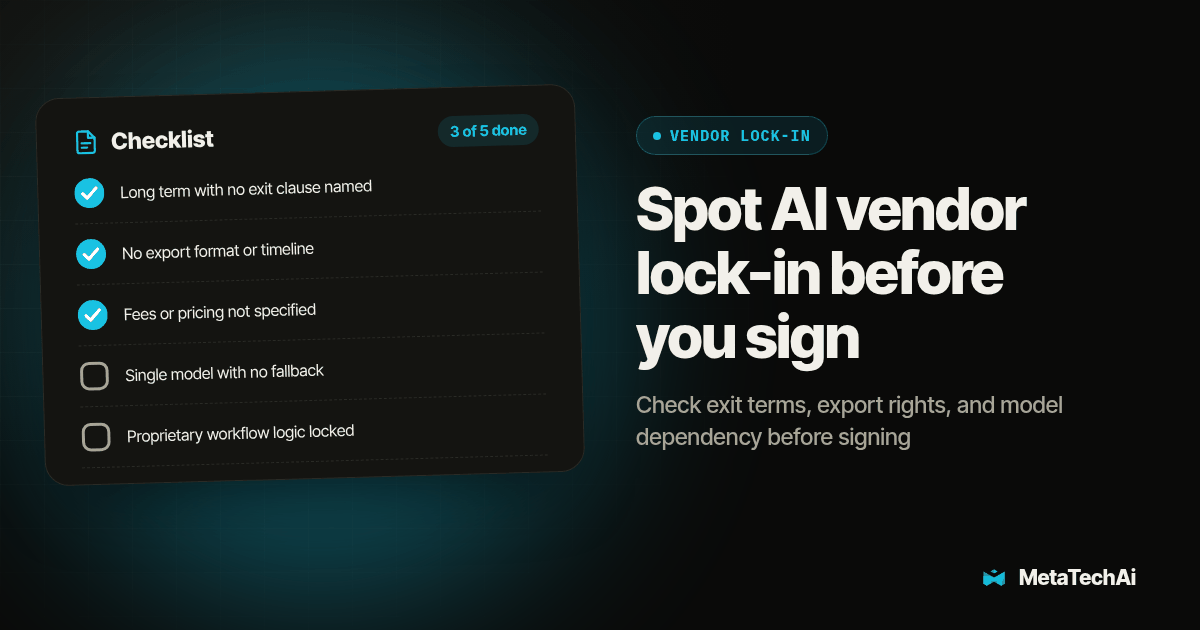
Run this checklist against the draft contract, section by section, before anyone signs. Treat an unresolved item that could stop your sales workflow as grounds for specific edits before moving forward. This is a proposed operational review, not a validated risk score or a substitute for having counsel review the agreement.
- Minimum term longer than your pilot window, with no written exit clause. A twelve-month term may fit an implementation plan; a twelve-month term with no language describing how either side can exit early is the red flag.
- Auto-renewal with a short notice window. If the contract renews automatically unless you cancel within a narrow window, measured in days rather than weeks, mark the exact date on a calendar the day you sign, and confirm who is responsible for sending a reminder.
- Early-termination fees that are not disclosed as a number. A contract that says termination fees "will be assessed" instead of naming a figure or a formula is asking you to sign a blank check.
- Step-up pricing at renewal with no cap. Ask what the per-seat or per-minute rate becomes at renewal, in writing, not as a verbal assurance from a sales rep.
- Data export described as a feature, not a right. "Export available" in a sales deck is not the same as an export clause in the contract that survives cancellation.
- No sample export offered before you sign. Ask for a demonstration using trial or synthetic records and agree on a turnaround time. An untested export leaves its usefulness unresolved before you commit.
- Proprietary or undocumented data formats. If the contract does not name the export format for each data type, audio, transcripts, lead scores, treat portability as unverified until your team opens a sample in an independent tool.
- No model or version inventory disclosed. You should be able to ask which exact AI model and version your account runs on and get a specific answer, not a general reassurance that the vendor "uses the most capable model available."
- Workflow logic that only runs on the vendor's own framework. If your call scripts, prompts, or routing logic are written in a vendor-specific format with no documented way to port that logic elsewhere, the workflow itself is the lock-in, independent of the contract.
- No named point of contact for data and compliance questions after signing. If nobody at the vendor can answer a direct question about where your leads' data lives and who can access it, that absence is itself the answer.
Keep a copy of the ten-item checklist with columns for the contract reference, the vendor's written answer, the evidence checked and the person responsible for closing any gap.
How Do Red-Flag Clauses Compare to What You Should Require in Writing?
| Contract area | Red-flag language | What to require instead |
|---|---|---|
| Minimum term | Long term, no exit clause mentioned | Term length plus a named exit path and conditions |
| Renewal | Auto-renews, short cancellation notice window | Renewal notice sent in advance, with a clear opt-out date |
| Early termination | Fee "to be assessed" at the time of cancellation | A specific fee or formula, stated before you sign |
| Data export | "Export available" with no format or timeline named | Named export formats, a request turnaround time, and a post-cancellation access window |
| Pricing at renewal | Rate subject to change, no cap or formula given | A stated cap or formula for renewal pricing |
| Model dependency | No model or version named anywhere in the agreement | The vendor can name the exact model your account runs and describe how a task would move to a different one |
| Workflow logic | Prompts and routing logic live only inside the vendor's proprietary builder | Logic is documented in a form your team can read and, if needed, rebuild elsewhere |
Does Relying on One AI Model Count as Lock-In?
Not automatically, and this is where a lot of service businesses get the question backward. Every AI sales vendor runs on some model, and there is nothing wrong with a vendor standardizing on one for speed and consistency. The lock-in question is not which model the vendor uses today. It is whether your account depends on that specific model in a way nobody has mapped out, so your review should include both a model inventory and a fallback plan for customer-facing work.
Ask the vendor two direct questions in the sales process: which model and version your account would run on, and what happens to your call scripts and prompts if that model is deprecated or changed. A specific answer gives your reviewer something to verify. A general answer leaves uncertainty about how changes are approved, tested and communicated. Our sister post on switching from ChatGPT to Claude for a small business covers the same tradeoff from the buyer's seat: the real switching cost is rarely the model itself, it is the context and workflow built around it.
What Should You Ask a Vendor Before You Sign?
Consider a hypothetical service business buying an AI appointment-setting workflow. Its owner asks whether the business will own the configured system or only have access while the subscription stays active. That distinction changes what to negotiate. Separate your customer records, your commissioned scripts and the supplier's underlying software, then ask which rights continue after cancellation. Do not assume that paying for configuration transfers ownership of the whole platform.
Ask these questions directly in the sales process, and insist on written answers, not verbal reassurance:
- Can you show me a sample export of a call recording, a transcript, and a lead score, right now, before I sign anything?
- What exact model and version will my account run on, and what happens if that changes?
- What is the fee, in dollars or as a formula, if I cancel before the minimum term ends?
- How many days before renewal will you notify us, and what is the cancellation window?
- If our business logic lives inside your platform's builder, is there a documented way to extract it?
A vendor relationship built on deliverable-based terms rather than vague activity promises tends to answer these questions more directly, because the discipline that defines a measurable metric and remedy also tends to define a clean exit. We cover what that written structure should include in how performance-based AI engagements are written; an outcome guarantee and an exit clause still need separate review. One does not imply the other.
For another hypothetical example, imagine a sales manager who cannot identify which supplier owns the lead-routing rules. Even a readable export will not explain how those rules were intended to behave. Require an owner and a plain-language description of each customer-facing workflow. That gives your team something concrete to compare with both the contract and a possible replacement system.
Should You Build Your Own System Instead of Signing with a Vendor at All?
Sometimes. The lock-in question changes shape if the AI agent your sales team uses is something your own developers built rather than something you licensed. A custom agent can give your team control when ownership and repository access are established, but it carries its own costs: ongoing maintenance, and the risk that only one person on your team understands how it works. We lay out that decision in build a custom AI agent or buy off the shelf. For this review, the decision is narrower than the entire build-versus-buy debate: can your team accept and verify this specific vendor's terms?
How Can You Test the Exit Path Before Signing?
Use this original four-step test on a trial workspace with synthetic records. Keep it away from live customer outreach. The goal is a small evidence pack that the business owner and technical reviewer can read together.
- Define the sample. Create a fictional lead, a transcript, a score explanation and a routing decision. Record their identifiers and relationships before requesting the export. Agree which artifacts the proposed service actually produces.
- Request and open the export. Ask the vendor to use its ordinary export process. Have your reviewer open the files outside the vendor's interface and match each artifact to the original record. Note missing attachments, timestamps or field definitions.
- Reconstruct one decision. Give the documented routing rule and sample record to a colleague who did not configure the system. Ask them to explain the intended next action. If they need undocumented vendor knowledge, record that dependency and request instructions.
- Attach the result to the review. Save the sample files, unresolved gaps, responsible owners and agreed fixes. Compare the demonstrated export with the proposed cancellation terms. Repeat the failed part before signing, or explicitly document the remaining dependency you accept.
Passing this small test does not prove a full migration will be easy. It does turn a broad portability promise into something observable, and it identifies which parts still need a larger technical review.
What If You Are Already Signed and Only Now Checking?
If you are past the signing stage and reading this because something already feels off, the checklist above still works as a diagnostic. Pull your current contract and run it against the ten items. Where you find a gap, request the missing term in writing now, while the relationship is active, rather than waiting for the week you give notice. If the review turns up enough red flags that you are already planning to leave, our guide to switching AI sales vendors without losing your data covers what to export and what to put in writing with the new vendor.
What Do Buyers Ask About AI Vendor Lock-In Before Signing?
Is a longer contract term always a sign of AI vendor lock-in?
Not by itself. A twelve-month term can be workable if its exit conditions and data-export rights fit your implementation plan. The red flag is a long minimum term combined with no exit clause, step-up pricing at renewal, or silence on what happens to your data if you leave before the term ends. Judge the term by what else sits next to it in the contract, not by its length alone.
What is a normal data export fee, and when is it a red flag?
There is no universal export fee to assume. Ask what work is included, whether self-service export is available and how any assisted export charge is calculated. It becomes a red flag when the fee is undisclosed until you try to leave, when it scales with how much data you have stored instead of the work involved, or when the contract lets the vendor set that fee unilaterally at cancellation instead of naming it up front.
Does using only one AI model mean we are locked in?
Using one model today is not lock-in. Lock-in is when your prompts, your workflow logic and your integrations are written in a way that only that one model or vendor can run, with no documented path to point the same task at a different model. Ask whether the vendor can name the exact model version your account is running and whether swapping it requires a rebuild or a setting change.
What compliance or audit rights should the contract include?
At minimum, the right to request a sample export of your own data while the contract is active, not only after cancellation, and a named point of contact for compliance questions about how your leads' information is stored and used. If the vendor touches regulated data, such as health or financial information, the contract should also state what safeguards apply and should never claim a certification the vendor cannot show you in writing.
How much does it cost to switch AI sales vendors if the contract has no exit clause?
Switching costs can include rebuilding history and recovering context as well as contractual charges. Without an exit clause, you may rebuild call scripts, retrain lead scoring from zero and re-map CRM fields by hand, on top of whatever early-termination charge the contract allows the outgoing vendor to apply. Reviewing the exit clause before signing helps you assess those obligations while you can still negotiate them.
What Should You Do Next?
Pull whatever draft contract is sitting in your inbox right now and run the ten-item checklist against it before you sign anything, even if the vendor has already told you the deal needs to close this week. Ask for specific written answers about exit fees, data formats and model dependency. An unanswered question remains an unresolved risk, even when the sales presentation sounds reassuring. MetaTechAi installs AI sales and marketing systems for service businesses with sales teams, with a conversions-up-or-you-don't-pay guarantee. Bring your workflow requirements and vendor questions to the scoping conversation so the proposed outcome, responsibilities and exit arrangements can be discussed before implementation.