
Selling to a Buyer Who Already Compared Quotes
By MetaTechAi ·
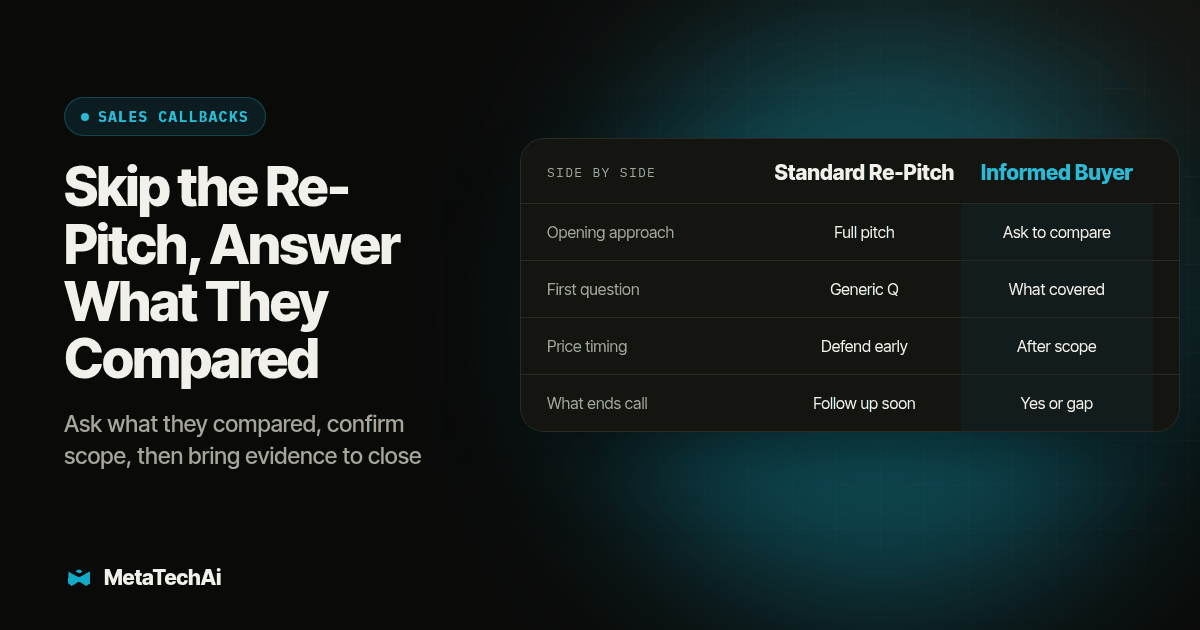
TL;DR: When a buyer calls back already holding two or three competitor quotes, do not re-run your standard pitch. Open by asking what those quotes covered, answer the specific gaps that are actually still open, and have your evidence (reviews, warranty terms, proof from past jobs) ready instead of a script. The buyer already did the shopping; your job on this call is to resolve what shopping could not tell them.
A buyer who calls back after comparing quotes does not need to hear why your company is good. They need the two or three specific questions answered that a spreadsheet of prices could not answer for them: what is actually included, what happens if something goes wrong, and whether the other company's cheaper number is the same job or a smaller one. We install AI sales systems for service businesses with sales teams, and recommend that reps use these callbacks to answer those questions directly.
Why Does the Standard Callback Script Fail Here?
Most quote follow-up scripts were written for a buyer who is still deciding whether to buy at all. They walk through value, handle objections about need, and build urgency. None of that fits a buyer who has already decided to buy something and is now choosing between three people who can do it.
Forrester's January 21, 2026 buyer insights release describes business buyers using generative AI for research while still seeking human validation of incomplete or unreliable answers. Its February 24, 2026 analysis of buyer preference reports that 68 percent of B2B buyers in its 2025 Buyers' Journey Survey had a front-runner at the start, and that vendor won 80 percent of the time. These are B2B research findings, not measured outcomes for home service callbacks. They support preparing for an informed buyer, not assuming every caller has used AI or already decided.
The practical implication is to ask what the buyer researched and which questions remain. They may have compared written quotes, read reviews, asked an AI tool for a summary, or spoken with a neighbor. Treat each as a starting point to verify rather than a complete account of the job.
This is different from the timing question we cover in our service quote follow-up guide, which is about when to call back. This is about what to say once the buyer picks up and you can tell, from the first thirty seconds, that they already know the field.
What Should the Callback Call Actually Open With?
Open with the fact that you expect them to have shopped, not with your pitch. That one move changes the whole call, because it tells the buyer you are not about to waste their time re-explaining things they already know.
Here is a seven-step opening procedure to rehearse for this specific call type:
- Name it first. "Most people call us back after getting two or three quotes, so I'm guessing you did the same, is that fair?" This gets the shopping out in the open instead of the buyer deciding whether to volunteer it.
- Ask what the other quotes covered. "What did the other companies include in their number, and what did they leave out?" Scope, not price, is where most quote confusion actually lives.
- Ask what stood out, good or bad. "Was there anything one of them said that made you more or less comfortable?" This surfaces the real objection before you have to guess at it.
- Confirm the job, not the price. Restate the scope of the job as you understand it and have them correct you if a competitor's quote covers something different.
- Answer the specific gap, not the category. If they said a competitor's crew showed proof of a similar job, pull up your own proof. If they said another quote was cheaper, go to step 6 before responding to the price itself.
- Lay the quotes side by side on scope, not number. Walk the buyer through what is and is not included in each quote they mention, using their own words for what the competitor said.
- Ask for the decision, not for more time. "Based on what we just walked through, does this answer what was still open for you?" If they need more time or another decision maker, agree on a next step that respects that need.
Practice the sequence in a short roleplay, but do not turn a rehearsal target into a customer deadline. End the live call when the buyer has the evidence needed for a decision or when you have agreed who will resolve the remaining questions.
How Does This Callback Script Compare to the Standard Re-Pitch?
| What the call does | Standard re-pitch script | Already-informed-buyer script |
|---|---|---|
| Opens by assuming the buyer hasn't shopped | Yes, walks through full value pitch from scratch | No, names the likely comparison shopping directly |
| First question asked | "Do you have any questions about our service?" | "What did the other quotes cover, and what stood out?" |
| How price objections get handled | Rep defends the number or offers a discount | Rep compares scope line by line before discussing price at all |
| Evidence used | General company reviews and claims | Specific proof tied to the exact gap the buyer named |
| Call pacing | Follows the full deck regardless of open questions | Follows the remaining questions and agreed next step |
| What ends the call | Rep asks to "follow up again soon" | Rep asks for a yes or a specific remaining objection |
The table's middle rows are the actual difference. A rep who defends price before confirming scope is arguing a number the buyer cannot yet evaluate, because the buyer does not know if the two quotes describe the same job.
What Evidence Should Be Ready Before the Call, Not During It?
Searching for evidence during a call can interrupt the conversation. If the answer is not verified, say so and agree when you will return with it; guessing is not a useful substitute for preparation. Build a folder, not a memory, for this:
- Reviews sorted by the job type you quote most, not a generic star rating. A buyer comparing roofers wants to see a review about a roof like theirs, not five reviews about gutter cleaning.
- Warranty terms written in plain language, including what voids them, printed or linked somewhere the rep can pull up in seconds.
- Before-and-after proof from a similar past job, with the property type or project size noted so the rep can match it to what the buyer described.
- A one-page scope comparison template the rep fills in live on the call (see the template below) instead of trying to hold two competitors' quotes in their head.
None of this replaces the rep's judgment. It replaces the search time that makes a rep stall on a call they should be winning.
Copy-paste scope comparison template
Use this on the call itself, filling in each column as the buyer describes what they heard from the other companies:
Job: ______________________
                 Our quote        Competitor A        Competitor B
Scope included:  ______________   ______________      ______________
Scope excluded:  ______________   ______________      ______________
Warranty:        ______________   ______________      ______________
Timeline:        ______________   ______________      ______________
Quote reference:  __________        ______________      ______________
Compare the amounts only after completing the scope rows. A rep who starts with price ends up defending a number before the buyer has agreed on what that number actually buys.
How Do We Train Reps to Stop Defaulting to the Old Pitch?
Habits built on a cold-call script do not disappear because a manager says "be more direct." Reps default to what they rehearsed most. Retrain the specific moment, not the whole call.
Run a short roleplay where the manager plays a buyer who opens with "yeah, I got two other quotes already." Watch what the rep says in the next ten seconds. If it is any version of "well, let me tell you what makes us different," that is the habit to break, and it is worth pointing out in the moment rather than after the call.
We cover the deeper version of this training question, what should stay a rep's judgment call versus what a script or an AI assistant can carry for them, in our guide on sales process automation. The short version for this specific call type: the opening question and the scope comparison template can be scripted and even prompted by an AI assistant ahead of the call. The read on what actually stood out to the buyer, and the decision on how far to flex on scope, stays with the rep.
What If the Buyer Picked Us Because We Were the Cheapest Quote?
Treat it as a scope question before you treat it as a pricing win. A buyer who chose you on price alone, without confirming scope against the other two quotes, may call back upset after work begins if they realize something they assumed was included was not.
Walk the same scope comparison with them even when you won on price. It takes a few extra minutes and it is the clearest way to prevent the lost-deal pattern we wrote about in our guide on reviewing lost-deal reasons with real evidence: deals that look won on the call and then quietly cancel once the buyer discovers the real scope.
And if pricing itself, not just scope, is a recurring sticking point on these calls, our guide on whether AI should set the price on a quote covers where automation can speed up the number and where a human still needs to own it.
How Does This Fit Into a Broader AI Sales System?
A callback script is one call. The pattern behind it, catching that a buyer already has competitor information and routing the right evidence to the rep before they pick up, is the kind of handoff we build into managed AI sales systems for service businesses. The CRM note should already flag "buyer mentioned competitor pricing" before the rep dials back, and the rep's evidence folder should already be one click away instead of a search mid-call.
Texting plays a role here too. A buyer who just finished comparing quotes by phone often prefers to review a written scope comparison on their own time rather than take a second call. Beam's outbound texting can support written follow-up. After the buyer agrees to receive it, have the rep send a link to the reviewed comparison, so the buyer can check the details instead of relying on memory.
MetaTechAi installs AI sales and marketing systems for service businesses with sales teams. Our guarantee is that conversions go up or you do not pay. Agree on the conversion definition, baseline and measurement window before rollout so the callback workflow is judged against an actual outcome.
None of this replaces the rep asking the right first question. It just makes sure the rep walks into the call already knowing it is coming.
What Do Service Sales Teams Ask About Selling to an Already-Informed Buyer?
How do we find out which competitors a buyer already got quotes from?
Ask directly, early in the call, before you say anything about your own pricing: "Who else did you get a quote from, and what stood out from those conversations?" If they choose to share, use their answer to identify what needs clarification. If they prefer not to name companies, ask about the scope and decision criteria without requiring names.
Should we still walk through our full pitch if the buyer says they already compared us to two other companies?
No. A buyer who names competitors has essentially heard the category pitch already, more than once. Walking through your standard deck again signals that you were not listening, which is a worse outcome than a short, specific call. Replace the pitch with direct answers to whatever made the other two quotes attractive or unattractive to them.
What do we say when the buyer picked a competitor mainly because that quote was cheaper?
Do not argue the number down on the spot. Ask what the cheaper quote included and excluded, in writing, then compare that scope line by line against your own quote so the buyer sees whether it is actually the same job. Scope differences can explain a gap, but equivalent work can also carry different quotes. Verify the documents before offering an explanation, and leave any unknown item marked for confirmation.
How long should a callback call take when the buyer already knows the field?
Let the remaining questions set the length rather than enforcing a universal call duration. The buyer has already spent time researching; a long call at this stage reads as either disorganized or as padding for a weak answer. Confirm what they already know, answer the two or three things that are actually still open, and get to a decision or a next step.
Does this change how we train a new sales rep on quote follow-up calls?
Yes. A rep trained only on a cold-pitch script will default to re-pitching because that is the only script they have. Give new reps a second script specifically for callback calls where the buyer already has quotes in hand, and have them practice the opening line, "what did the other quotes cover," before they take a live one.