
Sales Process Automation: What Stays Human
By MetaTechAi ·
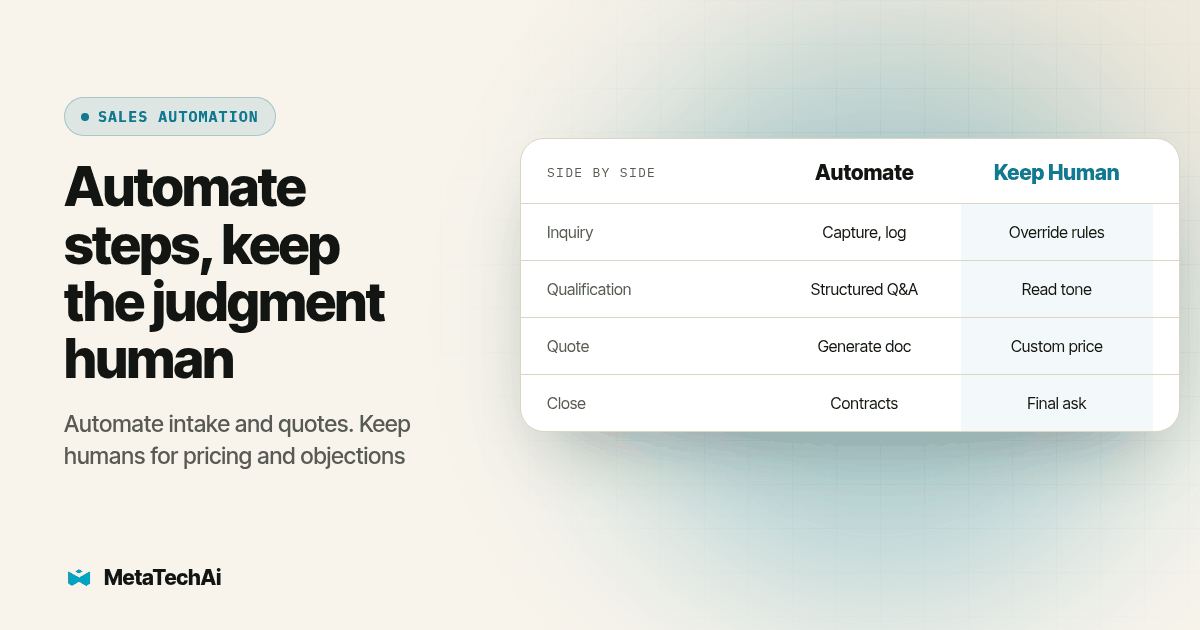
Automate the steps that are high volume and low judgment: capturing and logging an inquiry, structured qualification questions, generating a quote document, follow up cadence and reminders, and contract or payment paperwork. Keep a person on the steps that need judgment, negotiation or reading a reaction: unusual routing calls, probing a vague answer, pricing a custom scope, and the actual close. Measure every split by the conversion rate at that step, not by how many messages went out.
Consider a service business that already has a CRM and a few automations running, but whose owner wants to know which part of the sales process is actually safe to hand to a system. Most answers online default to "automate the repetitive stuff," which is true but useless without a map. So here is the map: five steps most service sales processes share, a clear call on each one, and a way to test whether you got the call right.
What are the five steps in a service business's sales process?
Strip away the CRM-specific stage names and almost every service business runs the same five steps in roughly this order:
- Inquiry. A lead calls, fills out a form, or messages in, and that contact has to get captured and logged somewhere real.
- Qualification. Someone, or something, asks enough questions to know whether this is a fit and how urgent it is.
- Quote or estimate. A price or scope gets put in front of the buyer, in writing, with enough detail to act on.
- Follow up. When the buyer doesn't respond right away, and someone has to keep the conversation alive without becoming a nuisance.
- Close. The buyer says yes (or no), terms get confirmed, and the deal moves to delivery or it doesn't.
A sixth step, post-close handoff to delivery or job scheduling, matters too, but it sits outside the sales process proper and deserves its own treatment. We're sticking to the five steps a sales team actually owns.
Which of those steps should a system own?
The steps, or parts of steps, that are high volume and low judgment. For each task, ask whether the written rule and available records are enough to choose the next action. If missing context could change that choice, assign an owner to review it. Nobel Recruitment's discussion of automation and human sales roles similarly distinguishes repeatable tasks from work requiring judgment.
By that test, here is what belongs to a system:
Inquiry capture and logging. There is no judgment in recording that a lead came in, tagging its source, and creating a task with an owner and a due time. This step is pure plumbing, and it should run itself every single time.
The structured part of qualification. Budget range, timeline, service type, property type, whatever your fixed intake questions are, those can be asked and scored by a form, a chat flow or a voice agent before a human ever gets involved. The output is predictable because the inputs are structured.
Generating the quote document. Once scope and pricing inputs are set, producing the document, applying the standard terms and sending it is calculation and formatting, not judgment.
Follow up cadence. Deciding when the third touch goes out, and sending it, is scheduling. A system should fire reminders, log every attempt and nudge a non-responder on a set cadence without anyone having to remember to do it.
Contract and payment paperwork. Once terms are agreed, generating the contract, sending it for signature and chasing a payment reminder is administrative, not relational.
Outreach's sales process automation guide recommends starting with repeatable administrative tasks and testing a limited rollout. Treat that as implementation guidance, not a promised timeline or proof of results for your own team.
Which steps need to stay human?
The parts of each step where a wrong guess costs you the deal, or where a person on the other end is actually trying to tell you something a form can't capture.
Judgment calls inside qualification. A structured form can log that someone said "maybe later," but it can't tell whether that's a real stall or a buyer who's actually comparing two quotes right now and deciding fast. That read belongs to a person. For a hypothetical insurance agency, license state and territory can be explicit routing rules. A system can apply those rules when the fields are reliable. Missing licensing information or a case outside the approved criteria should create a human review task rather than force an assignment. This is a useful distinction: complex rules can still be automated; unresolved exceptions need an owner.
Custom scope pricing and negotiation. A standard service at a standard price can be quoted by a system all day. A custom job, a price objection, or a buyer asking "can you match this other number" needs a person who can weigh the specific deal in front of them, not a rule written for the average one. For example, a hypothetical field-sales team could route by property address and territory once those rules are documented. If an address is incomplete or falls outside the service area, hold the appointment for review. The need for a review comes from uncertainty in the record, not from an assumption that software cannot handle territory routing.
The actual ask at close. Confirming paperwork is administrative. Handling the last objection, negotiating final terms, or reading hesitation in someone's voice on a call is not, and it can determine whether the buyer is ready to proceed.
Relationship-critical moments. Executive introductions, a strategic account renewal, or a service recovery conversation after something went wrong all depend on a person who can read tone and adjust in real time (Outreach, sales process automation).
Deal size and complexity change where this line sits. The higher the contract value and the more people involved in the buying decision, the more a human presence matters at every step, not just the close (Nobel Recruitment).
Where does the automate-or-human call actually land, step by step?
| Step | What a system should own | What stays with a person | Why |
|---|---|---|---|
| Inquiry | Capture, log, instant acknowledgment, simple rule-based routing | Overriding the routing rule when a case doesn't fit it | No judgment in logging; judgment in the exceptions |
| Qualification | Structured intake questions, scoring against fixed criteria | Reading tone, probing a vague or stalling answer, assigning complex cases | Predictable inputs stay automated; ambiguous ones don't |
| Quote or estimate | Generating and sending the document, standard pricing, standard terms | Custom scope pricing, matching or explaining a number that surprised the buyer | Calculation is a system task; negotiation is not |
| Follow up | Cadence, reminders, non-responder nudges, logging every attempt | A call once the lead signals real interest or raises an objection | Scheduling is mechanical; the actual conversation isn't |
| Close | Contract generation, e-signature requests, payment reminders | The final ask, objection handling, negotiating terms | Paperwork is administrative; closing is relational |
How do you audit your own process before changing anything?
Don't start by automating. Start by measuring what you already have, so you know whether a step is actually safe to hand to a system or whether you're guessing. Use this procedure to audit one workflow before changing it:
- Write down your real five steps, in the order a lead actually moves through them, not the order your CRM's dropdown implies. Check whether the CRM's stage names match what reps actually do.
- Pull your most recent closed and lost deals and read through what happened at each step, not just which stage they sat in.
- For each step, count how often a rep made a real judgment call versus just followed a script or filled in a form. A step where judgment shows up rarely is a strong automation candidate; a step where it shows up often is not.
- Note where deal complexity varies widely. If some deals at a step are simple and some are highly custom, that step probably needs a hybrid rule, automate under a complexity threshold, route to a person above it, rather than a flat yes or no.
- Record a conversion baseline for the step you're about to change, before you change anything. Without this number, you have no way to know later whether the automation helped, hurt, or did nothing.
- Automate one step at a time, starting with the step farthest from the close. Check capture and ownership first because missing records undermine every later comparison. Test with labeled records before exposing real leads to a changed workflow.
- Compare the conversion rate at that step, not the volume of activity, after the new version has run for a full cycle. More texts sent or more quotes generated is not the same as more deals won.
That order matters because each step's data depends on the one before it. You can't trust a stage-change conversion number if the inquiry step isn't logging consistently yet, and you can't judge a follow up cadence if you never captured a baseline before turning it on.
What does a copy-paste automate-or-human worksheet look like?
Run this on one step at a time. Fill in every column before you turn anything on for real leads.
| Field | What to write down |
|---|---|
| Step name | The exact step you're evaluating, from your five-step map above |
| Judgment frequency | How often, in your recent deal review, this step required a real judgment call rather than a scripted response |
| Complexity spread | Whether deals at this step are mostly uniform or vary widely in scope and size |
| Decision | Automate, keep human, or hybrid with a stated threshold |
| Owner | Who is accountable if the automated version misfires |
| Conversion baseline | The current conversion rate at this exact step, recorded before any change |
| Review date | When you'll check the new conversion rate against the baseline |
Why measure by conversions instead of activity?
Because activity is the easiest number to move and the least useful one to trust. A system can send more texts, generate more quotes and log more calls without a single extra deal closing, and a dashboard full of rising activity numbers will make that look like progress. Stage conversion and eventual closed deals help judge the result. Also inspect complaints, errors and lead mix so an apparent improvement does not hide a broken experience or a change in who entered the pipeline.
This is also the standard we hold ourselves to. Our managed AI services work installs exactly this kind of split, calling, qualification, follow up and booking, under a guarantee that conversions go up or we don't get paid for the work. Agree the conversion definition, baseline, measurement window and covered work in writing before launch. The engagement agreement determines coverage and remedy; this worksheet does not add new guarantee terms.
Nobel Recruitment's sales-role discussion argues that automating administrative tasks changes the work people do rather than automatically removing their roles. In this worksheet, that means identifying the actual conversation a rep will own after the system completes its part. A notification without a responsible person and a next action is an unfinished handoff.
Our AI infrastructure planning work helps plan this audit: mapping which of your five steps your current tools already support, which need configuration, and where a human approval point belongs before anything touches a real lead. If your real blocker turns out to be that reps aren't working the leads a system hands them, our build order for fixing that covers the task-and-nudge layer that makes follow up actually happen. And once the split above is live, the first five CRM automations to build is the order we'd build them in.
One more place this split shows up concretely: outbound calling at the follow up and close steps. RizzDial's cost comparison between an AI dialer and a human SDR walks through where a dialer earns its place in that mix and where a live rep still wins the call, which is the same automate-or-human question this article asks, just narrowed to one channel.
What do service sales teams ask about automating their process?
How long does it take to map our sales process and decide what to automate?
Timing depends on the quality of your records and whether reps agree on the real process. Start by reviewing recent closed and lost deals, then interview the people who handled unclear transitions. Estimate the remaining mapping work after that review instead of assuming every team can finish within a fixed number of hours.
Do we have to replace our CRM to split a step between a system and a person?
Not necessarily. First check whether your existing CRM can record the required events, assign an owner, pause outreach and route an exception. Test those actions together with a labeled record. A workflow decision does not by itself require a database migration, but compatibility depends on your configuration and integrations.
The FTC telemarketing guidance describes calling-time and Do Not Call duties for covered calls. Confirm the rules that apply to your channel and campaign before implementation.
Does automating qualification or follow up create TCPA or consent risk?
It can. Have the person responsible for compliance confirm the applicable consent, sending-time and opt-out requirements for each channel before launch. Keep suppression checks inside each workflow and route uncertain records for review. This process checklist is not a determination that a particular campaign complies with the law.
What happens if we automate a step that should have stayed human?
Look for missed exceptions, complaints and conversion changes at that step. Pause the affected branch when it produces an unsafe or incorrect outcome, review the records, and restore human approval where needed. Compare similar leads over a suitable measurement window before attributing a conversion change to automation alone.
Does MetaTechAi's conversions-up-or-you-don't-pay guarantee cover this kind of process split?
MetaTechAi's standing guarantee is that conversions go up or you do not pay. Agree which workflow, conversion metric, baseline and measurement window the engagement covers before work starts. Put the covered work and remedy in the agreement rather than treating every proposed automation as a separately guaranteed outcome.