
Will AI Replace Your Sales Team? Service Business Guide
By MetaTechAi ·
TL;DR: AI can take over repetitive work around a service business sale, but it is not a reason to remove the people responsible for trust, negotiation and closing. Start with research, qualification support, CRM notes and follow-up timing. Keep a named human accountable for exceptions and the final agreement.
The replacement question matters when an owner is deciding whether to hire another rep or improve the process the current team already uses. A useful answer starts with tasks rather than job titles: which steps repeat predictably, which need approval, and which depend on understanding a buyer whose requirements may change during the conversation?
Will AI Replace Your Service Business's Sales Team?
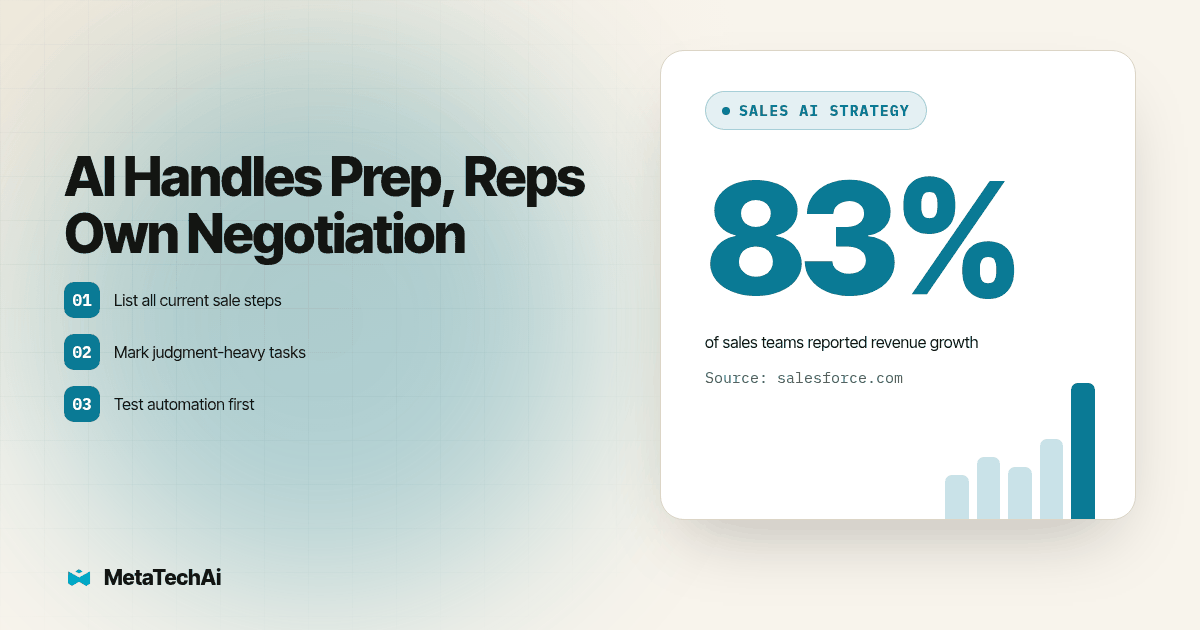
Do not plan on replacing the whole team. In Salesforce’s July 2024 State of Sales findings, 83% of sales teams using AI reported revenue growth, compared with 66% of those without it. Reps also reported spending 70% of their time on nonselling work. These are survey associations, not proof that AI caused growth or that all administrative time can be automated. Use the findings as a reason to examine work allocation, not as a forecast for your own results. Research, data entry and draft follow-up are candidates; deciding how to resolve a buyer’s concern still needs a responsible owner.
We built our managed services model around that split on purpose. Instead of selling a tool and walking away, we install the AI layer, run it against your existing sales motion, and guarantee conversions go up or you do not pay. That guarantee only works because we are specific about what AI owns and what a rep owns, which is the part most vendors skip.
What Does AI Actually Take Off a Rep's Plate?
The honest list is shorter than most AI vendors pitch, and more useful because of it.
AI is good at anything that is repetitive, rule-based, and does not require reading a person's tone in real time. In a service business sales pipeline, that means:
- Acknowledging a new inbound lead promptly, with delivery and routing checked before claiming a response target.
- Qualifying a raw list against basic fit criteria (service area, budget signal, timing) so reps stop dialing people who were never going to buy.
- Drafting call notes and proposed CRM updates after a call, with checks before changing consequential fields.
- Flagging a lead that went quiet for fourteen days instead of letting it rot in a rep's "later" pile.
- Drafting the first version of a follow-up email or text so a rep edits instead of starting from a blank screen.
These tasks still need accurate inputs, approved rules and an exception path. AI can misread a note or infer a budget the buyer never gave. Test whether it preserves the source statement, flags missing information and avoids changing a stage without evidence. Speed is useful only when the record and the next action are correct.
Which Parts of the Sale Still Need a Human Closer?
A useful boundary is to keep relationship decisions with a rep: exploring a concern, handling an objection outside the approved script, and working with several decision makers who do not yet agree. AI can prepare a summary or suggest questions, but the rep should verify what the buyer actually said before choosing the next move.
Buyer hesitation also deserves its own diagnosis. Challenger’s JOLT Effect training overview describes how uncertainty can stall a purchase and why sellers need to help buyers navigate it. That supports reviewing the conversation, not merely increasing message frequency. A buyer may need a clearer explanation of scope, agreement from another stakeholder, or time to evaluate the commitment. A rep should find out which concern applies rather than let an automated sequence assume every silence means the same thing.
Consider a hypothetical B2B team whose AI caller books meetings but whose reps reject the appointments. If nobody defined what qualified means, a full calendar can hide the problem. Review a sample of booked meetings against the actual service area, requested work, decision maker and agreed next step. The correction may be a tighter qualification definition and an accepted handoff, rather than a different voice model. This is an example to test against your records, not a reported client result.
How Do You Map Each Task to AI or a Rep?
Run this as a working session with your sales manager and one senior rep in the room, not as a solo spreadsheet exercise. Reserve a working session long enough to trace real records and settle disputed ownership.
- List every step in your current sale, from first contact to signed agreement, in the order it actually happens, not the order your sales deck describes.
- Mark each step judgment-heavy or judgment-light. Judgment-light steps follow a rule every time (if lead fills form, send confirmation text). Judgment-heavy steps change based on what the buyer says or does.
- Consider each judgment-light step for automation. If a rep is doing it purely because "that's how we've always done it," that is a signal, not a reason to keep it manual.
- Assign every judgment-heavy step to a human by default, and write down why, specifically, a rule cannot handle it. If you cannot name the reason in one sentence, test whether AI can actually handle part of it.
- Build the handoff point. Decide exactly what the AI passes to the rep (lead record, qualifying answers, call transcript, suggested next step) and in what format, before the first live lead goes through it.
- Pilot on one lead source for one full sales cycle. Do not flip your entire pipeline at once. Pick your highest-volume, lowest-complexity source and run the split there first.
- Review close rate and rep feedback at the end of the cycle, not just lead volume. A pipeline that is fuller but closes worse is not a win; it is busywork with better branding.
Use the table below as the ownership map: AI prepares and routes the lead, then a rep accepts responsibility for negotiation and close. Record who receives exceptions before enabling any automated customer contact.
Copy this checklist into your CRM notes or a shared doc before your mapping session:
[ ] List every step of the current sale, in the real order it happens
[ ] Mark each step judgment-heavy or judgment-light
[ ] Test judgment-light steps before assigning them to AI
[ ] Default judgment-heavy steps to a rep, with a written reason
[ ] Define the exact handoff format between AI and rep
[ ] Pick one lead source for a single-cycle pilot
[ ] Set a review date to compare close rate, not just lead count
Where Exactly Does the Line Fall Between AI and Your Reps?
Owners usually want this as a quick reference once the mapping session is done, so here is a proposed starting split for a service business. Validate each row against your own workflow before using it with customers.
| Sales task | Who owns it | Why |
|---|---|---|
| First response to a new inbound lead | AI | An approved acknowledgment can run while a rep is busy; substantive requests still need correct routing |
| Qualifying a raw or purchased list | AI | Fit criteria are rule-based (location, budget signal, timing); reps should not spend hours filtering wrong numbers |
| CRM data entry and next-step tagging | AI | Draft routine fields from source records; require review for uncertain notes and consequential stage changes |
| Stalled follow-up after fourteen days of silence | AI, then a flagged handoff | AI can nudge reliably; if the lead re-engages, a rep takes it from there |
| Live objection handling on a call | Rep | Requires reading tone and responding to something that was not scripted |
| Multi-threaded negotiation with several decision makers | Rep | Needs relationship judgment across people who may disagree |
| Final pricing conversation and close | Rep | A person confirms scope, commitments and buyer understanding |
| After-sale account growth and renewal trust | Rep | Ongoing relationship work, not a rule a system can apply |
Notice the pattern: AI owns anything with a clear rule and a short feedback loop. A rep owns anything where the right move depends on reading a specific human in a specific moment.
What Happens to Commission and Onboarding When AI Handles Part of the Pipeline?
Commission and adoption need explicit decisions before launch. Explain which work is moving, which responsibilities stay with the rep and how the team will review errors. A written policy is more useful than an assurance that AI will simply make everyone more productive.
First, commission. If AI books the meeting instead of an SDR, does the closer's pay change? We cover the full policy in our guide on sales rep commission for AI-booked appointments, but the short version is that a closer's commission should not drop because AI generated the meeting. The AI is replacing prospecting labor, not closing labor, so the budget for it should come from a lead-generation line item, the same bucket you would use for an SDR hire or an ad spend, not from an individual rep's payout.
Second, adoption. A rep may stop using a system they do not trust, even when the underlying technology works. We walk through the full rollout sequence, including how to pick the first pilot group and what a manager should check in week one, in our guide on sales rep AI adoption after launch. The short version there: start with a rep who already trusts process change, pair them with someone who needs more support, and measure whether they can explain the handoff in their own words before you call the rollout done.
A related decision shows up here too: whether to build a custom AI layer around your existing sales process or buy something off the shelf. We break down when each path makes sense, including the maintenance cost most owners do not see coming, in our comparison of a custom AI agent versus an off-the-shelf tool for service businesses.
On the calling side specifically, first response and qualification may run through a voice layer. RizzDial, an AI calling platform from MetaTechAi, offers AI voice agents alongside tools for sales teams. The operational question stays the same: which information must reach the rep, and who confirms that the handoff happened? A calling tool does not remove the need to define qualification, check customer intent and assign a person to the next conversation.
What Happens When a Team Leans on AI Without Defining the Human Side?
Use a concrete failure scenario to test the boundary before rollout. The following example is hypothetical and is intended as a rehearsal, not evidence of a client outcome.
Imagine a service sales manager finds that follow-up tasks sit untouched for several days. An automated reminder can surface the overdue work, but it cannot establish ownership if nobody is assigned to respond. Test a lead that replies while the original rep is unavailable. The system should pause scheduled nudges, route the reply to a covering person and show that person the previous promises. Automating the nudge without assigning a human owner only moves the bottleneck downstream.
Could staffing change over time? Yes, if the work changes, but this article cannot predict the headcount your business needs. Measure the manual effort removed, the review work added and the selling capacity actually recovered. If reps spend their saved time correcting records, the installation has not achieved its purpose. The Salesforce survey is context for that investigation, not evidence that your team can safely lose a role or will automatically grow revenue.
If you are weighing whether to invest in more reps, an AI layer, or both, start with the mapping exercise above before you spend on either one. Most owners find the honest answer is not "replace the team." It is "stop asking the team to do work a system should be doing," and then let the humans do the part only they can do.
What Else Do Owners Ask Before They Make the Switch?
Will AI actually replace my sales reps?
Not automatically. AI can take over repetitive front-of-funnel work such as research, qualification support, CRM drafts and follow-up timing. Keep people accountable for trust, objections, negotiation and the final agreement. Use your own conversion results and workload evidence before deciding whether staffing should change.
Which sales tasks should move to AI first?
Start with repeatable tasks that have clear inputs and rules: acknowledging an inquiry, checking basic fit, drafting call notes and flagging overdue follow-up. Test accuracy and exception handling first. Keep uncertain qualification decisions and consequential CRM changes under human review.
Does my sales team's commission change when AI books the appointment?
Not automatically. We recommend preserving the closer’s commission when AI supplies the appointment and treating the AI layer as a lead-generation expense. Your actual payout depends on the written compensation plan. Agree on credit, ownership and exceptions before the pilot so reps understand how the arrangement works.
How long does it take to roll out the AI and human split, and what if conversions do not improve?
Plan a pilot around one lead source and a full sales cycle after CRM stages, permissions and handoffs are ready. That is a test design, not a promised delivery timeline. MetaTechAi’s guarantee is that conversions go up or you do not pay. Agree on the conversion measure, baseline, review window and terms before starting.