
AI Sales Automation Software vs. a Managed AI System
By James Hill, MetaTechAi ·
AI sales automation software is a self-serve subscription your team configures and maintains. A managed AI sales system is scoped, integrated, tested and monitored by a provider. Choose based on who owns upkeep when your CRM changes and what the agreement says about conversion results.
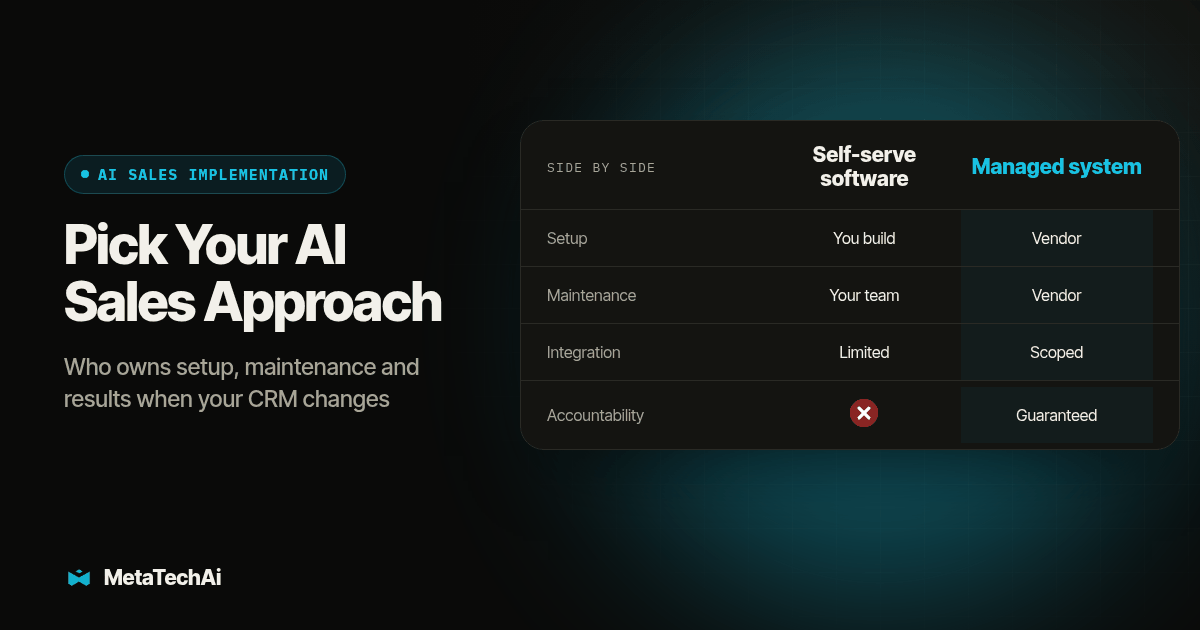
> Answer: AI sales automation software is a self-serve subscription your team configures and maintains. A managed AI sales system is scoped, integrated, tested and monitored by a provider. Choose based on who owns upkeep when your CRM changes and what the agreement says about conversion results.
MetaTechAi installs AI sales and marketing systems for service businesses with sales teams. Buyers comparing a self-serve tool with a managed system are comparing two different responsibilities: one subscription your team operates, and one implementation where a provider scopes and supports the system. The right fit depends on your internal capacity and the accountability written into the engagement.
What's Actually Different Between the Software Purchase and the Managed Purchase?
Self-serve AI sales automation software is a subscription. You sign up, connect it to your CRM and calendar, build the workflows yourself (or pay an in-house admin or a freelancer to do it), and you own every change after that. The vendor's job ends at uptime and feature support; your job is everything that makes the tool actually fit your sales process.
A managed AI sales system is a different kind of purchase entirely. A vendor maps your current workflow, builds the calling, follow-up, booking or CRM automation against it, tests it with your team before launch, and keeps monitoring and tuning it afterward. Struto's breakdown of software-versus-managed buying decisions frames this as a split between paying for access and control versus paying a provider to own outcomes measured after the fact (Struto, Nov 25, 2025). The distinction is access and control on one side, and provider-managed operations on the other. A broader managed IT services guide from MCP Inc. describes a similar allocation of operating responsibilities.
Both purchases can technically do the same list of tasks: respond to a new lead, qualify it, book an appointment, follow up on a stalled quote. The difference is who configures that task list correctly, who notices when it breaks, and who is on the hook when it does not move your numbers. Those three questions, not the feature list, are what should decide this purchase.
How Should You Evaluate Which Option Fits Your Business?
Run this evaluation before you sign. It moves from internal capacity to integration, accountability and exit planning, so the decision reflects the work your team can actually own.
- Assess your team's actual technical capacity and available time. Write down who on your team would own the software's setup: workflow logic, CRM field mapping, calling scripts, exception handling. If that person already has a full-time role, include the displaced work and support burden in your comparison.
- Decide, in writing, who owns upkeep the day your CRM or workflow changes. A CRM may gain a pipeline stage, lead source or compliance rule. With self-serve software, that change is your team's ticket to fix. With a managed system, confirm in the agreement whether the vendor's ongoing management covers workflow changes or only the original build; our CRM readiness piece covers the specific fields and ownership questions to settle before any AI sales system touches your CRM.
- Check integration depth against your actual stack, not a feature page. Pull your real list: CRM, calendar, dialer, text platform, payment or quoting tool. Ask the software vendor for the exact connector list and what happens outside it (webhook, manual export, or simply unsupported). Ask a managed vendor to map the same stack during scoping and name what they will build custom versus what they connect natively.
- Decide who is accountable if conversions do not move in 90 days. Ask what happens contractually if you follow the agreed process and your booked-appointment or close rate remains flat. A software subscription has no answer to this question, because nothing in the purchase ties payment to outcome. A managed engagement should have a written one.
- Match the answer to your team size and sales volume, not your budget alone. A solo owner with modest lead flow and spare technical time may reasonably run self-serve software. A sales team with no one assigned to own the tooling may value ongoing managed oversight. Size the decision to capacity first, then budget.
- Write the decision down with the specific triggers that would make you switch. Before you buy either option, note what would make you move off it: a certain number of unresolved configuration tickets, a CRM migration, a conversion rate that stays flat past an agreed review date. A decision made without exit triggers tends to get re-litigated from scratch every time something breaks.
How Do the Two Options Compare Side by Side?
| Factor | Self-serve AI sales automation software | Managed AI sales system (MetaTechAi model) |
|---|---|---|
| Setup effort | You or your team build the workflows, scripts and CRM mapping from a generic template | Vendor maps your actual workflow, builds and tests it with your team before launch |
| Maintenance owner | Your team, for the life of the subscription | Vendor's ongoing management, scoped in writing; your team still owns strategy and sensitive decisions |
| Integration depth | Limited to the vendor's published connector library; gaps become your problem mid-use | Scoped against your real CRM, calendar and phone stack during setup; gaps surface before launch |
| Accountability for results | None built in; a flat conversion rate after purchase is your diagnostic problem | Written guarantee tied to an agreed conversion measure; MetaTechAi's model is conversions go up or you do not pay |
| Typical team size fit | Solo owners or small teams with real in-house technical time to spare | Sales teams handling enough lead volume that nobody has spare time to own tooling full time |
The table is a filter, not a verdict. A technically strong small team may handle self-serve software, while a larger team with an experienced administrator may also prefer it. Run the six-step evaluation against your actual responsibilities before committing.
What Happens Three Months In, When Your CRM Changes?
The difference often becomes visible after a CRM change. Suppose your business adds a lead source, a quote requirement or a pipeline stage for a new service line. With self-serve software, the internal owner must update the workflow alongside other responsibilities. Until the change is reviewed, routing or follow-up may no longer match the process.
On a managed system, that same change should be a scoped request inside the existing engagement, not a new project from zero. Our guide to checking whether an AI sales vendor is actually running AI explains how to verify what a vendor means by managed service. Ask in writing whether post-launch CRM and workflow changes are covered by ongoing management or billed separately.
A team that lacks time to maintain a tool may find that self-serve software works as designed while still failing to fit its operating capacity. That is a mismatch in ownership, not necessarily a product failure.
Who Is Accountable When Conversions Don't Move?
A subscription generally covers access to software and its stated support. It does not automatically make the vendor responsible for your booked-appointment count. If the system is not producing the intended result, your team may need to determine whether the cause is the tool, lead quality, configuration, process or follow-up. Define who investigates each issue before launch.
A managed engagement should define accountability in writing before work starts. MetaTechAi installs systems for service businesses with sales teams under a conversions go up or you do not pay guarantee. Ask how the conversion measure is defined, what baseline applies, which work is covered, how results are reviewed and what exclusions appear in the agreement. A lower subscription charge does not alone establish the lower all-in cost.
If you are evaluating multiple managed vendors against that promise, not just us, our checklist for comparing AI automation agencies walks through the questions to ask about scope, billing and what a guarantee actually covers before you sign with anyone.
Is This the Same Decision as Build vs. Buy a Single AI Agent?
No. They are related but different buying decisions. Our piece on building a custom AI agent versus buying one off the shelf is about a narrower decision: whether one specific agent, for one specific task, should be custom-built or purchased as a packaged tool. This article considers the broader sales automation layer, including calling, follow-up, booking and CRM workflow. Either approach could include a packaged or custom agent. The software-versus-managed decision determines who configures and maintains it after launch.
What Does a Managed System Actually Look Like Once It's Running?
A managed engagement should define a workflow built against your CRM and sales process, a named contact for monitoring and adjustments, and a written measure of success tied to payment. Our managed services page lays out how we scope that work by function, lead response, calling, follow-up, CRM automation, so you can start with whichever piece is actually costing you the most leads today instead of buying a full platform rebuild you do not need yet.
Before either a software trial or a managed scoping call, AI Guy's guide to hiring an AI consultant covers the groundwork that applies to both paths: defining the outcome you actually want, checking a vendor's track record, and starting with a bounded pilot instead of a full commitment either way.
What Should You Do This Week?
Record lead volume, available technical capacity and every system your sales process touches. Run the six-step evaluation before taking a vendor demo. If nobody can own configuration and upkeep, discuss managed options. If your team has capacity and a simple workflow, self-serve software can fit, provided you document who maintains it when the CRM changes.
What are the common questions about this decision?
Does self-serve AI sales automation software cost less than a managed AI sales system?
Not reliably, once you count the hours your team spends configuring, fixing and babysitting it. Software subscriptions bill for access to the tool. Managed systems are scoped and quoted per project. Compare the all-in cost, your team's configuration time included, not just the monthly software bill, and ask any managed vendor for a fixed quote before work starts.
How long does it take to get each option running?
Self-serve software may be accessible after signup, but configuring it to reflect your sales process takes additional work. A managed system requires scoping and testing with your team before launch, so timing depends on the workflow, integrations and agreed scope.
Which option integrates better with our existing CRM and tools?
Self-serve software integrates as deep as its own connector library allows, and you are the one who finds out where that library ends. A managed system is scoped against your actual CRM, calendar and phone setup before launch, so integration gaps surface during scoping instead of during a live sales call.
Who is accountable if conversions don't move after we buy either option?
With self-serve software, you are. The vendor sold you a tool, and a flat conversion rate after three months is a configuration problem you have to diagnose and fix on your own time. A managed engagement should put the accountability in writing: MetaTechAi's model guarantees conversions go up or you do not pay for that work.
What does it cost us to switch later if we start with software and outgrow it?
Switching may require rebuilding workflow logic and training the team. Data portability depends on where records and activity are stored and what export the agreement permits. Document workflow rules, scripts and routing logic from day one, and confirm export rights before signing.