
Is Your AI Sales Vendor's Guarantee Real?
By James Hill, MetaTechAi ·
A vendor guarantee is only useful when the contract defines the metric, baseline, decision process, and remedy. The FTC’s Air AI case shows why buyers should verify those terms before signing. Use the questions and test below to evaluate any AI sales vendor, including MetaTechAi.
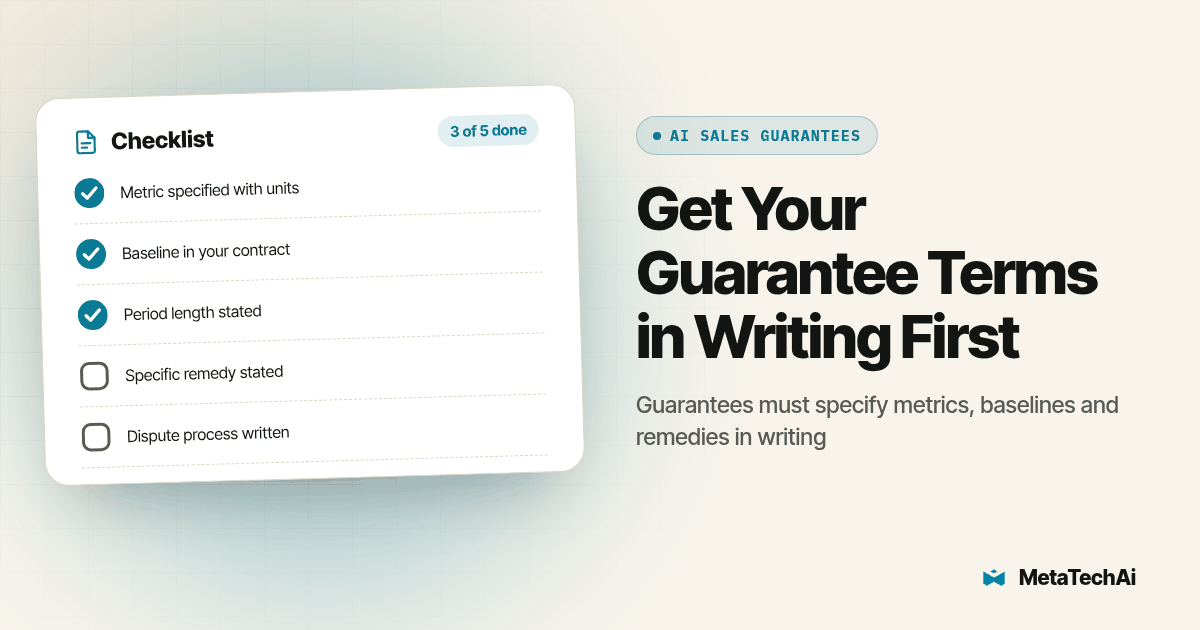
In short: A guarantee is only as real as what is written down: the exact metric it is tied to, who decides whether it was hit, and what happens if the vendor disagrees. The FTC's March 2026 case against Air AI, plus a stack of real buyer complaints on Trustpilot, shows what happens when none of that gets put in writing before a service business signs. Use the questions and checklist below on any vendor's guarantee, ours included, before you pay a deposit.
We hear a version of this on discovery calls often enough that we built a standing answer for it: "I signed with another AI vendor, they promised results or my money back, and now I can't get a straight answer on either." The caller usually paid every month for a tool that was supposed to book meetings or qualify leads, the number never moved, and when they asked about the guarantee, the vendor's story changed. That pattern has a name now, because in March 2026 the Federal Trade Commission put it in a public legal filing against a company most of us had seen advertised somewhere.
What happened with Air AI, and why does it matter for a buyer vetting any vendor's guarantee?
On March 24, 2026, the FTC announced that Air AI and three named owners, Caleb Maddix, Ryan O'Donnell and Thomas Lancer, would be banned from marketing business opportunities to settle charges that the company misled buyers (FTC press release). The core allegation: Air AI "falsely claimed that purchasers of the Air AI Access Card or licenses are protected by a refund or buy-back guarantee." The FTC also alleged the company misrepresented the performance of its services and made earnings claims it could not back up.
The settlement included a monetary judgment near eighteen million dollars, mostly suspended because the operators could not pay it, plus a required payment of fifty thousand dollars for direct consumer relief, on top of the marketing ban. That does not go far split across the buyers who expected a guarantee that, per the FTC's own filing, was never real in the first place.
The key distinction for any buyer: the FTC did not say Air AI's product failed. It said the guarantee attached to the product was a false claim. Those are different problems, and the second is what this article is about, because a product can be mediocre and still carry an honest refund policy, or work reasonably well and still be sold with a guarantee that was never going to pay out.
What do real buyer complaints about AI sales vendor guarantees actually look like?
Worse than a marketing page would ever admit, and not limited to one vendor. On Trustpilot, air.ai reviewer Greg Kruger describes waiting nine months for a promised refund that only arrived after he filed a complaint with Arizona's Attorney General (Trustpilot, air.ai). Another reviewer, Zane, says the company promised a full refund once his six month contract ended, then the CEO allegedly asked for another twelve months before paying, and stopped answering emails after that. A third reviewer, Erez Ahituv, described distributor licenses sold with money back guarantees where customers were each reportedly owed somewhere between roughly twenty thousand and fifty thousand dollars that never arrived.
On Lexson.ai's Trustpilot page, reviewer Sierra describes paying about a thousand dollars, getting poor results, and being refused a refund when she asked, calling the arrangement a scam (Trustpilot, lexson.ai). Another reviewer, Tom Salazar, requested cancellation and reimbursement, was invited to a meeting he could not attend, and could not reconnect with the company afterward. Neither complaint involves a regulator filing yet, which is why you cannot wait for the FTC to flag untrustworthy vendors: by the time a case is filed, the buyers who funded it have already been burned for months.
We hear a related version from our own prospects, not as an abstract warning but as the reason they call us: they already paid an AI vendor every month, the number they cared about never moved, and nobody could give a clear answer about what the guarantee was supposed to do about it. Some describe a calling agent that booked almost nothing over months of payments; others describe a broader AI and marketing engagement where no one could say what had moved the needle, guarantee or not. Either way, the problem traces back to the same gap: nothing specific was written down before the money started moving.
What exact questions should you ask any AI sales vendor before you sign?
Ask these in this order, and put the answers in writing, not in a sales call transcript that only the vendor has a copy of.
- What metric does the guarantee track, in plain numbers? Not "more conversions," but a defined number: booked appointments from a specific lead source, answered calls above a stated connect rate, or a similar measurable outcome you both agree on before day one.
- What is the baseline you are measuring against? A guarantee against an undefined starting point can be satisfied by cherry picking the comparison window. Ask the vendor to pull your current numbers before the pilot starts and put that baseline in the contract.
- Who decides whether the guarantee was met, and what is the process if you disagree? If the answer is "us," ask what happens next when you dispute the result. A guarantee with no dispute process is a guarantee the vendor grades itself on.
- How long does the pilot or trial period run, and does that match your actual sales cycle? A guarantee measured over two weeks on a business whose deals take two months to close is not measuring anything real.
- What is the remedy if the metric is not hit, exactly? A full refund, a prorated credit, an extra month of service at no charge? Get the specific remedy in the document, not a vague "we'll work something out."
- Can you get the guarantee terms in a signed document before any deposit moves? If the vendor only offers the guarantee verbally or buried in a sales deck, that is the single biggest warning sign in this entire list.
- What happens to your data, scripts and numbers if you cancel mid guarantee period? You want a written answer here too, because a vendor that owns your CRM configuration can make leaving expensive even when the guarantee clearly was not met.
- Can you talk to a current client whose guarantee actually paid out, not just a client who is happy overall? A reference who can describe the specific trigger and the specific remedy they received is worth more than a logo wall.
Diagram: a simple flowchart showing a dollar sign icon moving left to right through four labeled boxes, "Metric defined," "Baseline recorded," "Pilot runs," "Result compared to baseline," ending in a fork between "Guarantee paid" and "Dispute process," with a small red flag icon on any path that skips the "Baseline recorded" box.
What should actually be in writing before you pay anything?
Copy the following into an email to the vendor and ask them to confirm each point, or redline the parts missing from their proposal. State the exact metric the guarantee is tied to, with units attached, a count, a rate, or a dollar value, not a vague phrase. Pull the baseline number from your own systems and date it before the pilot start date, so there is no room to argue later about where the comparison began. Put the pilot or guarantee period length in a stated number of weeks or months, matched to your sales cycle rather than a generic default. Name the person or process that evaluates whether the metric was hit, and name the specific remedy if it was not, a stated number or percentage of fees, not a phrase like "we'll make it right." Spell out a process for what happens if you and the vendor disagree about the result, and get written confirmation of what you keep, your data, scripts, numbers, and configurations, if you cancel. Finally, pin down a cancellation notice period and any early termination terms in days, not in vague language about "reasonable notice."
If a vendor cannot fill in every one of those points without a follow up call to "check with legal," that hesitation is information. A guarantee that was built to be enforced reads like a contract clause, not a slogan.
How does a real written guarantee compare to a verbal or vague one?
| What to check | Verbal or vague guarantee | Written, specific guarantee |
|---|---|---|
| The metric | "Results" or "more conversions," undefined | A named number from a named source system |
| The baseline | Not mentioned, or set after the pilot ends | Pulled and dated before the pilot starts |
| Who decides | The vendor, informally | A named process both sides agreed to in advance |
| The remedy | "We'll figure it out" | A stated refund amount, credit, or extended term |
| Dispute process | None | A defined step if either side disagrees with the result |
| Where it lives | A sales call or a marketing page | A signed contract clause |
Air AI's marketing reportedly promised a refund or buy-back guarantee that, according to the FTC's filing, was never actually honored as described. Every row on the left side of that table is a way a vendor keeps a guarantee from ever being enforceable, whether or not that is the intent going in.
How does this fit with vetting an AI vendor's claims more broadly?
This is one slice of a larger buyer diligence problem. We have written separately about how to tell if a vendor's "AI" is actually AI and how to run an audit when a vendor you already hired is not delivering, since the guarantee question usually surfaces downstream of those two. Our comparison guide for evaluating competing AI automation proposals covers guarantee terms as one of five scoring categories alongside production evidence and ownership, and the AI Guy side of our world has written a parallel version of this discipline for solo founders hiring any AI consultant: how to hire an AI consultant covers reference checks and scope definition that apply just as well here.
How should you apply this same test to MetaTechAi's own guarantee?
The same way you should apply it to anyone else's. Our managed AI services page states the guarantee plainly: we agree on the call what conversions we're measuring for your business, we install the systems to move that number, and if it doesn't move, you don't pay for it. Walk that sentence through the eight questions above: the metric is agreed on a recorded call before work starts, specific to your business rather than a generic claim; the baseline is pulled from your own systems on that same scoping call; both sides decide together against the number agreed on, not our judgment alone after the fact; and the remedy is simple, you do not pay for the work tied to that metric if it does not move.
We would rather a prospective client hold our language to that standard and walk away unconvinced than sign on a slogan and find out six months in that nobody wrote down what "it works" was supposed to mean.
What do buyers ask us about vendor guarantees?
What exactly triggers MetaTechAi's conversion guarantee?
On the onboarding call, we agree in writing on what conversions we are measuring for your business, a specific number tied to a specific workflow. We install the systems to move that number. If it does not move, by the definition we agreed on, you do not pay for that work. That is the same test this article asks you to run on any vendor, including us: get the trigger in writing before you sign.
Is a verbal 'you don't pay if it doesn't work' promise legally enforceable?
A verbal promise is much harder to enforce than a written one, and a written guarantee with no defined trigger, no decision process, and no remedy is barely better. Enforceability comes from specifics in the contract: the metric, the baseline, who evaluates it, the timeline, and what happens if the vendor disagrees with your read of the numbers.
How long should a pilot run before you can fairly judge a guarantee claim?
Long enough to cover a full sales cycle for your business, not a flat 30 days by default. A short pilot with a hard deadline baked into the guarantee language is a common way vendors protect themselves against ever having to pay out, so ask for the pilot length in writing and compare it to how long your own deals actually take to close.
If a vendor won't honor its guarantee, what are your actual options?
Start with the written contract and send a dated, specific written request citing the exact guarantee language and the metric that was not met. If the vendor still refuses, you can dispute the charge with your card issuer or bank, file a complaint with the FTC at reportfraud.ftc.gov, and check your state attorney general's consumer protection division, the same channels several of the buyers in this article's case studies eventually used.
Does switching AI sales vendors mean starting over from zero?
Not if you kept your own records. The CRM data, the call scripts, the baseline numbers, and the written rules you built for the first vendor's pilot all transfer to the next one. What does not transfer is time, so the switching cost is mostly the weeks you spent on a vendor who could not show you a trigger, a decision process, or a remedy in writing.
What should you do this week if you already signed with a vendor and the results haven't shown up?
Pull out whatever you signed and look for the guarantee language. If it is there, send the dated written request described above and ask for the remedy within a stated number of days. If it was only ever spoken on a call, the options in that answer still apply. Then, whatever happens with that vendor, use the eight questions in this article on the next one before a single deposit moves. A real guarantee survives being read closely. A marketing claim does not, and the only way to find out which one you are looking at is to ask before you sign, not after the invoices start.