
What to Check Before Buying AI Sales Coaching Software
By MetaTechAi ·
A convincing demo call is not an evaluation. Before you sign, settle whether you need real-time or post-call coaching, confirm the tool writes into the dialer and CRM your reps already use instead of becoming a second login, define a success metric beyond login or completion rate, and run the trial against your own team's calls, not the vendor's hand-picked demo recordings.
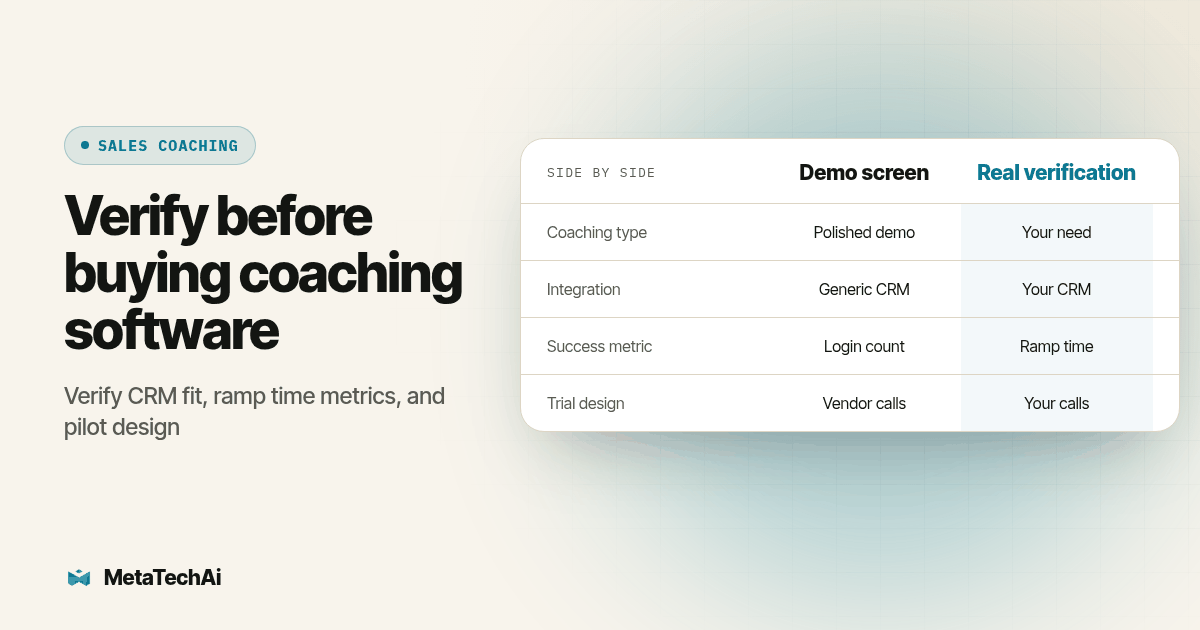
A sales manager who sits through three AI sales coaching demos in a week will see three polished walkthroughs and very little about what happens in month four. We install and manage AI systems for service businesses with sales teams, and coaching tools need evaluation beyond the demo screen. It is adoption in week six, a CRM field that silently stopped updating, or a rubric that was never actually checked against how your own managers score a call.
Should you buy real-time coaching, post-call coaching, or both?
This is the first decision, and a vendor may emphasize only the category it sells. Real-time coaching, sometimes called a whisper tool, listens to the live call and prompts the rep on pricing, objections or a missed step while the customer is still on the line. We wrote a separate breakdown of whether that live prompting is worth the risk, since reps tune out a badly tuned whisper tool fast. Post-call coaching scores the recording afterward and hands the rep and the manager a scorecard, a highlight reel, or both.
These solve different problems, and treating them as interchangeable is how a buyer ends up with a tool that technically works but does not fix what was actually broken. If your reps already know what they are supposed to say and the problem is that they forget it mid-call under pressure, real-time prompting addresses that directly. If the problem is that nobody has reviewed a call in months and you have no idea which three behaviors separate your top closer from the bottom of the roster, post-call scoring is the one that produces a usable rubric first. Decide which failure you are fixing before you take a single demo, because the evaluation needs to start with your workflow.
Does the coaching live inside your dialer and CRM, or is it a second login?
Ask this on the first call, not the fourth. A tool that requires reps to leave the dialer, log into a separate coaching platform, and manually check feedback adds friction a small team notices immediately and a larger team notices in patchy adoption six months out. Native integration means call recordings pull automatically, scores and summaries post back to the same CRM record your reps already work from, and a manager can see a score without opening a third tab.
A separate dashboard can create adoption friction when reps have no established reason to open it (Phosai Labs, 2026). Ask specifically which fields the integration writes, when it writes them, and whether that connection is native or runs through a third-party connector that can break on a CRM update. We cover the related scoring criteria in our guide on how to measure what an AI call scorecard should actually capture.
How do you measure success beyond completion rate?
Completion rate (did the rep log in, did they finish the scored calls) is the easiest number for a vendor to report and the least useful one for you. It tells you people opened the tool. It tells you nothing about whether a rep closes more deals because of it.
Two numbers matter more. First, ramp time: how long does it take a new rep to reach a competent call, compared with before the tool existed. Second, call-to-meeting or call-to-close rate on the specific behaviors the coaching targets, tracked over a full quarter rather than a single week. Vendors who sell this space point to real stakes behind that patience: reps who rate their own coaching as excellent are reportedly far more likely to hit or exceed quota, while a large share of reps say they rarely or never get coached at all, and the average sales manager already oversees more reps than one-on-one coaching alone can realistically cover (Nooks, 2026). Those figures describe the industry problem the category exists to solve, not a guarantee about any one vendor's results on your team, so treat them as context for why the category exists, not as a promise the tool you are evaluating will deliver it.
Before you sign, write down the one or two metrics you will check in ninety days, and get the vendor to agree in writing that those are the right ones. If a vendor only wants to talk about logins and completion percentages, that is a sign they have not been asked to prove anything harder.
How do you design a trial that is not just the vendor's favorite demo calls?
A vendor demo can use calls chosen to make the tool look good. A real trial uses calls chosen to tell you the truth.
Hand the vendor ten to twenty of your own recent calls, spanning a strong rep, an average rep, and a call that went badly, and have them score it blind against your rubric before you see their answer (Phosai Labs, 2026). Compare that output to how your own manager would have scored the same calls. Then run the live pilot against twenty to thirty of your team's actual calls across different reps and outcomes, not a curated set the vendor supplies, for a minimum of four weeks before anyone outside the pilot team sees a score (Phosai Labs, 2026). Treat those counts and the four-week live pilot as a proposed test design, not a validated sample size or a promise that conversions will change in that window. Allow setup and final review time separately, and extend the evaluation when too few comparable calls or closed deals are available.
How do the four evaluation criteria compare across a typical vendor pitch?
| Decision point | What the demo usually shows you | What to verify before you sign |
|---|---|---|
| Real-time vs post-call | A slick live-prompt overlay or a polished scorecard, whichever the vendor sells | Which failure you are actually fixing: mid-call forgetting (real-time) or no review process at all (post-call) |
| Native vs second login | A quick screen share showing the tool working inside "a" CRM | Whether it writes into your specific CRM and dialer, with which fields, and whether that needs a third-party connector |
| Success metric | Login count and completion percentage | Ramp time and call-to-meeting or call-to-close rate, tracked over a full quarter, agreed in writing |
| Trial design | A handful of the vendor's favorite recorded calls | Twenty to thirty of your own calls, mixed reps and outcomes, minimum four weeks, scored blind against your rubric first |
What is the seven-step process for evaluating AI sales coaching software before you sign?
Run these in order. Skipping ahead to step five because a demo looked good is exactly how teams end up locked into a tool that does not fit.
- Name the specific failure you are trying to fix (reps forgetting the pitch mid-call, no review process, inconsistent scoring between managers, or managers who physically do not have time to listen to enough calls) and write it down before any vendor call.
- Decide real-time, post-call, or both, based on step one, before you accept a demo from a vendor whose category you have not already chosen.
- Confirm native integration into the exact dialer and CRM your team uses today, with a live test in your own account rather than a generic screen share of "a" CRM.
- Request adoption data from accounts close to your team's size: what share of reps were still actively using the tool at ninety days and at six months, not just at launch week.
- Hand the vendor ten to twenty of your own historical calls and have them score it blind against your existing rubric, then compare that score to what your own manager would have given.
- Run a minimum four-week live pilot against twenty to thirty of your team's real calls, spanning new and experienced reps, before rolling out past the pilot group.
- Confirm data portability and switching cost in writing (can you export your rubric and your scored call history) before you sign the full contract, not after a renewal notice arrives.
What should the one-page vendor scorecard include?
Keep this on one page and fill it out live during every vendor call, so you are comparing apples to apples instead of trusting your memory of three different demos a week apart.
- Category: real-time, post-call, or both, and which failure from step one it addresses
- Integration: native to our dialer/CRM, yes or no, with the specific fields it writes and when
- Adoption proof: percentage of comparable accounts still active at ninety days and six months, with a source
- Rubric test: score on our own ten to twenty calls, compared against our manager's score on the same calls
- Trial terms: minimum four weeks, our own twenty to thirty calls, written success metric, written review date
- Data ownership: can we export our rubric and scored call history if we leave
- Support model: who configures rubric changes, and does that require the vendor every time
What can reported buyer experiences teach you about a good demo?
Two buyer questions documented in our existing guides illustrate the accountability issue. The AI agency accountability audit describes a prospect who reported paying a team without knowing what each person did while results slipped. The voice-agent review guide describes a reported nine-month booking problem. These are buyer accounts, not independently audited results or evidence about coaching software. They identify questions to investigate: who owns the work, what records show its outcome, and when does the buyer review whether to continue?
Use those questions during procurement. Have the proposed operator walk through a missed recording, a disputed score and a failed CRM update. For each case, record who notices it, who fixes it, and where the correction appears. Ask a manager to demonstrate the review from their normal working screen. A feature can exist in the contract while the operating responsibility remains unassigned. Making those responsibilities visible before signing gives you something concrete to check after launch.
That is the gap a conversions-up-or-you-don't-pay standard is built to close, and it is why we tie our own managed rollouts to a measured outcome instead of a monthly invoice for activity. If your team already has sales coaching live and adoption is the problem rather than the buying decision, our guide on getting reps to actually keep using an AI sales system after launch covers that next stage.
What do buyers ask most before they sign for AI sales coaching software?
How much does AI sales coaching software cost?
It depends on seat count, whether you need the real-time module or only post-call scoring, and whether it is sold standalone or bundled into a platform you already pay for, so we will not quote a figure here that will not match your setup. Ask any vendor for a quote scoped to your rep count and your current stack, and compare that number against what a managed rollout with us would cost before you decide.
How long does it take to pilot AI sales coaching software before a full rollout?
Plan setup time, a four-week live pilot, and a separate final review. First choose the rubric and score historical calls, then pilot with one team before comparing the AI's judgments with manager reviews. This is a planning recommendation, not a universal minimum that proves results; extend the evaluation if call volume or your sales cycle requires it.
Will AI sales coaching software work with the dialer and CRM our reps already use?
Only if the vendor can show you, inside your own account, that call recordings pull in automatically and that scores, summaries and next steps write back to the same CRM record your reps already work from. If the answer involves a manual export or a separate login your reps have to remember to check, test whether that extra step fits the rep workflow, and agree who maintains the connection before calling the integration complete.
Does AI sales coaching software raise call recording consent or compliance issues?
Yes. Recording and live monitoring can raise consent requirements, and adding AI does not remove them. Rules depend on the jurisdictions and circumstances of the call, including where participants are located. Confirm the recording and monitoring basis with qualified counsel before sharing calls with a coaching vendor, and agree on access, retention and deletion controls.
For state-specific background, see the Reporters Committee recording guide and its California consent summary.
What is the switching cost if we need to replace AI sales coaching software later?
Ask before you sign, not after: can you export your rubric, your historical scores and your call library in a usable format, or does the vendor own that data in a format only their platform reads? A coaching program with twelve months of scored calls is worth protecting, so a vendor who cannot answer this clearly in the sales process is telling you something about the switching cost.
Where does this fit if you are building the whole system, not just buying one tool?
A coaching tool is one piece of a sales system, not the system itself. If you are deciding whether to buy a standalone AI sales coaching platform or build coaching into a broader managed AI sales rollout, our managed services page explains how we scope calling, CRM automation and follow-up under a conversions-up-or-you-don't-pay standard. Discuss whether coaching belongs in your agreed scope, instead of leaving you to stitch together five separate vendor logins and hope they stay in sync. The agencies and resellers we work alongside run into the same evaluation problem on the voice-agent side, and RizzDial's own demo checklist for AI voice agent resellers asks a similar set of questions before anyone signs a contract based on a single polished call.