
What Actually Drives the Price of an AI Sales Agent
By James Hill, MetaTechAi ·
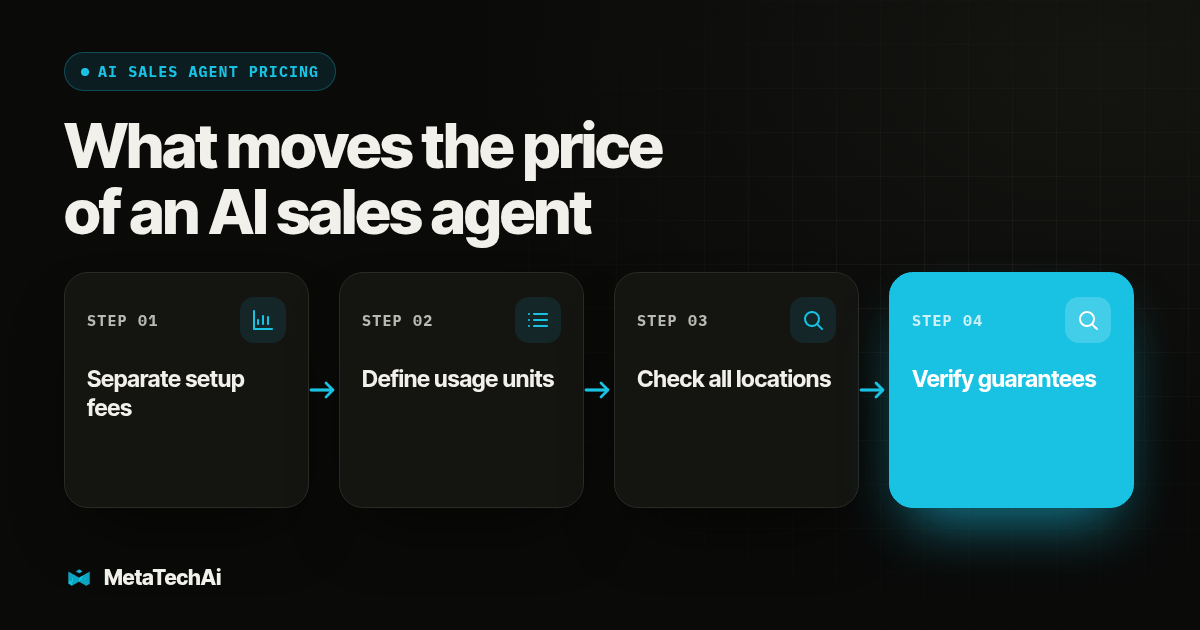
TL;DR: The price on an AI sales agent quote is set by four things: one-time setup scope, ongoing usage volume, how many locations or phone lines the system has to cover, and whether the agreement includes a performance guarantee. Two vendors quoting the same business can land on very different numbers because they are pricing different combinations of those four, not because one is simply cheaper. Before you sign, make a vendor itemize all four separately so you can see what is actually driving your number.
We get some version of this question on almost every discovery call: "what does this actually cost, and why can't anyone just tell me." It is a fair complaint. Most AI sales vendor sites either hide the number behind a "book a demo" wall or publish a sticker price that quietly assumes a single location, low call volume and no performance guarantee, then changes the moment your real business gets scoped. Neither approach tells you what you are actually paying for. This article breaks the quote into its real cost drivers, lays out the pricing models vendors use to charge for them, and gives you a numbered procedure to run on any quote before you sign.
Why Won't a Vendor Just Give You One Number?
Because an AI sales agent is not one product with one feature list. It is a bundle of setup work, ongoing compute and telephony usage, coverage across however many locations or lines you run, and, in a growing number of contracts, a guarantee tied to a measurable outcome. Change any one of those four and the number changes with it. A single-location business running a lead-response workflow at low volume with no guarantee is a different quote than a five-location business running full AI calling with a conversions-up-or-you-don't-pay term attached, even if both are buying from the same vendor's same base platform.
That is also why a published "starting at" price on a vendor's homepage is close to meaningless on its own. It tells you the floor for the thinnest possible scope, not what your business will actually pay once setup, usage and guarantee terms get added back in. The real work, for you as the buyer, is forcing a vendor to show you each of the four drivers separately instead of handing you one blended number.
What Actually Drives the Price on an AI Sales Agent Quote?
Four line items do almost all the work. In rough order of how much they tend to move a quote:
- Setup and implementation scope. Mapping your CRM and calendar, migrating or cleaning existing contact data, writing the rules for what the agent can do without a human, and testing the handoff to a live rep. This is usually a one-time charge, and it scales with how messy your current systems are, not with how big your business is.
- Usage volume. Calls placed, messages sent, minutes of AI talk time, or records processed each month. This is the line that grows with your business, and it is the one most vendors bill as a recurring, consumption-based charge rather than a flat fee.
- Number of locations, lines or sales territories covered. A single-location service business and a five-location franchise group are not buying the same thing even if they run the identical workflow, because each additional location usually means separate phone numbers, separate routing rules, and separate reporting.
- Guarantee and performance terms. A flat subscription with no outcome tied to it prices differently than an agreement where part of the fee is contingent on a defined result. Vendors that offer a real guarantee, where conversions go up on an agreed metric or you do not pay for that work, typically build that risk into the number somewhere, either as a higher base fee or as a split between a flat and a contingent portion.
Everything else on a typical quote, from support tier to reporting dashboards to the number of named users who can log in, is usually a smaller adjustment on top of those four, not a separate pricing axis.
How Do the Major AI Sales Pricing Models Compare?
Vendors package those four drivers into a handful of standard pricing models. Stripe's own guide to recurring pricing models lays out the same categories that show up across AI vendor quotes: flat recurring fees, per-seat fees, usage-based fees, and hybrids that blend a base fee with a usage component. Here is how each one tends to fit, or not fit, a service business with a sales team.
| Pricing model | What it charges for | What drives the number up | Where it fits a service business |
|---|---|---|---|
| Flat license fee | Access to the platform, regardless of volume | Added features, support tier, number of workflows turned on | Predictable, low-volume use where you want a fixed monthly number to budget against |
| Per-seat | Each person who logs in to review calls, scripts, or dashboards | Headcount with login access, not call volume | Teams where several reps and managers all need direct visibility into the tool |
| Usage-based | Calls placed, minutes used, messages sent, or records processed | Growth in your own lead and call volume | Businesses whose volume swings seasonally, so the bill tracks activity instead of a fixed headcount |
| Outcome-based or guaranteed | A defined result, such as conversions above an agreed baseline | The size and scope of the guaranteed metric | Buyers who want the vendor to carry real risk on whether the system works, not just on whether it runs |
| Hybrid | A base platform fee plus a usage or outcome component on top | Both volume growth and guarantee scope together | Most real AI sales engagements, since setup and base coverage rarely map cleanly to a single axis |
Outcome-based pricing is the newest of the group to show up in AI contracts specifically, and it works a little differently than the others: instead of charging for activity, it ties spend to a defined, measurable result that the vendor has to verify, which only works if that result is written down in enough detail that both sides agree on what counts. Our own conversions-up-or-you-don't-pay guarantee is built on that same discipline: the trigger metric, the baseline and the decision process get agreed on before any work starts, the same test we recommend you run on any vendor's guarantee language, ours included.
What Numbered Procedure Should You Run Before You Sign a Quote?
Run this on any AI sales agent quote you receive, ours or anyone else's, before you sign anything.
- Ask the vendor to separate the one-time setup fee from the recurring usage fee. If they only give you one blended monthly number, ask again until the two are split out. A vendor who cannot separate them has not actually scoped the setup work.
- Get the usage unit defined in writing. Is it minutes, calls, messages, or records? Ask what happens at low-volume months and at high-volume months, since a usage-based number should move with your activity in both directions, not just up.
- Confirm the location or line count the quote assumes. If you run more than one location, make sure the number in front of you is priced for all of them, not just the first one, with the per-location increment stated as its own line.
- Ask whether a guarantee is included, and if so, get the exact metric and baseline in writing. A guarantee with no defined trigger is marketing language, not a pricing term. Our guide to vetting a vendor's guarantee has the full list of questions to ask here, and it applies to any vendor's guarantee, not just a vendor claiming the biggest promise.
- Compare the quote against building the workflow yourself with off-the-shelf tools. Sometimes a custom build genuinely costs less than a managed quote, and sometimes the ongoing maintenance a custom build requires erases that saving within a few months. Our breakdown of custom AI agents versus an off-the-shelf managed service walks through that tradeoff directly.
- Check the quote against your own budget plan for the year, not just this one line item. A quote that looks reasonable in isolation can still blow a budget that never accounted for the governance and monitoring work that keeps the system accurate after launch. Our AI sales tools budget worksheet covers the categories a single vendor quote tends to leave out.
- Ask what it costs, in time and in dollars, to leave if the engagement does not work out. Get the data export process and the notice period in writing before you sign, not after you decide to cancel. Our guide to switching AI sales vendors without losing data covers exactly what to confirm here.
What Should Change the Number on Your Quote?
Four things, and only four things, should move your price up or down in a legitimate quote. Growth in call or message volume should raise the usage line, and a slower season should lower it, assuming the model is genuinely usage-based rather than a flat fee dressed up as one. Adding a location or a phone line should raise the location line by a stated increment, not by a vague "it depends" the vendor refuses to quantify. Adding a performance guarantee, or widening the metric it covers, should change either the base fee or the split between flat and contingent pricing, since the vendor is now carrying more of the risk that the system actually works. And scope changes to setup, like adding a second CRM or migrating more historical data, should change the one-time fee, not the recurring one.
What should not move the number on its own: how big your company is in general, how many competitors you mention on the call, or how much the vendor thinks you can afford. If a renegotiated number shows up without a changed driver behind it, ask what specifically changed, and expect a specific answer.
A caller we spoke with described paying for an AI calling agent that booked one meeting in nine months while the bill kept arriving every month regardless. That is not a pricing problem by itself, it is a signal that nothing in the original agreement tied the price to a result, so the number never had a reason to move even after it was clear the system was not working. A guarantee tied to a real metric is exactly the mechanism that is supposed to prevent that outcome, which is why it belongs on the list of things that should change your price, not just on the list of things vendors mention in a sales deck.
What Do Buyers Actually Ask Us About AI Sales Agent Pricing?
What price range should I expect for an AI sales agent, and why won't a vendor give me a flat number before a call?
There is no honest flat number to give you before a vendor knows your setup scope, usage volume, location count and guarantee terms, because all four move the quote in different directions. A vendor who quotes a round number before asking about any of those is pricing a template, not your business. We have had prospects tell us they paid an AI and marketing team every month and could not say what each person on the team actually did or what the money covered, which is the real cost of a quote that was never itemized in the first place.
How long does setup take before the usage-based part of an AI sales agent's price even starts?
Setup is usually a defined, one-time scope: mapping your CRM fields and calendar, pulling a baseline, writing the approval rules for what the agent can do without a human, and testing the handoff to a rep. That work should be scoped and billed separately from the ongoing usage charges, so you can see exactly where the one-time cost ends and the recurring cost begins instead of one blended number that hides both.
Does adding CRM, calendar or phone number integrations change the quoted price?
Yes, and this is one of the most common reasons two businesses with similar call volume get different quotes. Each additional system the agent has to read from or write to, plus any custom action beyond standard read and write, plus however much of your existing data needs cleanup before the agent can trust it, adds real setup hours. Ask a vendor to itemize integration cost separately from the base platform fee so you can see what each connected system actually adds.
Does a vendor's compliance and data-handling commitment affect what they charge?
It should. Ongoing monitoring, human review of edge cases, and documented approval rules are staffed work, not a toggle in a settings screen, and a quote with no governance line item is usually a quote that skipped that work rather than priced it in. Ask what gets reviewed, by whom, and how often, and expect that answer to show up somewhere in the price.
What does it cost to switch AI sales vendors after I've already signed?
The dollar cost is between you and the new vendor, but the real cost is almost always time, not a line item: exporting your data, rebuilding the automation rules, and retraining your team on a different interface. Our guide on switching AI sales vendors without losing data walks through what to export and verify before you cancel the old contract, which is the step that determines how expensive the switch actually turns out to be.
Where Does This Leave You Before You Ask for a Quote?
Go into the first call knowing which of the four drivers matters most for your business. A single-location business with light, steady lead volume should be pushing hard on setup scope and usage unit pricing, since those will dominate the number. A multi-location group should be pushing on the per-location increment specifically, since that is where quotes quietly balloon. And anyone being pitched a guarantee should be asking for the metric and baseline in writing before anything else, because that single document is what turns a marketing promise into an enforceable term.
We built our managed AI sales and marketing services around that same itemization, scoped per workflow, with usage and guarantee terms spelled out before a dollar moves, because a buyer who cannot see what is driving their own number cannot tell a fair quote from a padded one. If you want a second set of eyes on a quote you already have in hand, or you want the drivers above scoped against your own setup before you talk to anyone, RizzDial's guide to pricing AI voice agent services breaks down the calling-specific side of the same four drivers, and it is a useful second reference before you sign anything.